One visual language, one connected experience: Presenting ESTECO’s new product logos
Written by Matteo Miotto and Carla Ferro
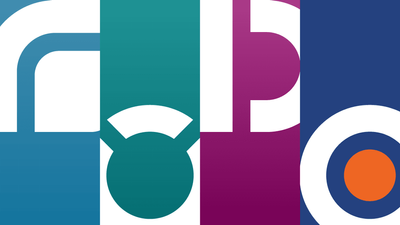
Today, we’re proud to unveil a new set of product logos and app icons that redefine the branding of the ESTECO software portfolio. This isn’t just a change in graphics; it’s a visual declaration of how our technology has evolved and a signal of the connected ecosystem we’re building.
The journey to consistency
ESTECO was founded twenty-six years ago around a single, revolutionary software for process automation and design optimization: modeFRONTIER. In the decades since, our offerings grew along different paths — led by industry trends and technological explorations. VOLTA, our digital engineering platform for simulation process and data management (SPDM) and multidisciplinary design optimization (MDO), was introduced in 2016. Cardanit followed in 2019, our first Software as a Service (SaaS) solution that explores the Business process management (BPM) frontier. Most recently, nDAI has expanded our offering with AI-driven modeling.
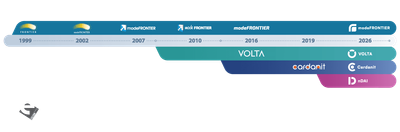
As our portfolio grew, so did our brand identity — piece by piece. Each product had its own independent logo and style. While SOUL, our design system, brought consistency to our interfaces, our fragmented brand identity no longer reflected where we are today or where we're going.
Making unified architecture visible
New logos are easy to dismiss as a cosmetic update. They aren’t. Research and experience both suggest that changes in iconography are almost always read as a signal of deeper product change. For us, they’re the visible part of a much deeper shift in how we build software.
We’re moving from large, monolithic products to a portfolio of focused apps. The idea behind an app is simple: it has a single responsibility. It does one thing well, and it exposes that capability in three ways: users can interact with it through a UI, developers can call it through an API, and, increasingly, AI agents can use it too. It’s a meaningful shift: apps remain the building blocks, but the driving force of the experience is no longer the app or the product itself. It’s the outcome the user — or an agent acting on their behalf — wants to achieve.
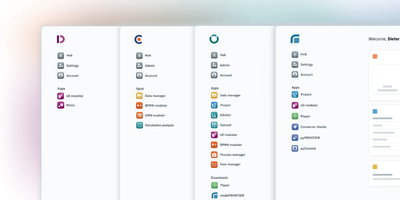
Because each app is focused and self-contained, it can scale independently. If a customer needs more data management capacity, we scale that specific app, not the entire product around it. And because apps aren't tied to a single product, the same app can live inside different products. The Data Manager used in VOLTA is the same one coming to Cardanit. The nD Modeler available today in modeFRONTIER will soon be available in VOLTA as well. Once you learn an app, you know it everywhere it appears.
This is where visual design connects back to the software architecture. If apps travel across products, they need a shared visual language. Otherwise, every transition feels like landing in a different country.
The logic of the new look: a shared visual DNA
To support this integrated experience, we designed a system where each product keeps its own identity but clearly belongs to the same family. Consistent logos, app icons, and consistent components (powered by our SOUL design system) make transitions between products feel natural. The visual identity isn’t decoration; it’s how the architecture becomes legible to the people using it.
The new logos share a common visual DNA: consistent shapes, uniform weights and shared proportions. The guiding principle throughout has been evolution, not revolution: we wanted the new system to feel like a natural step forward.
This evolution led us to replace complex logotypes with graphic logos paired with the product name in plain text. It aligns with a broader trend in the software industry and ensures scalability across mediums, from UIs to marketing communication.
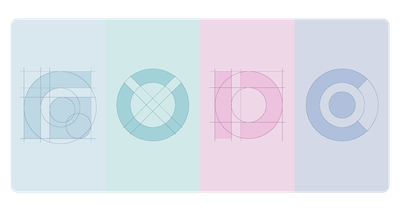
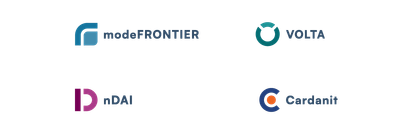
- modeFRONTIER: our long-standing flagship has received a deep refresh, honoring its 26-year legacy while aligning with our modern visual standards.
- VOLTA and Cardanit: as newer brands, their logos have been refined with a more evolution-focused approach, integrating their main visual mark within the new ecosystem while aligning logotypes for total consistency.
- nDAI: created entirely from scratch, the nDAI logo confirms the scalability of this new language, which is flexible enough for all the innovations yet to come.
We also rethought app icons from the ground up. Until now, icons across our products had grown organically, resulting in minor inconsistencies that accumulated over time. The new app icons follow a shared design language and are grouped by domain: engineering design, simulation data analytics, AI-driven modeling, business process management, and so on. Each domain is assigned its own distinct color, allowing users to instantly recognize which area they're working in.
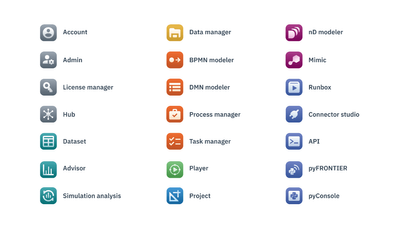
The result is a visual language that scales across every context where our products live — whether it’s a website, a presentation slide, a product interface, a desktop OS or a browser tab.
See the ecosystem in action
Today, you can see this new visual language reflected across our websites and communication channels. In the upcoming weeks and months, these changes will be incorporated across our product interfaces, creating a more intuitive and cohesive experience for every user.
For those joining us at ESTECO International Users’ Meeting 2026 next week, you’ll have the opportunity to dive deep into this new visual ecosystem and see the logos “in action,” both as a brand experience and within the software interface themselves.
Aligning our marketing and product design has been a rewarding journey. It’s been amazing to see how naturally the visual work has aligned with everything else we’re building: shared apps, a common platform and a consistent user experience.
Thank you
A project of this size is never the work of a single team. While there are too many people to name everyone individually, a special thanks goes to our visual designers, Fabio D'Apote and Sabrina Zilli, for their dedication and craft. We also extend our gratitude to the Marketing and UX teams for their constant collaboration, to the Product Managers for their guidance, and to everyone who shaped this work along the way with their invaluable feedback and input.