
Robust design and reliability
Identify manufacturing tolerances and deliver design quality with our technology for uncertainty quantification.


Manage uncertainties efficiently and deliver high-quality products
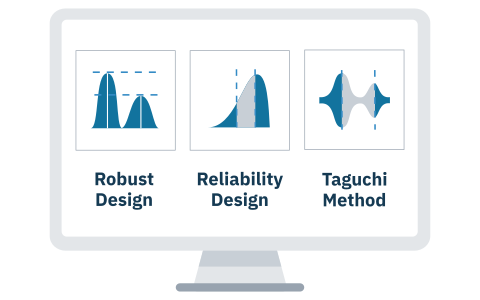
Product performance is often determined by factors that are difficult to predict during the design stage. These factors, known as uncertainties, may include manufacturing errors, material property variations, or shifting external conditions. Proceed to production with confidence by verifying design robustness and reliability early in the development process. Our robust design and reliability based optimization methods ensure your products perform consistently (robustness), achieve the lowest possible failure rate (reliability), or minimize quality loss through Taguchi-based engineering.
What is robust design and reliability?
While tackling optimization within the manufacturing process, engineers face uncertainty regarding design variables and problem parameters from various sources. These uncertainties impact the optimization process in two key ways:
- robustness: the stability of an optimization outcome against the variations in input parameters.
- reliability: the probability that a certain design will meet a predefined criterion or performance function without failure.
Multi-objective robust design optimization (MORDO) in modeFRONTIER
MORDO investigates uncertainty (or noise) factors in the neighborhood of a design using probability distributions. The goal is to optimize mean values while minimizing their variation. modeFRONTIER offers several advanced sampling techniques, including Monte Carlo, Latin Hypercube, and Polynomial Chaos. Because robust design optimization can be computationally expensive, modeFRONTIER’s Adaptive Sparse Polynomial Chaos Expansion generates the most efficient model possible. By identifying the most influential terms and building high-performance surrogates, it allows you to predict uncertainty while drastically reducing the number of required simulations.
Leverage modeFRONTIER to predict designs faster
Learn moreHow our customers use robust design
Our technology helps customers account for uncontrolled factors in the earliest phases of product development.
“It’s difficult to make a part exactly to client specifications due to the variability in the rubber extrusion and molding process. Robustness therefore becomes very important when designing automotive seals. That’s why we choose modeFRONTIER for its optimization and robustness capabilities.”

Key challenges in robust design and reliability
High manufacturing costs
Traditional development often fails to systematically identify critical manufacturing tolerances during the early design phase.
Barriers to start with robust design
Initiating robust design optimization requires specialized knowledge of uncertainty propagation, statistical methods and advanced tools.
High computational costs
Standard Monte Carlo methods demand thousands of samples, causing computational costs to explode for high-fidelity CFD or FEA simulations.
Benefits of robust design and reliability
With modeFRONTIER, you can manage uncertainties by choosing a robust, reliable or Taguchi quality engineering method. Depending on your scenario, you can configure parameters and objectives, apply numerical methods to investigate the behavior of uncontrolled factors, (i.e. manufacturing errors, operating conditions, external factors) and deliver high-quality design solutions.

Learn how modeFRONTIER robust and reliability-based optimization capabilities can be applied to avoid opting for designs that perform well on paper, but under-perform in real life.
Managing uncertainty quantification

Robust analysis
Explore how responses behave in the presence of variations in input parameters and operating environments.

Robust design optimization
Find the best compromise between design performance and its stability with our state-of-the-art stochastic approach.

Reliability-based design optimization
Define the best design solution while specifically considering the unavoidable effects of uncertainty to minimize failure probability.

Taguchi quality engineering
Benefit from Taguchi-based quality engineering method when minimizing product quality losses is more cost-effective than trying to control their source.
Frequently asked questions
Quick answers to questions you may have.
Robust design and reliability analysis often work together, but they address different engineering goals.
Robust design: reduce sensitivity to variation
Robust design focuses on making your system stable, even when inputs change.
You design the product so that variations, such as noise, tolerances, or environmental factors have minimal impact on performance.
Reliability analysis: measure the risk of failure
Reliability analysis focuses on understanding how likely your design is to fail.
You model uncertainties and calculate probabilities, such as failure rates or reliability indices. This evaluates the design’s current state before making changes.
The difference in simple terms:
Robust design → improves the design’s stability
Reliability analysis → evaluates the design’s risk
How they work together
In tools like modeFRONTIER, these approaches are usually combined. You first analyze reliability to understand specific risks, then, you apply robust optimization to mitigate them. This allows you to move from understanding uncertainty to managing it.
The primary methods used in RBDO include:
Simulation-based methods - the most flexible
Reliability index methods - FORM/SORM
Surrogate model-based methods - efficient for complex models
Double-loop vs single-loop approaches
How they work together
In practice, you rarely use just one method. In platforms like modeFRONTIER, you typically combine:
- DOE + surrogate models to reduce cost
- Sampling methods to capture uncertainty
- Reliability constraints to control risk
Choosing the right method:
- Need accuracy? → Monte Carlo
- Need speed? → FORM/SORM
- Need scalability? → surrogate models
Yes. Simulating manufacturing tolerances is one of the most practical ways to ensure your design is prepared for real-world production.
What it means to simulate tolerances
Instead of using exact dimensions, you define ranges for each parameter. For example, if a component diameter is 10 mm ± 0.1 mm, the simulation accounts for real production variation.
How to include tolerances in your workflow
In tools like modeFRONTIER, you can integrate tolerance analysis directly into your simulations:
- Define tolerance ranges: Assign min/max values or probability distributions to dimensions and properties.
- Select a sampling method: Use Monte Carlo or Latin Hypercube to generate realistic combinations.
- Run multiple simulations: Each run represents a possible manufactured part.
- Analyze variability: You evaluate performance spread, failure risk, and sensitivity.
The outcome: moving beyond “perfect design” assumptions.
This helps you to:
- Identify critical tolerances that impact performance
- Detect potential failures before production
- Improve product quality and consistency
The biggest value is knowing where precision actually matters.
How it connects to robust design
Tolerance simulation is a key step in robust design. By first simulating variability (tolerances), you can then adjust the design to reduce sensitivity. This way you avoid over-engineering and focus only on what affects performance.
Yes. Monte Carlo simulation is supported in ESTECO technology, specifically in modeFRONTIER.
What Monte Carlo simulation does
Monte Carlo simulation allows you to evaluate how uncertainty affects your design. Instead of relying on fixed inputs, you generate numerous random samples based on defined distributions. This provides a full range of possible outcomes.
How it works in ESTECO tools
You can integrate Monte Carlo directly into your workflow using these steps:- Define uncertain variables: Assign probability distributions (Normal, Uniform, etc.).
- Generate samples automatically: The tool creates hundreds or thousands of input combinations.
- Run simulations across solvers: Each sample runs through your connected simulation models.
- Analyze statistical results: You get distributions, confidence intervals, and probability of failure.
Performance and scalability → Running numerous simulations can be computationally expensive. modeFRONTIER helps you to scale efficiently using:
- Workflow automation
- Parallel computing (HPC/cloud)
- Surrogate models to reduce cost
By combining these features, you can conduct complex studies more efficiently.
Yes. Combining multi-objective optimization with reliability constraints is a standard approach for advanced engineering workflows.
How the combination works → In tools like modeFRONTIER, you can define:
- Objectives → what you want to improve (e.g., minimize weight, maximize efficiency)
- Constraints → what must be respected (e.g., probability of failure < 1%)
The optimizer explores thousands of design options and filters only those that satisfy reliability targets.
Understanding the output → Instead of a single “best” solution, you get a Pareto front. Each point represents a design that:
- balances trade-offs between objectives
- meets reliability requirements
However, some designs may perform better in one objective but worse in another.
Implementation within the workflow → You usually combine:
- Multi-objective algorithms (e.g., genetic algorithms)
- Uncertainty quantification methods
- Reliability evaluation (Monte Carlo or FORM)
All of this runs in one automated workflow inside modeFRONTIER.
The main benefit of robust optimization is simple: it delivers designs that work in real conditions, not just in perfect conditions.
Deterministic optimization: ideal but fragile
Deterministic optimization assumes all inputs are fixed. You optimize using single values (exact loads, exact dimensions, exact materials). However, because real-world variability is ignored. Result:
You get the “best” design on paper—but it may fail in reality.
Robust optimization: stable and reliable
Robust optimization includes variability directly in the process. You optimize not just for performance, but also for low sensitivity to uncertainty. Therefore, your design performs consistently across different conditions. Result:
You get a design that works well even when inputs change.
Key benefits of robust optimization
- Consistent performance: Your design maintains performance despite variations in inputs.
- Reduced risk of failure: You minimize the chance that small changes cause large problems.
- Real-world accuracy: Results reflect manufacturing tolerances, environment, and noise.
- Fewer redesigns later: You catch issues early instead of during testing or production.
The comparison in simple terms:
Deterministic → “This design works at exactly these values.”
Robust → “This design works across a range of values.”
How it’s implemented in practice → In tools like modeFRONTIER, robust optimization combines:
- Uncertainty quantification
- Sampling methods (e.g., Monte Carlo)
- Optimization algorithms
Therefore, every design you evaluate already accounts for variability.
Experience VOLTA and modeFRONTIER software
Whether you have a question about our products, licensing options or pricing, our solution experts are here to assist you.