
How machine learning and design optimization reduce frictional power losses in spur gear transmissions
Written by Naser Sanoussi, Tarek Belgasam and Zhendan Xue

Efficient power transmission is central to the performance of mechanical systems, from automotive drivetrains to industrial gearboxes. In spur-geared transmissions, one persistent source of inefficiency is frictional power loss during tooth meshing. These losses may look small at the component level, but they influence energy consumption, thermal behavior, durability and the overall efficiency of the larger system.
For engineers, the challenge is not only calculating frictional power loss but understanding how to reduce it when many variables interact at the same time. Tangential force, tangential velocity, gear ratio, number of teeth, contact ratios, tooth width, lubricant viscosity, surface roughness and other parameters all influence the result. Traditional empirical equations and statistical methods are valuable starting points, but they struggle to capture the nonlinear relationships that emerge when design, operating and lubrication parameters are considered together.
A recently published ASME Journal of Mechanical Design study, "Machine Learning-Based Optimization of Frictional Power Losses in Spur-Geared Transmissions", explores how a machine learning (ML) and multidisciplinary design optimization (MDO) workflow can address this problem. Using ESTECO modeFRONTIER process automation and design optimization software, we executed a workflow combining:
- design of experiments (DOE)
- adaptive sampling
- sensitivity analysis
- surrogate modeling
- genetic optimization
to accurately model and minimize frictional power losses in spur gears before validating the results against experimental gear data.
Why gear power loss is difficult to optimize
Frictional power loss in spur gears depends on both physics and design choices. The study uses an analytical formulation in which the meshing loss is the product of the input power, the gear loss factor and the coefficient of friction between the teeth. Each of these terms depends on several variables, 13 in total:
- Gear geometry (tooth count, gear ratio, contact ratios, face width).
- Operating conditions (tangential force and velocity, rolling velocities, radius of curvature).
- Lubrication (dynamic viscosity, surface roughness and lubricant factor).
The failure of classical statistical models
This creates a demanding optimization problem: the design space is large, the relationships are nonlinear, and the best solution must remain physically meaningful and manufacturable. One-factor-at-a-time exploration misses interactions, and purely empirical models may not generalize across operating regimes. In fact, the study first screened the variables with classical definitive screening design and response surface methods (RSM), and the residual diagnostics showed that a low-order statistical model could not reproduce the nonlinear behavior. That was the signal that a more powerful, data-driven modeling approach was needed. A structured, optimization-driven design approach helps engineering teams move beyond trial-and-error and turn a complex design problem into a repeatable process.
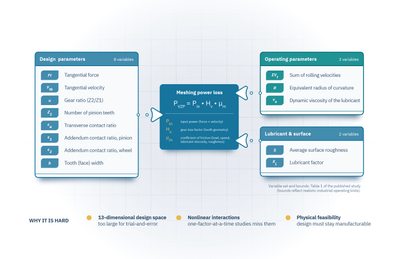
The 13 designs, operating and lubrication variables that govern meshing power loss in the study, and the three terms of the analytical loss model they feed.
Data-driven gear design optimization with modeFRONTIER
We relied on modeFRONTIER to improve gear transmission performance under different operating conditions using ML methods.
1. Workflow setup and logarithmic response transformation
The process began by defining the ranges of the 13 design and operating variables in the modeFRONTIER workflow. A calculator node then evaluated the analytical power-loss equation for every design configuration, producing both a direct and a logarithmic response. The logarithmic transformation stabilizes the variance across a wide range of loss values and keeps every computed value positive, which makes the subsequent surrogate models more robust.
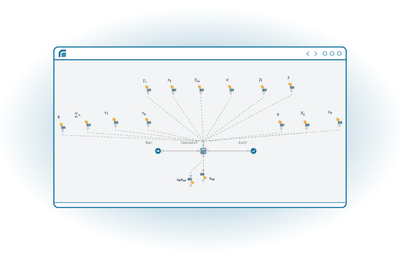
The modeFRONTIER workflow. Adapted from: ASME Digital Collection, Machine Learning-Based Optimization of Frictional …, Journal of Mechanical Design, 148(3), 033501, 2026
2. Space-filling DOE with Uniform Latin Hypercube Sampling
At the top of the workflow, we applied a DOE strategy based on Uuniform Latin hypercube (ULHC) sampling to examine the design space and reveal the correlations among the 13 variables. We generated an initial set of 2,000 design points, uniformly distributed across the entire design space, which helped identify the regions of interest where optimization could be most effective.
3. Smart refinement via adaptive space filler
To increase model accuracy, we then used the adaptive space filler (ASF) technique to identify the regions of the design space where additional samples were required. ASF works iteratively, adding new design points in areas with low sample density or high prediction uncertainty in the response surface model, in this case a radial basis function (RBF) model. ASF intelligently added 162 new design points, bringing the dataset to 2,162 points and helping the response surface reach a coefficient of determination of 0.95. Combining space-filling DOE with adaptive refinement explores the design space far more efficiently than simply adding random samples.
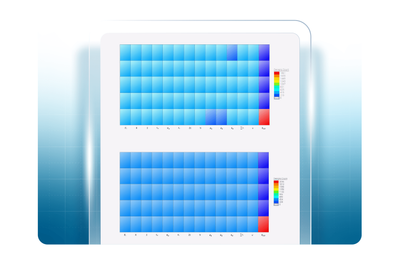
Uniform Latin hypercube sampling provides broad coverage (top); the adaptive space filler adds points where the surrogate needs more information (down). Adapted from: ASME Digital Collection, Machine Learning-Based Optimization of Frictional …, Journal of Mechanical Design, 148(3), 033501, 2026.
Turning data into engineering insight with sensitivity analysis
Sensitivity analysis identifies which variables most significantly influence frictional power loss, improving problem understanding and reducing the size of the optimization problem. We employed two algorithms available in modeFRONTIER:
- Polynomial chaos expansion (PCE) computes variance-based Sobol' indices that decompose the output variance into contributions from each input and its interactions. It captures the effects of nonlinear interactions and is ideal when the precise contribution of each variable matters.
- Distributed random forest (DRF) ranks variable importance from the reduction in squared error across the splits of an ensemble of decision trees. It handles high-dimensional data and complex interactions robustly and scales well to large datasets.
Key sensitivity analysis takeaways
- Primary drivers: operating conditions dominated performance. Tangential force and tangential velocity accounted for 54.6% of total variance in PCE (30.6% and 24.0% respectively) and 40.3% in DRF.
- Geometric levers: pinion tooth count and contact ratios were the leading geometric contributors. Overall design variables accounted for 35.4% (PCE) to 46.1% (DRF) of variance.
- Dimensionality: 7 variables explained 90% of variance in PCE, while the top 10 explained 91.3% in DRF.
This helps prioritize the variables that deserve the most attention, supports better design reviews and reduces the time spent investigating factors with limited influence. Instead of relying on intuition alone, we were able to quantify which parameters drive system behavior. Because both design and operating variables proved influential, all 13 parameters were retained for surrogate training rather than screened out.
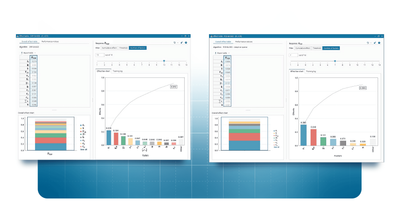
Effect of various factors on frictional power losses using DRF-based analysis (left) and PCE-based analysis (right). Adapted from: ASME Digital Collection, Machine Learning-Based Optimization of Frictional …, Journal of Mechanical Design, 148(3), 033501, 2026.
Using response surface models to predict nonlinear gear behavior
After the DOE and sensitivity analysis steps, we trained response surface models (RSM), also known as surrogate models or metamodels, to find the best fit for predicting the log-transformed frictional power loss. The 2,162 design points were split 80/20 into training and validation sets, and six algorithms available in modeFRONTIER were compared:
- Gaussian process: a probabilistic, kernel-based model that provides predictions with uncertainty estimates and captures complex nonlinear correlations.
- H2O automated machine learning (H2O-AML): automates the training and tuning of multiple models to find the best-performing one.
- H2O distributed random forest (H2O-DRF): an ensemble of decision trees that is robust against overfitting and handles large datasets effectively.
- Kriging: a geostatistical interpolation technique that provides best linear unbiased predictions and models complex surfaces.
- Artificial neural network (ANN): layered networks of nonlinear units that learn arbitrary input–output relationships directly from data, well suited to strongly nonlinear responses.
- Radial basis function (RBF): a distance-based interpolation approach that is effective at approximating complex nonlinear functions.
Surrogate performance comparison
Each model was evaluated on mean absolute, relative and normalized error and on the coefficient of determination. The ANN delivered the strongest predictive performance, with R² = 0.998 and a mean relative error of about 1.2% on the log-transformed response, followed by RBF (R² = 0.991) and Kriging (R² = 0.988). A residual analysis of the ANN model showed uniformly distributed, low-magnitude residuals across the design space with no systematic bias. The ANN was therefore selected as the surrogate for optimization.
| Metamodel algorithm | Coefficient of determination (R²) | Mean relative error |
|---|---|---|
| Artificial neural network (ANN) | 0.998 | ~1.2% |
| Radial basis function (RBF) | 0.991 | Low |
| Kriging | 0.988 | Moderate |
This matters because a reliable surrogate can evaluate design alternatives in a fraction of the time required by repeated physical tests or high-fidelity numerical studies. Once trained and validated, the model becomes a fast decision-support tool: engineers can explore trends, compare trade-offs and focus detailed analysis on the most promising design regions. The RSM exploration tools in modeFRONTIER make this tangible, showing, for example, how frictional power loss responds to tangential force and velocity, tooth count and contact ratio, and where the low-loss regions lie.
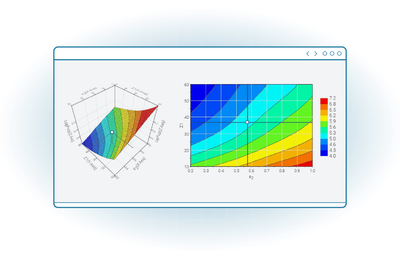
RSM explores 3D of frictional power loss against number of teeth and contact ratios. The white marker indicates the optimal values to be minimized. Adapted from: ASME Digital Collection, Machine Learning-Based Optimization of Frictional …, Journal of Mechanical Design, 148(3), 033501, 2026.
From prediction to optimization with a multi-objective genetic algorithm
The next step is optimization. We used MOGA-II, the multi-objective genetic algorithm available in modeFRONTIER, to search for configurations that minimize the logarithmic frictional power loss while satisfying all mechanical, geometric and operational constraints. Each of the 13 variables was bounded within its physical and operating limits to preserve mechanical realism and manufacturability, and a geometric constraint on the contact ratios kept the meshing behavior within acceptable limits, with infeasible designs penalized in proportion to their violation.
The optimization ran in self-initializing mode for 5,000 evaluations, with elitism enabled to preserve the best non-dominated solutions and a balance of directional crossover, classical crossover, mutation and selection operators to explore and exploit the design space. After optimization, the designs concentrated in the low-loss region of the design space: the wide spread of loss levels seen before optimization gave way to a compact cluster of efficient configurations, with correspondingly lower variability in performance.
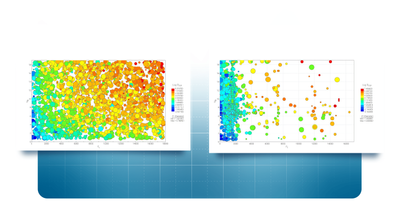
4D Design points distribution before (left) and after (right) the optimization study. Adapted from: ASME Digital Collection, Machine Learning-Based Optimization of Frictional …, Journal of Mechanical Design, 148(3), 033501, 2026.
Validation against experimental gear data
A key strength of this study is the comparison of ML predictions with experimental results from FZG-A10 spur gears tested at several load stages and rotational speeds. In all four test cases, the ANN predictions were closer to the measured losses than the traditional empirical formula. In the third case, for example, the ANN predicted 158 W against a measured 169 W, whereas the empirical formula gave 148 W. Averaged over the four cases, the ANN deviated from the measurements by 3.7%, compared with 6.8% for the empirical formula, and its advantage was most evident in the demanding scenarios with higher power losses.
For industry adoption, validation is essential. Engineers need confidence that a data-driven model is not just fitting a dataset but capturing meaningful behavior. By comparing predictions with experimental measurements, we demonstrated how ML can complement established engineering methods and provide additional accuracy where nonlinear interactions are difficult to model explicitly.
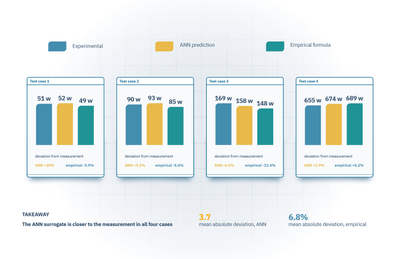
ANN-predicted and empirical-formula frictional power loss for the four FZG-A10 test cases reported in the study.
Business value for engineering teams
The optimization-driven design approach described in this research is not limited to spur gears. It reflects a broader pattern for engineering design:
- DOE to explore the design space
- Adaptive sampling to improve the dataset where it matters
- Sensitivity analysis to identify the most influential parameters
- Surrogate models to accelerate prediction
- Optimization algorithms to search for better designs under constraints
For organizations developing gearboxes, drivetrains or other power-transmission systems, this approach can help reduce late-stage redesign, improve the traceability of design decisions and accelerate the path from concept to validated performance. It also creates a common digital framework in which design engineers, simulation specialists and optimization experts collaborate around the same data, models and trade-offs.
Key takeaways
- Reducing frictional power losses in spur-geared transmissions requires more than a single equation or an isolated parameter study.
- This research demonstrates how combining machine learning with multidisciplinary design optimization provides a clearer view of complex design interactions and guides engineers toward lower-loss configurations, with an ANN surrogate that reached R² = 0.998 and tracked experimental measurements more closely than the empirical formula in every test case.
- By connecting DOE, adaptive sampling, sensitivity analysis, surrogate modeling, optimization and validation in modeFRONTIER, engineering teams can make gear design optimization more systematic, transparent and scalable: a practical pathway toward more efficient and reliable mechanical systems.
Reference
Sanoussi, N. S., Belgasam, T., Hammami, M., Abbes, M. S., Xue, Z., and Mande, O., "Machine Learning-Based Optimization of Frictional Power Losses in Spur-Geared Transmissions," ASME Journal of Mechanical Design, Vol. 148, March 2026, Article 033501, DOI: 10.1115/1.4070619.
Dr. Naser Suliman Sanoussi is the President of the National Academy for Technical Education, Libya, and an Associate Professor of Mechanical Engineering. His research focuses on the analysis, modeling, optimization, and performance evaluation of mechanical systems and engineering applications, with research interests spanning friction, tribology, energy losses, geared transmissions, and other mechanical engineering applications. His work integrates analytical and computational modeling, Design of Experiments (DoE), Response Surface Methodology (RSM), statistical analysis, and machine learning to develop predictive models and optimize mechanical system performance. His research combines physics-based engineering approaches with data-driven methods to investigate complex engineering problems, evaluate system performance, and identify optimal operating and design conditions. Dr. Sanoussi has published more than 25 research papers in international journals and conference proceedings. His academic and professional activities also include engineering education, academic supervision, and the development of technical education, with a focus on applying advanced engineering, computational, and data-driven methodologies to practical mechanical engineering applications.
Dr. Naser Suliman Sanoussi is the President of the National Academy for Technical Education, Libya, and an Associate Professor of Mechanical Engineering. His research focuses on the analysis, modeling, optimization, and performance evaluation of mechanical systems and engineering applications, with research interests spanning friction, tribology, energy losses, geared transmissions, and other mechanical engineering applications. His work integrates analytical and computational modeling, Design of Experiments (DoE), Response Surface Methodology (RSM), statistical analysis, and machine learning to develop predictive models and optimize mechanical system performance. His research combines physics-based engineering approaches with data-driven methods to investigate complex engineering problems, evaluate system performance, and identify optimal operating and design conditions. Dr. Sanoussi has published more than 25 research papers in international journals and conference proceedings. His academic and professional activities also include engineering education, academic supervision, and the development of technical education, with a focus on applying advanced engineering, computational, and data-driven methodologies to practical mechanical engineering applications.
Dr. Tarek Belgasam is a Principal Materials Research Engineer and Digital Development Technical Expert within the Frame Materials Division at the Automotive Development Center, Honda Development & Manufacturing of America. He holds a PhD in Mechanical Engineering and advanced postgraduate training in AI and Machine Learning. He specializes in materials informatics, ICME, machine learning, and physics-based CAE to enable data-driven design, validation, and manufacturing optimization of automotive structures. His work integrates materials testing, multiscale modeling, and AI-enabled digital twins for welding, forming, durability, and performance prediction across advanced steels, aluminum alloys, polymers, and composite systems. Dr. Belgasam leads global, cross-functional collaborations with industry and academic partners to translate advanced analytics into production-ready solutions aligned with cost, quality, and manufacturability targets. In parallel, he serves as an adjunct engineering professor and research mentor, supporting workforce development at the intersection of materials science, manufacturing, and computational engineering.
Dr. Tarek Belgasam is a Principal Materials Research Engineer and Digital Development Technical Expert within the Frame Materials Division at the Automotive Development Center, Honda Development & Manufacturing of America. He holds a PhD in Mechanical Engineering and advanced postgraduate training in AI and Machine Learning. He specializes in materials informatics, ICME, machine learning, and physics-based CAE to enable data-driven design, validation, and manufacturing optimization of automotive structures. His work integrates materials testing, multiscale modeling, and AI-enabled digital twins for welding, forming, durability, and performance prediction across advanced steels, aluminum alloys, polymers, and composite systems. Dr. Belgasam leads global, cross-functional collaborations with industry and academic partners to translate advanced analytics into production-ready solutions aligned with cost, quality, and manufacturability targets. In parallel, he serves as an adjunct engineering professor and research mentor, supporting workforce development at the intersection of materials science, manufacturing, and computational engineering.
People also ask
Empirical formulas rely on simplified statistical regressions that miss nonlinear interactions between operating parameters and gear geometries. Machine learning models, such as Artificial Neural Networks (ANNs), learn complex multi-variable interactions directly from simulation or test data, offering higher predictive accuracy.
modeFRONTIER is equipped with numerical methods such as DOE sampling, adaptive space filling (ASF), surrogate modeling (ANN, Kriging, RBF), sensitivity analysis (PCE, DRF), and multi-objective genetic algorithms (MOGA-II) to improve gear transmission performance.
The adaptive space filler (ASF) is an adaptive DOE algorithm which iteratively adds new points to an existing database, enabling design space exploration, and iteratively trains and validates the response surface of the output variables until the required accuracy levels are reached.
Schedule a live demo tailored to your needs.
See modeFRONTIER in action
Schedule a live demo tailored to your needs.
See modeFRONTIER in action
Schedule a live demo tailored to your needs.