
The critical role of numerical simulation in transforming the automotive industry
Written by Mario Felice
23 December 2025

The automotive industry is going through an unprecedented transformation — one that extends far beyond the shift from internal combustion engines to electrification. We're witnessing the integration of autonomous driving, advanced connectivity, and radically new propulsion systems, all converging at a pace never seen before. In this context, innovation is no longer optional: it's the only way to stay competitive.
Consequently, development times need drastic reductions to keep up with new market product introductions. Because of this, numerical simulation is being adapted as a main catalyst for delivering innovative products to the market at much faster speeds and with unbeatable cost-value efficiencies. Automotive OEMs (Original Equipment Manufacturer) across the industry are establishing digital engineering processes consisting of moving from a physical test development process to a virtual design and development process.
In this blog we examine the critical role of simulation and the essential steps to full implementation of a virtual product development process with the help of ESTECO’s digital engineering solutions for multidisciplinary design optimization (MDO), AI data-driven modeling and simulation data management.
Evolution of automotive simulation - How CAE transformed the vehicle development process
What “near-zero prototypes” really means
Traditionally, physical prototypes were essential for every stage of vehicle development — from concept validation to final testing. But the costs, timelines, and inefficiencies of physical testing have become unsustainable in today’s hyper-competitive market. That’s why leading OEMs are now focusing on a “near” zero prototypes strategy — minimizing physical testing to the bare essentials for final validation and regulatory certification.
“The zero-prototype strategy reflects a multi-decade commitment by leading automotive OEMs. Over time, the role of simulation has undergone a profound transformation, from a tool used primarily for late-stage issue resolution to a design-driven, computer-aided engineering (CAE) integration process that begins in the concept phase and extends through product launch. This approach leverages simulation to identify, refine, and optimize designs before a single physical part is built.”
It is worth noting that the zero-prototype initiative is designed to drastically reduce reliance on costly physical prototypes and the extensive testing they require, thereby shortening overall development time. In practice, achieving a truly zero-prototype process is not feasible, as final hardware validation remains essential to meet the various legal certification requirements. The real objective is to minimize prototypes to the absolute essential set.
How CAE evolution enabled the near-zero prototype strategy
The evolution of CAE tools has moved beyond finite element analysis (FEA) or computational fluid dynamics (CFD). Today’s virtual development environments require multi-physics, multi-domain integration that mirrors the full system behavior of modern vehicles. Whether it's noise, vibration, and harshness (NVH), structural integrity, battery thermal management, or vehicle dynamics, simulation now spans across several multi-domain analysis methods, including:
- Finite element analysis (FEA)
- Computational fluid dynamics (CFD)
- Multibody dynamics
- Acoustics
- Electromagnetics
- Design optimization and robustness evaluation
- Model-, software-, and hardware-in-the-loop testing (MiL, SiL, HiL)
And increasingly, machine learning (ML) is being added to the mix — enabling companies to combine historical test data with simulation models for faster and smarter design decisions.
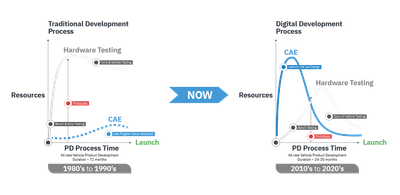
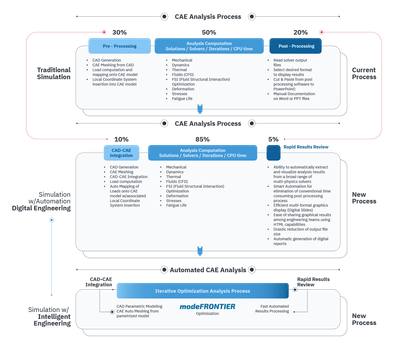
CAE efficiency has skyrocketed over the past four decades. In the 1980s, 70% of the simulation process was spent on manual meshing. Today, thanks to auto-meshing and smarter preprocessing tools, 90% of engineering time can be dedicated to actual analysis, allowing faster iterations and more accurate evaluations.
This has translated into dramatically compressed development timelines: from 72-month product cycles in the 80s and 90s, to 24-30 months between 2010s and 2020s (today), with the next frontier targeting 18-month fully virtual development cycles.
Simulation is no longer a back-office function, it’s driving the entire product development process from concept to launch.
How is digital transformation accelerating in the automotive industry?
As the race for innovation tightens, the automotive industry is turning to digital-first product development to eliminate bottlenecks and respond to fast-changing market demands. This transformation isn’t just about using more simulation software, it’s a strategic shift that fundamentally redefines how vehicles are designed, validated, and brought to market.
The effects of digital transformation
Digital transformation in the automotive space goes beyond replacing hardware with software. It’s about creating a fully integrated virtual development process, where physical prototypes become the exception, not the rule.
Thanks to advances in CAE tools, along with simulation process and data management (SPDM) platforms, and high-performance computing (HPC), companies are now able to:
- Compress development cycles (from 60 months to 30–24 months, and soon to 18 months)
- Integrate CAD and CAE seamlessly within SPDM platforms for real-time collaboration across departments and suppliers.
- Leverage actual customer usage data (from vehicle-embedded sensors) to define more realistic boundary and loading conditions.
- Use multi-domain simulations to account for regional driving differences, fuel types, infrastructure constraints, and more.
The result? Substantial cost savings, faster time-to-market, and more robust, data-driven vehicle designs.
But digital transformation doesn’t happen in a vacuum, it needs a clear structure.
What is the golden thread, and how does it align engineering with business goals?
At the heart of successful digital transformation lies the golden thread. It’s a framework that connects a company’s vision, goals, people, and processes. It ensures that engineering decisions made on the ground align with high-level business objectives like profitability, sustainability, and innovation leadership.
In practical terms, the golden thread requires mapping company-wide initiatives to concrete engineering metrics, aligning every product development stage with shared key performance indicators (KPIs) and traceable business process workflows, and ensuring all stakeholders — from engineers to executives — understand the virtual development journey and their role within it.
This organizational alignment creates the foundation for agile, digital-first decision making and prepares companies to scale simulation capabilities across teams and programs. It helps deliver the business through a disciplined product development process based on a set of key initiatives and metrics targets.
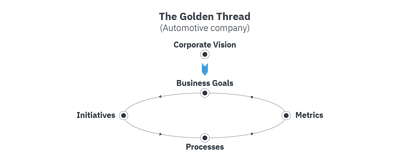
- Corporate vision: to be a global automotive leader in technical innovation, sustainability and mobility. Providing vehicles that customers want with the highest quality, reliability and safety requirements.
- Business goals: profitability, market share, innovation and technology, quality and reliability, sustainability and customer satisfaction.
- Initiatives: electric, hybrid and internal combustion engines (ICE) vehicles, autonomous driving (AD), connected cars, sustainability, digital transformation.
- Metrics: vehicle sales, market share, revenue and profit margin, quality metrics, fuel and range efficiency, safety ratings, regulatory compliance, market trends.
- Processes: innovation and technology integration, product design and development efficiency, product validation and verification, fast time to market, production efficiency and customer feedback and improvement.
How the golden thread enables a scalable, simulation-driven ecosystem
Following this golden thread, digital transformation becomes an enabler for:
- Establishing and evaluating metric-driven targets through CAE tools
- Accelerating product development cycles
- Improving manufacturing efficiency
- Enhancing overall design robustness across programs
This process is closely tied to a modern simulation process and data management (SPDM) environment, empowering engineering teams to:
- Manage simulation data, workflows, model exchanges, and resources efficiently
- Operate within a centralized database fully connected across internal teams, suppliers, and even the customer base
- Leverage real-world data from in-vehicle data-gathering devices to improve simulations by accurately assessing regional driving cycles, improving product quality, and boosting customer satisfaction.
But digital transformation isn’t just about high-level strategy or better data — it’s also about democratizing simulation across the organization.
As simulation becomes more reliable and accessible, non-CAE experts — like test engineers and designers — are entering the virtual development process with the help of automated simulation tools. With physical testing on the decline, test engineers are now transitioning to virtual validation, using intuitive CAE workflows that don’t require deep expertise.
Meanwhile, designers can run basic design checks directly on their computer aided design (CAD) models before handing them off for more advanced analysis. This frees up CAE specialists to focus on high-value tasks such as complex simulation studies, optimization, and the development of new methods.
In short, the golden thread doesn't just connect strategy to execution, it unlocks a smarter, more agile, and more inclusive simulation ecosystem.
Implementation of a disciplined virtual simulation process
Digital transformation doesn’t end at replacing a few crash tests with simulations. A disciplined virtual simulation process is essential to ensure confidence, reliability, and traceability at every step. A successful digital transformation in the automotive industry hinges on the implementation of a comprehensive, systematic, and disciplined virtual simulation process — one that seamlessly connects all enterprise teams, including CAE, design & release, attributes, systems, and suppliers. This means going beyond ad-hoc simulation to build a mature, repeatable, and trusted process that replaces physical testing and delivers consistent, validated results across programs and over time.
To build trust in simulation, companies must evaluate and validate all applied simulation software tools and methods by requiring:
- A systematic correlation process between CAE predictions and physical test results, accounting for tolerances, manufacturing variation, and test conditions.
- A confidence rating system, expressed on a numerical scale (for example, 1 to 4), is used to assess the accuracy of CAE tools. A rating of 1 indicates that the tool is sufficiently robust to replace physical testing fully. In contrast, a rating of 4 signifies a complete lack of correlation, meaning no physical testing can be reduced. The intermediate ratings (2 and 3) represent varying confidence levels, indicating the extent to which physical testing can be reduced.
- A loopback validation approach where simulation results are constantly refined based on test feedback, enabling continuous improvement of tools and processes.
This enables teams to rate each simulation tool/method based on a confidence level rating scale that reflects the accuracy and robustness of results. It’s key to enabling risk-aware design decisions and identifying where simulation is mature enough to replace physical prototypes.
Simulation tools can only replace physical testing when proven to be accurate over time and across programs. And that proof isn’t anecdotal, it’s data-driven and cross-verified by technical expert panels.
By automating CAE analyses with simulation process integration and automation technology provided by software like modeFRONTIER, companies can achieve what once seemed impossible: a “near” zero-prototype development process.
Enabling multi-domain and multi-physics simulation
Modern vehicles are complex systems and require equally sophisticated simulation strategies. Companies must establish a multi-domain, multi-physics simulation approach by integrating:
- FEM (finite element method)
- MBD (multi-body dynamics)
- BEM (boundary element method)
- CFD (computational fluid dynamics)
- MiL, SiL, HiL (model/software/hardware in the loop)
- MBSE (model-based systems engineering)
This allows teams to assess non-linear system behavior, model interactions among components, and simulate real-world driving conditions, even those affected by manufacturing variability.
Efficient data flow between product design and manufacturing is critical here. Simulation models, data, and results must be easily transferable across internal teams and suppliers for full-system evaluation.
How do ESTECO’s solutions accelerate and democratize CAE workflows?
The use of multi-physics CAE, when combined with MDO, ML and reduced order models (ROM) methods, integrated within modeFRONTIER software, offers several advantages across the simulation-driven product development process:
- In-depth physics understanding of linear & non-linear system behavior.
- Assessment of complex system interactions which is essential for evaluating real customer-driving events.
- Evaluation of manufacturing variability, critical for driving design robustness.
- Integration of ROM reduces very large models while keeping high-resolution accuracy to significantly speed-up the computational time for faster design solutions.
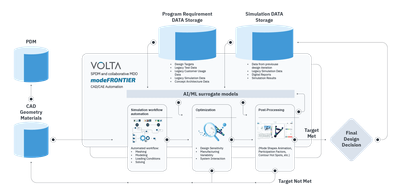
To effectively scale simulation across the organization, companies must also invest in digital engineering platforms that support SPDM and MDO, such as VOLTA. This platform automates end-to-end CAE workflow, streamlining complex processes from initial CAD phase to the detailed interpretation of simulation results. It also plays a critical role in democratizing access to simulation technologies by making them more user-friendly and accessible to a broader audience of engineers within the organization, not just simulation experts.
How can companies position themselves for a near-zero prototype development process?
To reach the ambitious goal of near-zero prototypes, companies must fully embrace a virtual design verification process. This means making simulation the central pillar of all decision-making — embedding computer-aided engineering (CAE) into every stage, from initial concept to final validation. This shift requires a deep integration of data and processes across teams and with external suppliers.
This transition is more than just a technical update, it's a cultural mind-set change. It requires teams to trust virtual assessments over limited physical tests. By starting simulations early in the concept phase and continuing through design freeze, companies can ensure robust designs, accelerate time-to-market, and achieve significant cost reductions.
The success of this approach hinges on several key enablers that connect CAE across all internal organizations and suppliers.
- A systematic approach to data: timely exchange of data and models is crucial. This requires implementing an analytical bill of materials (BOM) process that facilitates seamless communication and ensures all parties have the information needed for successful simulation sign-offs.
- Leveraging advanced simulation and system engineering technology: we must continue to advance CAE applications by incorporating variational analysis, design for six sigma (DFSS), machine learning (ML), and model-based systems engineering (MBSE). This allows us to account for design sensitivities, manufacturing variability, system interactions, and even customer usage patterns.
- Robust correlation and automation: success doesn't hinge on correlating with a single physical test. Instead, it requires a robust correlation process that includes statistical test sampling. We can further accelerate data analysis by leveraging existing test databases with AI and ML. Maximizing process efficiencies through simulation automation is key. This means reducing or eliminating manual model preparation and post-processing, which are often time-consuming bottlenecks.
- Democratization of CAE: by implementing user-friendly tools and methods, we can make CAE accessible to all engineers, not just specialists. This broad application helps embed simulation throughout the entire design process.
The foundation: SPDM and IMM
Simulation process and data management (SPDM) and integrated materials management (IMM) are two critical systems forming the backbone of this transformation.
A single, enterprise-wide SPDM system provides the foundation for an efficient, accurate, and collaborative virtual product development. It ensures traceability, accelerates simulation sign-off, and enables a single-pass design verification, where virtual validation replaces multiple prototype iterations. By integrating with suppliers, the SPDM system seamlessly connects all essential data, including CAD, CAE models and results, materials data, physical test results, and manufacturing data.
A dedicated IMM process provides one centralized, digitized repository for all materials specifications and experimental data. This “golden source” is accessible across the enterprise and connected with suppliers for real-time data sharing, enabling consistent materials information across design, simulation, and manufacturing, faster updates and approvals during development, and improved accuracy in both simulation and physical validation phases.
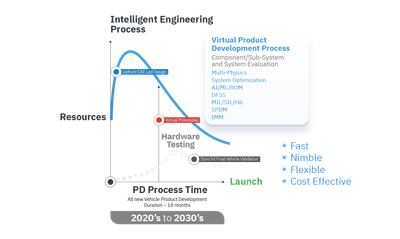
OEMs are intensifying their push to accelerate new product and technology launches, compressing development cycles to just 18 months. Meeting this challenge requires a next-level shift in simulation, transforming the already established digital engineering into an intelligent engineering virtual development process.
The intelligent engineering process, brings together all the elements discussed in this blog: multi-physics simulation, MDO, AI/ML, SPDM, IMM, etc., within a disciplined framework that maximizes workflow automation. This enables a process that is fast, nimble, and cost-effective path to market, dramatically reducing the need for physical prototypes and delivering true design verification efficiency. By combining these elements, companies can reduce or eliminate physical testing, increase design efficiency and robustness, and achieve a single-pass design verification for final validation.
In conclusion
The move toward near-zero prototypes represents one of the most significant shifts in modern automotive engineering. As vehicles become more complex and development timelines continue to shrink, companies can no longer rely on physical testing alone. Instead, success will depend on mature, validated, and scalable virtual development processes supported by trusted CAE methods, automation, and enterprise-wide data management.
By integrating simulation earlier, aligning engineering decisions with business objectives, and enabling broader access to digital engineering tools, OEMs can accelerate innovation while maintaining quality, safety, and regulatory confidence. The organizations that embrace disciplined simulation frameworks, reliable SPDM and IMM foundations, and advanced MDO and AI-driven modeling will be the ones best prepared to lead the next era of automotive mobility.
Key takeaways:
- Near-zero prototypes become feasible when simulation is validated and consistently applied.
- SPDM and IMM create the foundation for reliable, scalable virtual development.
- Advanced CAE, MDO, and AI-driven methods speed up decisions and improve design robustness.
- Democratizing simulation brings earlier insights and reduces late-stage changes.
Schedule a live demo tailored to your needs.
See modeFRONTIER and VOLTA in action.
Schedule a live demo tailored to your needs.
See modeFRONTIER and VOLTA in action.
Schedule a live demo tailored to your needs.