
Powering the energy transition through digital verification and validation
Written by Thomas Capderou
29 January 2026

The energy sector stands at a pivotal moment, balancing surging global energy demand with the pressing goal to decarbonize, creating a high-stakes environment that demands innovation and agility. From continued innovations in Oil and Gas to scaling new energy solutions, engineering teams must deliver increased operational efficiency and accelerate time-to-market to maintain competitiveness in a rapidly transforming energy landscape. By leveraging digital technologies, the energy industry can pursue these goals and achieve future growth, laying the groundwork for a transformation where digital verification and validation (V&V) becomes the central driver of innovation, efficiency, and sustainability.
At its core, digital V&V is a methodology that uses modeling and simulation to analyze and refine designs before they reach the physical world. It provides a systematic framework to ensure that products meet performance expectations and safety standards through data-driven, model-based evaluation. This shift from physical to digital validation allows engineers to minimize prototyping costs, shorten design cycles, and make better-informed decisions early in development.
Bridging the gap towards this engineering methodology enables large enterprises to solve its important challenges:
- energy companies operating at large scales and around the globe inherently suffer from siloed team structures preventing people and their work from collaborating all together;
- the creation of disparate physics models and undocumented variability in model/data fidelity, hindering the reuse of datasets and insights already generated.
Breaking data and model silos in large energy organizations
Breaking organizational silos requires more than simply sharing data, it requires people and models to work together within a common executable framework. In many engineering organizations valuable simulation models exist but they remain disconnected from day-to-day decision-making because they are manual, fragmented, or dependent on individual experts. True collaboration happens when models are not only accessible, but also automated, repeatable, and reliable enough to be used across teams with confidence.
This is where orchestration and automation become essential. By enabling simulation workflows to be automated and centrally orchestrated, organizations can ensure that models run consistently and scale across projects according to their needs. Once these technical foundations are in place, business processes including design approvals or operational checks can be layered on top to further streamline execution.
Why governance and data management are critical for digital V&V
To fully realize enterprise value from digital V&V, organizations must move beyond model execution and address how the resulting data, insights, and knowledge are governed. As simulation and optimization activities scale, the volume of generated data increases rapidly, making it difficult to track which models were used under what assumptions and for which decisions. Without proper governance, valuable insights risk being lost or may never be found in the first place.
A centralized data management framework is therefore essential. By managing simulation models and results in a single environment, enriched with structured metadata, organizations gain traceability and searchability across their digital assets. Metadata enables engineers to understand model context and version history, while decision-makers can confidently reuse validated insights rather than recreate analyses. In this way, governance transforms digital V&V from a collection of technical activities into a scalable, knowledge-driven capability that supports consistent decision-making across the enterprise.
How does simulation democratization support faster energy decisions?
Model and simulation democratization begins with giving every team access to trusted engineering insights. Instead of simulations and workflows being locked within a specialist team, an engineer in the field, a designer in another country, or an operations planner with no simulation background, it's possible to run the same vetted process with consistent results. This removes the bottleneck of relying on a handful of experts and ensures that decisions are informed by high‑quality engineering models, not assumptions or outdated data.
For global energy companies, this level of accessibility directly impacts speed and quality. Teams working across different sites, continents, or business units no longer need to:
- recreate analyses,
- request files over email,
- interpret conflicting versions of the same model.
Instead, they operate from a unified source of truth that improves collaboration and reduces duplicate effort.
ESTECO as a catalyst for digital engineering transformation in the energy sector
Digital V&V integrates simulation, process automation, and optimization to validate energy systems at every stage of their lifecycle. Whether optimizing flow distribution in a hydraulic fracturing perforation cluster or predicting fatigue behavior in a turbine assembly, ESTECO’s technology enables engineers to balance competing objectives and assess design trade-offs before deployment.
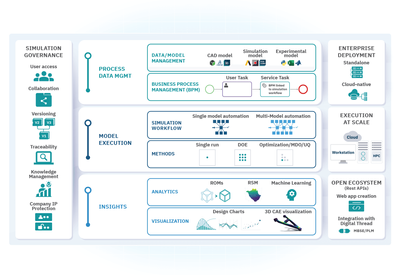
VOLTA digital engineering platform provides governance, collaboration, and traceability across distributed engineering teams.
modeFRONTIER process automation and design optimization software solution orchestrates multi-physics simulations linking computational fluid dynamics (CFD), structural analysis, and system modeling into an automated, repeatable simulation process workflow. Optimization algorithms explore vast design spaces efficiently, uncovering configurations that maximize performance while minimizing risk and engineering time.
VOLTA digital engineering platform extends these capabilities to enterprise scale, providing governance, collaboration, and traceability across distributed engineering teams. VOLTA APIs further benefit teams by enabling the creation of democratized digital products, allowing simulation experts to package advanced workflows into intuitive applications that can be deployed to internal or external clients. These technologies expand the reach and impact of engineering models far beyond the specialist community.
Use case: optimizing perforation design with digital V&V
This study leverages a fully integrated modeFRONTIER workflow combining CAD modeling, CFD simulation, and automated optimization to analyze and improve the performance of perforation layouts in unconventional oilfield completions. By applying physics-based modeling and multi-objective evaluation to job planning, this project produces meaningful insights that enhance operational performance, reduce variability in well output, and contribute to better-informed well design.
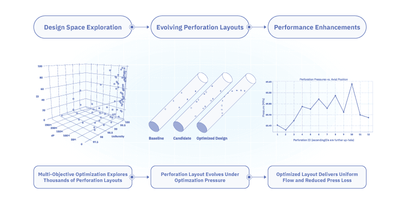
Automated design space exploration and optimization of perforation layouts. Multi-objective optimization evaluates thousands of candidate designs, evolving perforation geometry from a baseline configuration toward layouts that deliver more uniform flow distribution and reduced pressure losses.
Digital V&V workflow for perforation optimization
Building on this foundation, the optimization study systematically explores the impact of perforation count, phasing, and spatial distribution on key flow performance indicators. Design variables were parameterized directly in the CAD model and propagated automatically through meshing and CFD execution, allowing hundreds of design variants to be evaluated consistently. Objective functions captured both local flow behavior at the perforations and global system metrics, enabling engineers to quantify trade-offs between total pressure drop and flow uniformity.
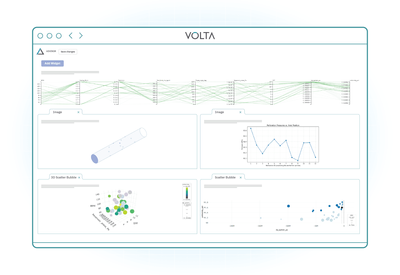
VOLTA Advisor dashboard enabling enterprise access to simulation insights. Optimization results are captured as a governed digital asset, allowing engineers and decision-makers to interactively explore trade-offs, compare designs, and trace every result back to its underlying models and assumptions.
From simulation results to decision-ready digital assets
The VOLTA Advisor dashboard turns complex simulation studies into a searchable, governed digital asset that can be accessed beyond CFD experts. Engineers can intuitively explore design trade-offs and performance drivers through interactive visualizations, while every result remains fully traceable to its underlying model and study plan. By combining easy access to insights with strong data governance and model management, the platform enables true simulation democratization while preserving trust, reuse, and enterprise-wide scalability.
Rather than relying on isolated sensitivity studies or empirical rules of thumb, the workflow creates a reusable digital experiment that can be adapted across wells, formations, and completion strategies. modeFRONTIER orchestrates this process end-to-end, linking geometry, physics, and decision criteria while VOLTA ensures that the resulting knowledge is preserved, searchable, and ready for reuse. Together, they transform advanced simulation from a one-off analysis into a scalable decision-support capability, aligning technical rigor with the speed and repeatability required in modern energy operations.
Digital V&V as a foundation for scalable energy innovation
The adoption of digital technologies is transforming how the energy industry approaches product development and system design. By integrating optimization and simulation data within a unified digital framework, organizations can better quantify uncertainty, explore trade-offs, and improve design robustness. The digital engineering approach reduces equipment downtime and maintenance costs while paving the way for digital products that are adaptable to industry trends.
As the complexity of energy systems grows, digital engineering will become the cornerstone of innovation. It allows companies to move beyond isolated simulations toward holistic digital twins, systems that continuously learn from operational data and guide future design improvements.
Key takeaways:
- Digital V&V enables faster, earlier engineering decisions.
- Digital validation reduces cost, risk, and time-to-market.
- Breaking data and model silos is essential at scale.
- Governance ensures traceability and reuse of results.
- Simulation democratization expands access to trusted insights.
- Digital V&V turns simulations into decision-ready assets.
SPDM empowered with collaborative design optimization
See VOLTA in action
SPDM empowered with collaborative design optimization
See VOLTA in action
SPDM empowered with collaborative design optimization