
How ROM-based design optimization enables acoustic gains in electric vehicles
Written by Pedro Luta

The automotive industry is rapidly evolving with the shift toward electric vehicles (EVs). While much attention focuses on battery performance, another challenge is becoming increasingly important: cabin noise. Unlike internal combustion vehicles, EVs lack engine noise, which exposes other sound sources such as road and aerodynamic noise. As a result, ensuring acoustic comfort has become a key design priority for original equipment manufacturers (OEMs). This blog explores how ROM-based design optimization helps engineers address this challenge by enabling faster and more efficient acoustic analysis.
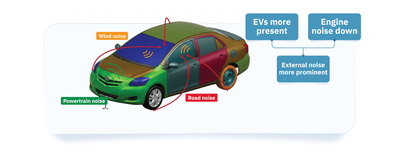
The new noise, vibration, and harshness (NVH) challenge in electric vehicles
Cabin noise in the automotive industry has always been dominated by the engine. But when the engine is replaced by a totally different system, much more quiet, this definitely changes the focus of the design engineering. Other noise sources, often overlooked before, such as road noise and aerodynamic noise start to be the predominant sources of unwanted sound in passengers' ears, prompting OEMs to take different routes to attune these sources.
To address the necessity of design processes focused on noise-controlling treatments (NCTs), this study presents a framework combining the capabilities of Keysight’s Vibro-Acoustics (VA One) as a simulation tool to predict road noise, and modeFRONTIER's process automation and design optimization solution to reach an optimal design regarding noise-cancelling and weight addition.
Using Vibro-acoustics (VA One) on product design: road noise and damping patches
Vibro-acoustic simulation methods play a critical role in predicting the noise performance of vehicle components and systems before physical prototypes are built. Common simulation techniques such as finite element method (FEM), used to model structural behavior, and boundary element method (BEM), used to simulate the propagation of sound, are widely used to predict vibro-acoustic performance with high accuracy.
One of the normal vibration modes present in VA One’s solution 103 from a Body-In-White. This solution captures vibration modes up to a specified frequency, enabling their inclusion in analyses of structural dynamics and vibration interactions.
Using VA One for damping patch optimization
This study uses a demonstrator finite-element (FE) model of an automotive body-in-white built inside VA One. Damping patches with variable thickness are strategically distributed across the vehicle’s floor, and the main objective is to optimize their thickness to enhance the acoustic comfort while, at the same time, not compromising vehicle performance with too much added weight. Therefore, the optimization process focuses exclusively on adjusting the thickness of each patch to achieve the desired balance between the vibro-acoustic performance and weight constraints.
Road-induced structure-borne noise was simulated, which is a dominant contributor to the interior cabin noise as electric vehicles (EVs) are heavier and require stiffer tires. Unit forces are applied to the VA One model on each shock tower in the vertical direction. The vibration response is recovered on points randomly distributed throughout the body-in-white, focusing mainly in the narrowband from 20Hz to 150Hz. The body-in-white structural modes up to 200Hz are also included in the calculations.
The initial formulation of the multi-objective optimization problem comprised 29 design variables, each corresponding to the thickness of a noise control treatment patch applied to the vehicle’s interior.
VA One and modeFRONTIER: automated vibro-acoustics simulation for design optimization
Once you can now replicate your product’s behavior computationally and predict its performance, another question arises: how well can the product be designed to assure peak performance in the corresponding field?
Using modeFRONTIER’s integration capabilities, it was possible to automate VA One’s simulation in a sequential, controlled and repeatable manner. This way, the 29 design variables and its combinations could be varied and evaluated.
Key techniques applied to the modeFRONTIER workflow:
- Sensitivity analysis: used to identify which of the 29 patches actually influenced noise. By stripping away non-contributing variables, the design space became more manageable.
- Optimization algorithms: the study used NSGA-II (non-dominated sorting genetic algorithm), an evolutionary strategy used to find optimal trade-offs between competing objectives, making it well-suited for complex, multi-objective optimization problems.
- The bottleneck: traditional full-scale acoustic simulations are computationally expensive. Performing a global optimization using only high-fidelity physics models would typically be reserved for late-stage development when design flexibility is low.
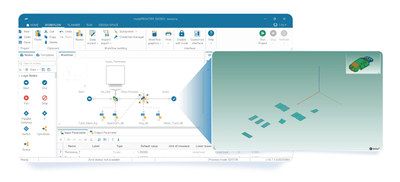
Accelerating optimization: response surface models (RSM) and reduced order models (ROM)
With this automation achieved, every modeFRONTIER’S design exploration and optimization capabilities could then be used in this engineering design process. For this study, a few different techniques were used: design of experiments (DOE), sensitivity analysis, response surface models (RSM), reduced order models (ROM) and optimization algorithms.
The main purpose of doing a sensitivity analysis, in this study, was to reduce the number of design variables from the initial problem.
The process followed these steps:
- generate a DOE table
- evaluate simulation results
- identify variables with low impact on outputs
- remove non-influential variables from the model.
As a result, the optimization problem became simpler and more computationally efficient.
In other contexts, sensitivity analysis can also be used to:
- quantify the impact of critical variables on system performance,
- identify key drivers behind specific outputs,
- gain insights with relatively low computational effort.
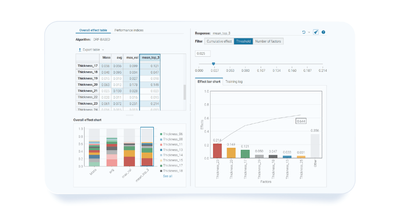
modeFRONTIER’s sensitivity analysis allows you to understand the relationships between inputs and outputs. A comprehensive analysis together with clear visualization tools made it possible to understand which patches had the biggest and smallest influences on each output. The ones with the smallest influences were stripped from the model.
Exploring optimal design solutions with advanced algorithms
The optimization algorithms provided by modeFRONTIER address the challenge of finding out what is the best combination of design variables to achieve a minimum (or maximum) output value. A wide range of different optimization strategies can be employed:
- gradient-based optimization: useful for reaching a satisfiable result quickly especially when the simulation time is high;
- evolutionary algorithms: ideal for exploring the design space as a whole, assuring that the final result is most likely the global optima.
- multi-strategy algorithms: employ the latter two together with design of experiments (DOE), virtualization and sensitivity analysis are also offered in modeFRONTIER, assuring that there is no shortage of different paths to reach your goal, should there be any roadblocks in any of them.
An additional obstacle, however, is the shear processing time required by some of the analysis employed in NCT design. Due to simulations taking a lot of time, full-scale acoustic simulations are often reserved for the later stages of vehicle development, once geometric and design parameters are more stable and design space is limited. This delay can limit design flexibility and increase the cost and effort required to implement noise control modifications, since significant changes at this stage can affect multiple subsystems and production timelines.
To address these challenges, modeFRONTIER’s RSM and ROM methods empower faster and more efficient predictions earlier in the design process. These methods use higher fidelity simulation data to create simpler and faster-running models while focusing on preserving the essential dynamic behavior of the system, significantly lowering computational cost without major sacrifices in accuracy. By integrating these approaches into the modeFRONTIER simulation workflow, engineers can perform meaningful acoustic assessments much earlier in the development cycle, enabling quicker iterations, more informed decisions and reduced design risk.
The vibro-acoustics optimization test using RSM and ROM
In this study, a 150 design DOE was created to be used for the training of the RSM and ROM. The generation of this data used the uniform latin hypercube (ULH) method, which ensures that the design space is explored and represented as much as possible. This process took roughly 6 hours.
Building surrogate models for acoustic prediction
The sum of the masses of all patches was predicted using a radial basis function (RBF) RSM. RBFs are particularly effective in capturing nonlinear relationships in complex engineering systems, as they provide smooth, continuous approximations of the response surface with high accuracy even from relatively sparse datasets. Mass values are also historically easy to predict using RSMs, so it was easy to get really low errors on the model prediction.
In parallel, a ROM was used to predict the acoustic spectrum. It was also developed using an RBF-based technique, aimed to approximate the full simulation model by projecting the system behavior onto a lower-dimensional space while preserving essential physical characteristics.
A multi-objective evolutionary algorithm was employed using modeFRONTIER’s implementation of the non-dominated sorting genetic algorithm II (NSGA-II), motivated mainly by its strong exploratory capabilities, which are particularly well-suited for navigating complex, multi-dimensional design spaces. While traditional high-fidelity simulations are often computationally prohibitive for such algorithms, the RSM and ROM employed made it possible to use this algorithm.
For the actual optimization, three objective functions were chosen:
- the total mass sum of the damping patches,
- the average of the noise spectrum,
- the mean of the top three peaks of the noise spectrum.
The latter two metrics were calculated by post-processing the ROM’s output signal).
Evaluating optimization performance and accuracy
To assess the performance and efficiency of the models, two independent multi-objective optimization runs were conducted using the NSGA-II algorithm, each going through 1,000 individuals each. One run employed the full physics-based simulation engine, while the other used RSM and ROM. All optimization parameters, including population size, crossover and mutation probabilities, were kept identical across both runs to ensure a consistent and fair comparison of the results.
The first run, using the full physics-based model, took a total runtime of approximately 39 hours. The second, using the ROM and RSM techniques, made it possible to complete the optimization in roughly 30 minutes. The Pareto fronts of both simulations present a very similar behavior throughout the entire scope of objectives, with individuals being presented in a wide spectrum of results.
| Feature | Full physics-based model | RSM & ROM-based model |
|---|---|---|
| Total runtime | 39 Hours | 30 Minutes |
| Accuracy | Baseline | Near-identical Pareto front |
| Efficiency | High Compute Cost | 98% reduction in time |
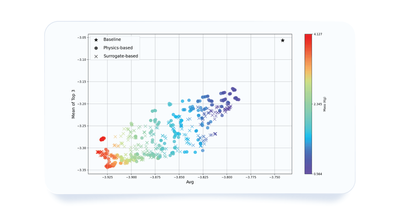
The Pareto plot lets you analyse the distribution of your optimization individuals along the objective values. On this three-dimensional plot, with the total weight of the acoustic patches represented as the color gradient, the spectrum average and mean of top 3 peaks on the x and y axes respectively, it can be seen that the RSM and ROM based population overlaps the physics-based one, this way, the insights obtained by the two different optimizations are very similar.
To further validate the accuracy and reliability of the surrogate-based optimization, a subset of designs was selected from the Pareto front generated by the ROM/RSM optimization and subsequently evaluated using the full physics-based simulation model.
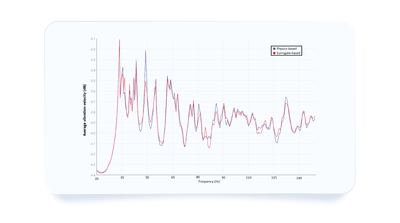
On a direct spectrum output comparison between the physics-based simulation (blue) and the ROM based one (red), it can be seen that they are really similar, therefore the general behavior of the problem is kept when the ROM simulation is introduced.
Despite the difference in runtime, the optimization results from both approaches were consistent, with similar Pareto fronts and design trade-offs. This demonstrates the effectiveness of the surrogate models in capturing the essential behavior of the system while enabling rapid and resource-efficient exploration of the design space.
When should engineers use ROM-based acoustic optimization?
ROM-based acoustic optimization is most valuable when simulation time limits the ability to explore design alternatives. It allows engineers to run faster iterations while still capturing the essential behavior of the system.
This approach is especially useful in scenarios such as:
- Early-stage design: when engineers need fast feedback before design parameters are fixed.
- Complex optimization problems: when multiple objectives, such as noise reduction and weight, must be balanced.
- Computationally expensive simulations: when full physics-based models take too long to run repeatedly.
- Design exploration phases: when evaluating a large number of variable combinations is required.
In these situations, tools like help automate workflows and integrate ROM and RSM models into the optimization process.
As a result, engineers can shift acoustic analysis earlier in the development cycle, reduce design risk, and make faster, data-driven decisions without relying solely on high-cost simulations.
Conclusion
Keysight’s VA One and ESTECO’s modeFRONTIER are powerful tools to speed up design processes in the new era of EVs. When used together, they allow you to simulate, iterate and evaluate your product in a fast and controlled manner. Additionally, the ROM and RSM technologies allow you to use faster-running models with little to no loss compared to a standard optimization.
By leveraging ROM, the optimization time was slashed from 39 hours to just 30 minutes. This allows for:
- earlier insights: perform acoustic assessments in the concept phase;
- cost reduction: minimize the need for physical prototypes and late-stage design changes;
- optimal performance: reach the global optima for weight and sound without the computational burden.
People also ask
ROM-based optimization fits best in the early and mid design phases of electric vehicle development. It allows engineers to explore many design options before finalizing geometry or materials. Therefore, teams can identify noise issues early, when changes are still easy and cost-effective. This reduces the risk of expensive redesigns in later stages.
Structure-borne noise travels through the vehicle’s physical components, such as the chassis or body panels. Airborne noise, however, travels through the air inside or outside the cabin. In electric vehicles, structure-borne noise becomes more noticeable because the engine is no longer masking it. Therefore, engineers focus more on controlling vibrations within the vehicle structure.
Traditional acoustic simulations rely on high-fidelity physics models, which require significant computational resources and time. Running large optimization studies with these models can take days or even weeks. However, early design stages require fast iteration and quick feedback.
Software like modeFRONTIER helps address this by integrating reduced order models (ROM) and response surface methods (RSM) into automated workflows. This allows engineers to explore many design alternatives much faster while maintaining reliable accuracy.
Engineers use sensitivity analysis to determine which design variables have the greatest impact on performance. Variables that show little or no influence on outputs are removed to simplify the problem. This reduces computational effort and makes optimization more efficient.
As a result, engineers can focus only on the parameters that truly affect outcomes like noise reduction or weight.
Leverage modeFRONTIER’s AI/ML workflow automation for rapid design optimization early in product development.
The guide to AI data-driven design in modeFRONTIER
Leverage modeFRONTIER’s AI/ML workflow automation for rapid design optimization early in product development.
The guide to AI data-driven design in modeFRONTIER
Leverage modeFRONTIER’s AI/ML workflow automation for rapid design optimization early in product development.