
From silos to scale with simulation apps: building automated engineering design processes your whole team can use
Written by Alessandro Viola, Chiara La Guardia and Gabriele Degrassi
According to the ASSESS Initiative, the democratization of engineering simulation requires that the use of engineering simulation is broadened to all users being able to make more informed design decisions throughout the entire product/process lifecycle. As the capability of the software and experience of the users have increased, the role of engineering simulation has evolved from being a “supporting act” supplemental to the mainstream design process to being in a “leadership” role during the product design creation, integrating complex systems, optimizing product performance, reducing cycle times, improving robustness, and supporting operational and maintenance issues.
Engineering design processes typically involve a wide range of stakeholders:
- CAD designers who create and iterate geometry
- CAE engineers who set up and validate simulations
- Technical managers who define performance targets
- Suppliers who have to confirm manufacturability and material constraints
- Sales teams who need reliable data for proposals
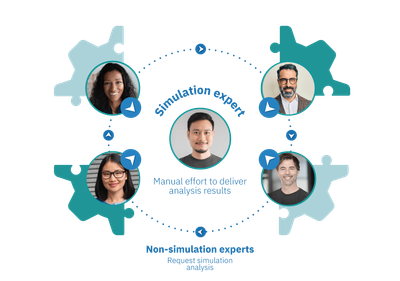
Each of these groups routinely request analyses to support critical design decisions. Meanwhile, simulation experts have to manually translate those requests into executable models, run computationally intensive design optimization studies, interpret results, and produce reports. This becomes an operational bottleneck for many organizations. First, simulation experts are often unable to respond quickly because of the very high workload that they have. When tasked with routine or repetitive requests like running standard simulations or supporting minor design iterations, they become unintended choke points for innovation. Time that should be spent on high-value tasks (method development and improving simulation models) is instead consumed by operational work. Second, the simulation tool chains or the engineering solvers themselves are often too complex for the non-experts to set up and use effectively. These tools demand specialized knowledge and hands-on experience; locking out the very people who could benefit most from quick simulation feedback. Additionally, there is an urgent need to deliver ready-to-use CAE workflows in the hands of end-users to perform routine simulation analysis. By capturing an expert's process once and automating it, you can empower the entire organization. Solving simulation operational challenges is the key to unlocking the full potential of your engineering teams. It's about moving from a manual, expert-driven process to an automated, democratized one. And that’s exactly where ESTECO technology comes in.
Capturing and automating simulation workflows
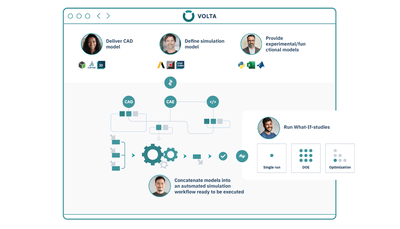
In most organizations, you may have different subject matter experts responsible for different part of the simulation-driven design process. You have a designer who delivers the CAD model, a simulation engineer who defines the simulation model, and perhaps other experts who provide experimental or functional data. Historically, the process of bringing these different pieces together has been manual, time-consuming, and prone to errors. This is the problem we solve.
Integrating disparate tools into a single source of truth
With the VOLTA digital engineering platform, we leverage the powerful workflow technology from modeFRONTIER to integrate all these different components. Whether it's CAD software, CAE tools, or even your own in-house software, we can bring it all into a single, automated simulation workflow. This becomes an authoritative source of truth. The different models are concatenated into a process that is ready to be executed. Once this automated workflow is defined and published in VOLTA, your team can then easily run what-if studies, perform a design of experiments (DOE), or even run optimization studies to find the best possible design. The simulation process automation approach is not just about saving time. It is also about ensuring consistency, capturing expert knowledge in the simulation workflow and ultimately, enabling much deeper design exploration that would ever be possible with a manual process.
Enabling democratization in simulation
At ESTECO, we democratize simulation by embedding simulation process automation into the VOLTA digital engineering platform, making advanced analysis capabilities accessible to a much broader audience. This happens in two steps:
- Planner web interface: this is where method developers have full control to set up and configure a simulation execution (single run, DOE or optimization study) to explore the design space.
- Runbox simulation app: the same method developers can package their complex simulation workflows into simple, easy-to-use web apps.
Frictionless access for non-simulation experts
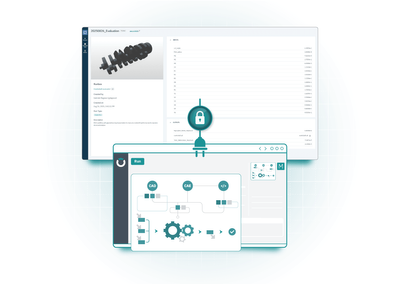
Simulation end users access the Runbox web app directly from their browser, change a small set of input parameters, and run analyses that return results for exploration. Behind the web interface, expert-driven simulation workflows execute in VOLTA and Runbox. Users therefore receive fast, decision‑accurate answers without needing to know solver configuration or workflow details.
Unlocking business value across engineering teams
This approach creates a bridge between simulation experts and the broader design and engineering teams:
- Faster decision cycles: designers and engineers iterate quickly because they can run and compare scenarios on demand.
- Reduced risk: automated, validated workflows enforce input checks, boundary conditions, and convergence monitoring so results remain trustworthy.
- Scalable expertise: simulation specialists create and maintain the workflows once, and the broader team reuses them safely, freeing experts for deeper problems.
“With ESTECO software solutions and VOLTA Runbox API-based verticalization, we orchestrated data and physics-informed AI models to automate and optimize the design of EV gears and reduce design time by 65%."
VOLTA Runbox application use case: fluid-structure interaction (FSI) on a front wing
As with many engineering design problems, the FSI analysis of a front wing of a racing car involves multidisciplinary simulations. Specifically, the goal is to study the interplay between the aerodynamic loads and the structural response in order to prevent aero-structural problems and to optimize the performance during the race.
The multidisciplinary design challenge
Obviously there are several people who work on it, each of which is expert for the single discipline:
- CAD modeling expert who develops the front wing design
- External fluid dynamics expert that works on the CFD simulations in order to compute the pressure distribution acting on the front wing
- FEM expert that deals with the structural simulation, studying how the wing deforms when subjected to the pressure field
The fundamental challenge here is to enhance collaboration between these team members who are working on this project. But this collaboration extends far beyond simply exchanging files between colleagues. In this context, how could we automate the design process and give access to the FSI simulation to all the team members, including the non-expert ones? They might not know all the details about CFD and FEM simulations, but, on the other hand, they may need to test some front wing configurations, maybe they need to keep track of the results or make decisions based on those results.
Bridging the gap with web applications
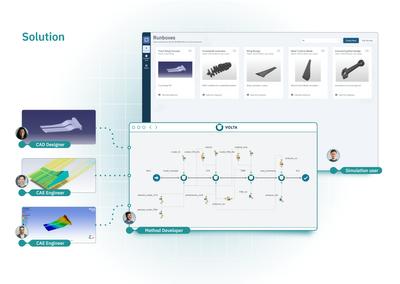
By adopting the VOLTA platform, CAD, CFD and FEM specialists can share their models not only with peers but also with a method developer who plays a crucial role. The method developer does more than assemble CAD/CAE models and automate the entire simulation process. They encapsulate expert knowledge into simulation workflows and build the Runbox web apps that let non-simulation experts launch simulation evaluations with a single click. For a CAD expert, this Runbox simulation app is especially valuable: instead of learning the technicalities of high‑fidelity FSI set-ups, they can use the simulation app to explore how different wing geometries perform, run parametric studies, and compare tradeoffs rapidly. The result is faster design iteration and wider reuse of expert models across the organization without sacrificing result fidelity.
Key takeaways
- VOLTA vertical integration: encapsulating your company's valuable simulation expertise within a Simulation web app, complete with a customized user interface. It's about taking that expert knowledge and making it a scalable, reusable asset across your organization.
- Runbox user-friendly interface: Accessibility is key. Because it's web-based, there's no software to install, and no prior simulation experience is needed. Anyone who needs the data can get it, simply and intuitively.
- Democratization in simulation: The ultimate goal is to empower more engineers to perform simulation analyses and rapidly create and test new design configurations. This allows your company to bring forward simulation into the v-cycle development and empower non-simulation experts like CAD designers to assess in a quick way if their design is going to work or not.
Watch and learn Runbox - the VOLTA web app which bridges the gap between simulation experts and non-experts.
Democratizing simulation with VOLTA web apps
Watch and learn Runbox - the VOLTA web app which bridges the gap between simulation experts and non-experts.
Democratizing simulation with VOLTA web apps
Watch and learn Runbox - the VOLTA web app which bridges the gap between simulation experts and non-experts.