
ESTECO UM2026: Navigating the agentic frontier in engineering simulation
Written by Alessandro Viola
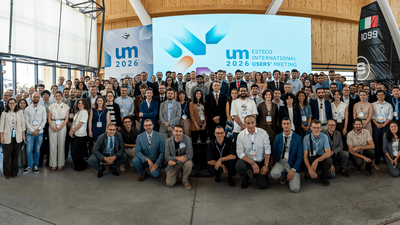
The agentic frontier represents a shift in digital engineering where software moves beyond simple assistance. AI agents now plan, orchestrate, and execute complex simulation workflows autonomously, requiring a foundation of absolute precision. But, is your data ready for AI? This was the recurring theme of the 12th edition of the ESTECO International Users’ Meeting (UM26).
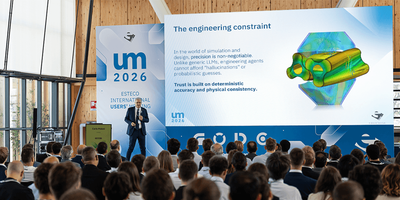
“In the world of simulation and design, precision is non-negotiable. Unlike generic large language models (LLMs), engineering agents cannot afford “hallucinations” or probabilistic guesses. Trust is built on deterministic accuracy and physical consistency. ESTECO provides the secure software infrastructure that allow AI Agents to navigate safely and effectively."
Speakers from leading companies such as Cummins, Ferrari, Fincantieri, GE Aerospace, Honda, Leonardo, Luna Rossa, Jaguar Land Rover and SLB showcased how their industries tackle simulation-driven design challenges using ESTECO’s three core software solutions:
- modeFRONTIER - process automation and design optimization
- VOLTA - digital engineering platform for SPDM and design optimization
- nDAI - AI engineering platform for instant design predictions
Key takeaways from UM26
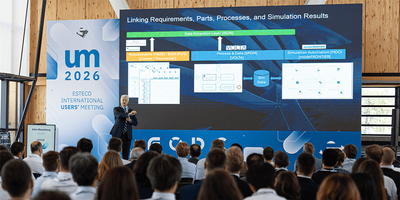
VOLTA's BPM capabilities to manage and link engineering handoffs across GE Aerospace product design
John Bloomberg, Sr. Systems Engineer - Digital Integration Leader at GE Aerospace, said the company needed to convert a fragmented high-pressure-compressor design iteration process into an executable, traceable workflow. The goal was to connect requirements management systems, simulation execution, and artifact governance in a single business process driven by a SPDM framework. Using VOLTA’s BPM capabilities, the team connected engineering handoffs, linked requirements to analysis artifacts and invoked simulation workflows automatically. As a result, they preserved metadata, version control, and context of the full product development process.
Dumarey’s digital transformation and AI/ML adoption
According to Ivan Flaminio Cozza, Analysis Technical Leader at Dumarey Automotive Italia SpA, digital transformation is built on a simple idea: trustworthy AI is only possible with strong data foundations, not flashy algorithms. Rather than treating data management as a purely IT concern, the team sees it as an engineering capability that enables traceability, workflow connectivity, and reliable decision-making across the full simulation lifecycle.
With VOLTA as a central SPDM environment and modeFRONTIER supporting automation, optimization, and surrogate-model development, Dumarey is connecting experimental and virtual engineering into a single, collaborative framework. This approach not only improves the quality and reusability of data, but also creates the conditions for scalable analytics, faster innovation, and AI applications that engineers and decision-makers can actually trust.
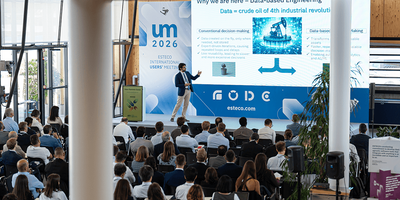
Data-governed collaborative MDO, physics-based solvers automation, and simulation-to-ML bridging
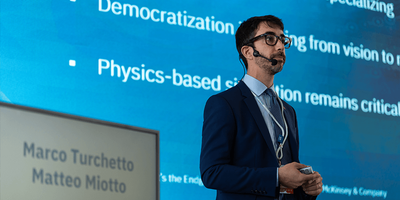
Marco Turchetto, Product Manager for VOLTA at ESTECO, argued that the engineering simulation industry isn't yet ready for AI because simulation data lacks the contextualization, structure, and traceability AI needs to function effectively. The present and future of the VOLTA digital engineering platform center around a single ambition: transforming simulation knowledge into an organizational asset and the bedrock of AI adoption in engineering. By embedding context directly into simulation data, automating CAD/CAE and business process workflows around it, VOLTA empowers teams to collaborate in simulation and reduce product time-to-to-market. This evolution is guided by data-governed collaborative multidisciplinary design optimization (MDO) approach. VOLTA introduces an empowered data governance framework that ensures team collaboration, their IP protection and version control of their simulation executions and design exploration studies. Without this foundation of structured data and codified processes, AI risks becoming "confused" and confidently wrong. VOLTA builds the base today so engineers can confidently adopt AI co-pilots and agentic AI tomorrow.
From connectorSTUDIO to data-driven modeling
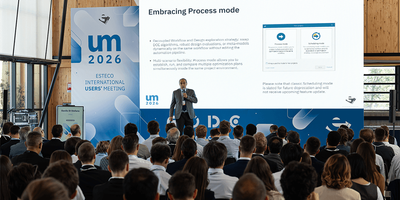
Danilo Di Stefano, Product Manager for modeFRONTIER at ESTECO, presented the latest improvements of modeFRONTIER, vendor-agnostic desktop solution for process automation and design optimization. The newly introduced connectorSTUDIO app lets engineers build custom integrations for virtually any solver and share them across their organization as portable .mfn files, alongside a redesigned Parameter Chooser with side-by-side input/output visualization and automated tagging for Python and MATLAB scripting nodes. Behind the scenes, the modeFRONTIER Planner environment is taking center stage: decoupling the engineering simulation workflow from the design exploration logic, gradually moving DOE, optimization, RSM training, and eventually post-processing into a standardized environment. On the data-driven modeling side, recent additions like the multi-fidelity RSM methodology, PyFrontier and PyRSM extensions, and reduced order models (ROM) point to a clear direction.
Accelerating design cycles with accurate Physics AI
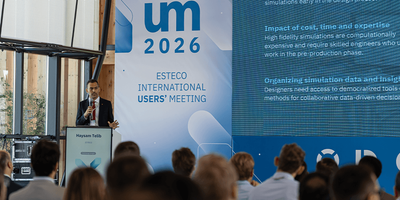
Haysam Telib, Product Manager for nDAI at ESTECO, highlighted that as product development processes shrink, automotive design cycles have dropped from three years to 18 months within a single decade. Moreover, products grow ever more complex. Engineers need faster tools that don't sacrifice accuracy. Physics AI answers this need with machine learning models that replace traditional physical solvers while preserving the same input-output relationships, letting teams work directly from CAD geometry or extract full flow fields rather than relying on simplified parameters. nDAI supports two key strategies companies use to cope with this pressure: "shift left," which brings high-fidelity tools to the earliest design stages, and "push right," which reuses decades of accumulated simulation data. At its heart sits nD Modeler, an AI/ML training app that helps teams answer the hardest questions of any AI journey:
- Which model architecture suits a given problem?
- How much data is needed to reach a target accuracy?
Designed as an agnostic collection of apps working in symbiosis with other ESTECO products modeFRONTIER and VOLTA, nDAI ultimately aims to make engineering simulation more sustainable, reduce time to market, and democratize physics AI so trained models can be shared across teams and break down the silos that slow down collaboration.
What comes next?
Our next Users’ Meetings will take place in 2027 in India and US respectively. In the meantime, if you want access to the proceedings and gain more insights on customer presentations, please contact us at marketing@esteco.com
Schedule a live demo tailored to your needs.
See modeFRONTIER, VOLTA and nDAI in action
Schedule a live demo tailored to your needs.
See modeFRONTIER, VOLTA and nDAI in action
Schedule a live demo tailored to your needs.