
Technology
Design optimization
Find better engineering solutions, faster. Our advanced optimization algorithms explore thousands of possibilities and identify solutions that traditional methods often miss.


Find the best product, faster
Our algorithms significantly reduce development costs and time-to-market. They let you easily manage hundreds of parameters and balance complex tradeoffs to identify optimal solutions — even for highly constrained designs.
What is parametric design optimization?
Parametric optimization finds the best engineering design by going beyond human intuition. It automatically adjusts input variables (parameters) to meet a defined objective — what you want to maximize or minimize — while respecting essential constraints. This systematic approach pinpoints the most effective solution set.
Find the best product, faster
Our algorithms significantly reduce development costs and time-to-market. They let you easily manage hundreds of parameters and balance complex tradeoffs to identify optimal solutions — even for highly constrained designs.
What is parametric design optimization?
Parametric optimization finds the best engineering design by going beyond human intuition. It automatically adjusts input variables (parameters) to meet a defined objective — what you want to maximize or minimize — while respecting essential constraints. This systematic approach pinpoints the most effective solution set.
How to choose the optimization algorithm
ESTECO provides a full suite of deterministic, stochastic, and heuristic algorithms for both single- and multi-objective problems.
Our smart, self-learning algorithms efficiently explore the design space, using advanced mathematics to identify optimal variable sets that meet all constraints and objectives. This significantly reduces time and computational effort. For complex challenges that involve multiple physics domains (structural, fluid, thermal, and more), our tools seamlessly support multidisciplinary design optimization (MDO).
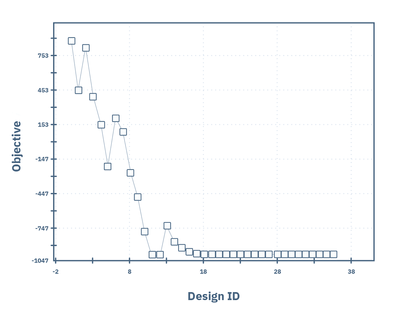
Single-objective
Optimize a single output by maximizing or minimizing its value (one best solution).
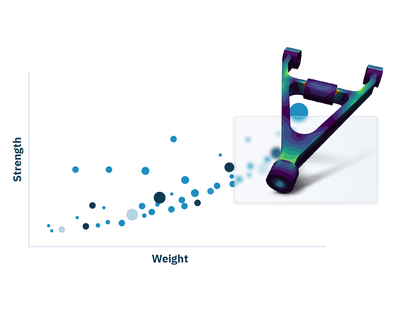
Multi-objective
Optimize multiple outputs at the same time. Objectives often conflict and the optimization produces a set of trade-off solutions (the Pareto frontier).

modeFRONTIER’s pilOPT algorithm for multiple exploration scenarios
Our proprietary algorithm acts like an autopilot, reducing your workload as the driver in optimization. With pilOPT you can:
- Combine multiple numerical investigation strategies for smart exploration of the design space.
- Use it even when there’s limited knowledge of variable behavior or problem characteristics.
- Save time and computational resources by minimizing the amount of interactions required.
Full suite of algorithms for optimization-driven design
Heuristic
Find a good, but not necessarily the absolute best, solution to a complex optimization problem quickly.
Simulated annealing
A probabilistic optimization algorithm that excels at avoiding local optima, making it suitable for complex, non-linear problems with multiple local optima.
Particle swarm
An iterative multi-objective optimization algorithm with fast convergence, making it a strong alternative to genetic algorithms when evaluations are computationally expensive.
Genetic
Designed for highly constrained problems, supporting both continuous (NSGA-II) and discrete (MOGA-II) variables.
Evolution strategy
Highly effective for continuous parameter optimization problems in non-linear search spaces.
Multi-strategy
Integrate multiple techniques to find better solutions more quickly and reliably.
MEGO
Achieves a high convergence rate and efficiency in finding the global optimum particularly for heavy simulations.
FAST
Leverages RSM performance over the region of interest in the design space, enabling the fast detection of optimal solutions.
pilOPT
A multi-strategy, self-adapting hybrid algorithm that combines the advantages of local and global search algorithms while balancing real and RSM-based optimization to explore the Pareto front.
MUSA
Adaptively combines various optimization techniques and RSMs, improving efficiency and solution quality for complex multi-objective problems.
MOGT
Effective for improving baseline configurations and handling multi-objective problems where trade-offs between objectives are important, while reducing the number of simulations.
Derivate free optimization
Use function evaluations to iteratively search for an optimal solution by building a surrogate model or using direct search techniques.
Powell
Single-objective algorithm useful for calculating the local minimum of continuous, but complex functions.
Simplex
Solves non-linear, single-objective optimization problems, even for noisy functions.
Gradient-based
Favor speed over robustness and converge to local optima rather than global solutions.
SQP algorithms
Reliable local search solutions based on sequential quadratic programming (SQP), suitable for a wide range of single-objective and non-linear programming problems.
Bounded BFGS
Single-objective algorithm for non-linear optimization problems.
Simulated annealing
A probabilistic optimization algorithm that excels at avoiding local optima, making it suitable for complex, non-linear problems with multiple local optima.
Particle swarm
An iterative multi-objective optimization algorithm with fast convergence, making it a strong alternative to genetic algorithms when evaluations are computationally expensive.
Genetic
Designed for highly constrained problems, supporting both continuous (NSGA-II) and discrete (MOGA-II) variables.
Evolution strategy
Highly effective for continuous parameter optimization problems in non-linear search spaces.
MEGO
Achieves a high convergence rate and efficiency in finding the global optimum particularly for heavy simulations.
FAST
Leverages RSM performance over the region of interest in the design space, enabling the fast detection of optimal solutions.
pilOPT
A multi-strategy, self-adapting hybrid algorithm that combines the advantages of local and global search algorithms while balancing real and RSM-based optimization to explore the Pareto front.
MUSA
Adaptively combines various optimization techniques and RSMs, improving efficiency and solution quality for complex multi-objective problems.
MOGT
Effective for improving baseline configurations and handling multi-objective problems where trade-offs between objectives are important, while reducing the number of simulations.
Powell
Single-objective algorithm useful for calculating the local minimum of continuous, but complex functions.
Simplex
Solves non-linear, single-objective optimization problems, even for noisy functions.
SQP algorithms
Reliable local search solutions based on sequential quadratic programming (SQP), suitable for a wide range of single-objective and non-linear programming problems.
Bounded BFGS
Single-objective algorithm for non-linear optimization problems.
RSM-based optimization
RSMs serve as a surrogate for heavy simulation processes, allowing engineers to run classic optimization processes faster.
- RSMs are trained from an available database of real designs and validated against one another.
- RSMs replace the engineering solver to calculate objective values for each design.
- Best designs found with RSM-based optimization are then evaluated using the real engineering solver.

Leverage modeFRONTIER to predict designs faster
Learn moreHow customers use design optimization
Our multidisciplinary design optimization platform powers innovation for engineering leaders worldwide. Customers apply it to their toughest MDO projects, achieving breakthrough products and processes.
“modeFRONTIER ticks all of the boxes: a flexible optimization tool that provides us with a wide range of state-of-the-art optimization algorithms, easy to use, allowing our engineers to be productive almost immediately. And, it’s a proven software product with a long record of successful usage.”

“modeFRONTIER enabled us to save computational time when optimizing design variables for each head impact point. Design of Experiments analysis identified the impact point No. 6 as not meeting the HIC requirements. The Multi-Objective Simulated Annealing algorithm was used to optimize the worst impact point, allowing us to find the best designs after only a few evaluations.”

"The optimization process enabled us to achieve up to 10% reduction in cab vibration."

"We trust the results we get with modeFRONTIER so much that we don’t expect to need a prototype. We go straight into production."

"Our simulation toolchain, combined with modeFRONTIER’s optimization capabilities, enabled us to evaluate 500 catalyst system designs within two weeks. Manufacturing and testing even a few prototypes would have taken months and required significant resources due to the expensive precious metals involved and additional operational costs."

Key challenges in design optimization
Potential of design optimization is sacrificed
Engineers often develop only two or three design alternatives due to time and resource constraints, relying on intuition to pick the most promising option — without verifying if it’s the best or most cost-effective solution.
Product designs are inherently complex and challenging
Optimization often requires addressing multiple disciplines, conflicting objectives, and constraints, making the design space difficult to navigate manually.
Steep learning curve for numerical methods
Selecting and configuring the right algorithms to get the best results can be complex, time-consuming and challenging for engineers.
Benefits of design optimization
Our design optimization technology leverages ESTECO’s 25 years of experience in numerical methods. We provide one-to-one support to help you apply the best strategy for your design challenge so that you can:
Eliminate guesswork by applying optimization algorithms from the earliest stages of the design process.
Harness existing CAD/CAE tools with optimization algorithms to balance conflicting design objectives.
Implement a rational decision process to evaluate trade-offs between design solutions.
Employ optimization algorithms to develop ground breaking innovative product solutions beyond the limits of human perception.
Use optimization algorithms to handle hundreds of design parameters simultaneously and quickly identify a set of optimal solutions.
Get your optimization project on the fast track by balancing the time needed to reach an optimal design with the quality of that solution.

Leverage VOLTA to democratize design exploration and optimization
Extend model-based design processes using a collaborative web framework for multidisciplinary design optimization.
VOLTA is the only SPDM solution with fully integrated design optimization capabilities. It makes design optimization accessible by combining web-based collaboration, process automation, and data management. This simplifies access for non-simulation experts and enables your teams to:
- Exchange simulation data across teams.
- Share automated MDO workflows with other subject matter experts.
- Connect simulation to the digital thread of product data.
Scale and democratize MDO workflows with VOLTA
Learn more about VOLTAFrequently asked questions
Quick answers to questions you may have.
The difference between single-objective and multi-objective optimization lies in how many goals you’re trying to optimize at once and how the platform handles trade-offs between them.
Single objective: typically, search methods are directed toward a single optimum, such as gradient‑based methods (SQP, BFGS) or metaheuristics tuned to find a single best solution (simulated annealing, single‑objective GAs).
Multi‑objective: strategies that explore and approximate a Pareto front, often using populations of solutions; classic examples are multi‑objective genetic algorithms (NSGA‑II, MOGA-II in general) or weighted sums that turn multiple objectives into a single one by varying weights/targets.
How to handle both? VOLTA integrates optimization workflows from modeFRONTIER, letting you:
- Switch between single and multi-objective modes easily within the same workflow.
- Visualize trade-offs using interactive charts and Pareto fronts.
- Compare scenarios to make data-driven design decisions collaboratively.
You can create a workflow with multiple objectives in modeFRONTIER by defining each target in the workflow editor and choosing a suitable algorithm from the optimization menu. After running the workflow, modeFRONTIER displays a Pareto front where each point represents a design with a unique trade-off between the objectives.
The best way to define constraints for design optimization is to separate what is truly non‑negotiable from what is merely desirable. Hard constraints should encode physics, safety, regulations, and absolute packaging limits: violating them would make the design infeasible, unsafe, or non‑compliant. Everything else can often be modeled more flexibly as objectives. This shift lets you explore trade‑offs instead of artificially shrinking the feasible space.
A practical workflow is to first write many candidate “constraints”, then explicitly ask for each: “Is this a must‑have or a preference?” Must‑haves stay as constraints; preferences become objectives that are minimized or maximized. In multi‑objective settings, you can even promote some traditional constraints (e.g., mass, NVH, efficiency margins) to full objectives to visualize their trade‑offs on the Pareto front and only later impose thresholds during decision making. This approach improves robustness, reduces infeasibility, and makes the design priorities much clearer.
Yes, modeFRONTIER can handle discrete and continuous variables in the same project. You can define integer, categorical and continuous design variables together and let the chosen algorithm work on a mixed encoding. In practice, discrete choices (e.g., material, gear number, topology option) are mapped to integers, while dimensions, angles or control parameters remain continuous. Evolutionary and other population‑based optimizers in modeFRONTIER are well suited for this mixed‑integer setting, and you can also build hybrid strategies where the global search explores discrete combinations while a local gradient‑based method refines the continuous variables for each configuration.
Yes, modeFRONTIER can absolutely optimize a process using Python scripts.
Python is fully integrated into the modeFRONTIER platform, making it a powerful component for both the automation of the simulation workflow and for advanced data analysis.
Two primary ways to use python in modeFRONTIER
modeFRONTIER provides dedicated tools to leverage Python for optimization and data handling:
- Python in the workflow (process automation)
You can use Python scripts as application nodes within the modeFRONTIER workflow, effectively making the script a part of the simulation chain that the optimizer controls.
- Custom simulation/analysis: the Python script can act as a solver for a custom model, perform data manipulation, or execute complex pre- or post-processing tasks that aren't handled by standard CAE tools.
- Driving external tools: a script can be used to launch and control third-party software that doesn't have a direct modeFRONTIER node, making it a wrapper for the external program.
- Input/output handling: in the workflow, the Python script node receives the design variables (inputs) from the modeFRONTIER scheduler, executes its logic, and then outputs the calculated values (objectives and constraints) back to the optimizer.
- pyCONSOLE and Python APIs (advanced data & analysis)
modeFRONTIER also offers a dedicated pyCONSOLE and Python APIs to use Python's extensive scientific and machine learning libraries directly within the platform's analytical environment.
By combining Python's flexibility with modeFRONTIER's robust optimization algorithms (like MOGA-II, NSGA-II, etc.), you gain a powerful framework for multi-objective and multidisciplinary design optimization (MDO) on processes that rely on custom code.
Experience VOLTA and modeFRONTIER software
Whether you have a question about our products, licensing options or pricing, our solution experts are here to assist you.