
Webinar
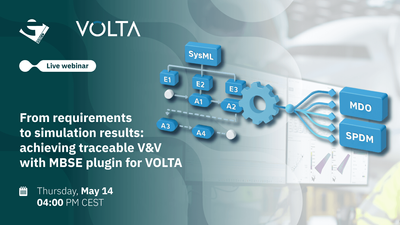
From requirements to simulation results: achieving traceable V&V with MBSE plugin for VOLTA
Watch the recording of ESTECO webinar and learn how to link SysML parametric models with physics-based simulation models for requirement verification by analysis.
eBook
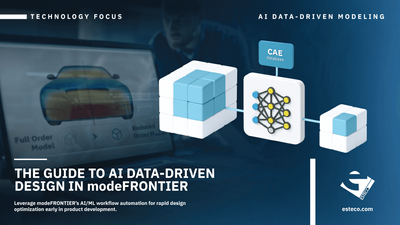
The guide to AI data-driven design in modeFRONTIER
Leverage modeFRONTIER’s AI/ML workflow automation for rapid design optimization early in product development.
White paper
The digital transformation in energy: integrating requirements, design, and simulation using a digital engineering platform
Discover how digital engineering can help your organization innovate faster, optimize performance, and support the transition toward a more sustainable energy future. Fill the form to download the white paper.
All resources
Showing 131 - 136 of 136 resources
Webinar
Coupling modeFRONTIER and Sculptor
This webinar, hosted jointly by ESTECO and Optimal Solutions, provides a demonstration of the new interface between the **modeFRONTIER and Sculptor, including some relevant case studies where the direct coupling has been used.**
Agenda:
Introduction to ESTECO and modeFRONTIER
Introduction to Optimal solutions and Sculptor
Test case introduction
The new interface between modeFRONTIER and Sculptor
Test case: DOE and Optimization studies and results for F3 Race car
Success story
Bottero innovates with optimized high performance mold-motion
Bottero innovates with optimized high performance mold-motion
Leading in the glass industry is Bottero’s declared ambition. The recent launch of E-MOC, a family of mold opening and closing mechanisms (MOC), has challenged the hollow glass industry. E-MOC introduces a completely new cooling concept, granting the possibility to achieve the proper temperature profile, according to the type of process required for the application field.
Challenge
“The innovative idea behind E-MOC design is the result of our R&D team’s work: numerous constraints were limiting the possibility of changing the machinery design, so modeFRONTIER, the multi-objective optimization platform, came to our help”, says Marcello Ostorero, Structural and Fluid Dynamics Simulation Department Manager at Bottero. The mechanism had to be equipped with a universal mold holder providing efficient cooling and, when mounted, it had to be readily accessible and installable on both new and existing machines. The optimal system performance called for a smooth and precise mold motion, with fast closing time, and maximum closing and clamping forces. ## Solution
The complexity of the problem was tackled with modeFRONTIER within two optimization cycles. The aim of the first one was to minimize mold motion oscillations. The results were then used to conduct a sensitivity analysis, which revealed the piston center movement as the most important variable for mechanism stability, but the geometrical constraints did not allow the piston to maintain the optimal trajectory. This unexpected obstacle was bypassed by replacing the single large piston with three smaller ones. In the second optimization cycle modeFRONTIER guided the model adjustments to minimize mechanism lability and oscillations, while keeping constant the newfound optimal values of component geometries and of piston center movement. ## Benefits
“Due to the intricate nature of the required mechanism, the systematic optimization approach proposed by modeFRONTIER was the only way to obtain a functioning high-performance design”, says Ostorero, “modeFRONTIER managed to find a fine balance between a high number of rigorous constraints and adjust the model geometry to the most important mechanism specifications so as to increase its efficiency and quality, while successfully driving a number of software, each solving a single aspect of the problem, integrated in a single workflow”.
Success story
Multidisciplinary collaboration made easy at Airworks Engineering
Multidisciplinary collaboration made easy at Airworks Engineering
Airworks, a multidisciplinary company for mechanical engineering, was facing the challenge of improving efficiency in the conversion of wind energy into electrical power by optimizing the whole assembly of a wind power unit rotor. ## Challenge
Experts in wind power unit, specialists in CAD (Computer Aided Design) and CFD (Computational Fluid-Dynamics) professionals from different organizations were involved in a complex design scenario and needed to collaborate by effectively sharing a different kinds of information and resources. Engineers from the University of Trieste prepared the parametric CAD model and set up CFD simulations, while Airworks took care of aerodynamic performance calculations of the wind rotor blade, and subsequently performed optimization analysis with modeFRONTIER, the multidisciplinary optimization platform. The need for a common platform to share results emerged rapidly, and was successfully tackled with SOMO software solution (now evolved in VOLTA SPDM enterprise platform). This enabled the seamless execution of inter-organizational simulation workflows. ## Solution
With SOMO each partner of the simulation workflow was able to contribute to the project providing its own high level of collaboration. The CAD expert generated the geometry of the blades providing a parametric model and the CAD solution used to update it, while the CFD expert set up the aerodynamic simulation model, which used the geometry to evaluate the rotor aerodynamic performance. Both simulation workflows were made available to partners in a shared repository. Then the wind power unit expert was able to integrate his performance evaluation software into an automated multi-disciplinary workflow. Ultimately he used the workflow to evaluate the power efficiency of the system and to optimize it in a complete range of environmental conditions. ## Benefits
Through the entire process, simulation data and engineering knowledge were effectively managed and shared through SOMO, allowing a faster process and a considerable resource-saving”, says Stefano Picinich, Airworks Engineering Managing Director. With the set up of the optimization workflow, Airworks professionals were able to explore and evaluate new parametric geometry, leading to innovative designs, analyzed by the decision-maker via the post-processing tools. The considerable result was of a wind turbine design with an outstanding power coefficient and an annual energy production increase of respectively 1.26% and 0.47%.
Webinar
Using modeFrontier-TurboOPT II integration node to run FEA and CFD optimization studies
In this webinar, experts from CN and ESTECO gives a short presentation of the two software packages and demonstrate the process of integrating a TurboOPT II model with modeFRONTIER.
Watch the webinar to learn more about the following 3 test cases:
Axial fan blade section optimization using AxCent® and Pushbutton CFD® analysis
Centrifugal pump multi-disciplinary optimization (MDO) with CFD and at design and off design conditions
MDO of a compressor third stage impeller using CFD and FEA analysis
Success story
Optimization Wins the Race Against Time at Polestar
Improvements in weight, aero-dynamics and brake distribution led to a lap time reduction ranging from 0.19 to 0.50 seconds
Polestar Racing has been using modeFRONTIER in different steps of the development of the “Polestar Performance” concept. The software is used both as a tool for driving the aerodynamics, multibody and structural analysis process, and to improve the real lap time simulation. In 2012 Touring Car Team Association (TTA) championship, Polestar Racing won the first prize for the Drivers, Teams and Manufacturers categories with their innovative car design. ## Challenge
The 2012 season of the Racing Elite League run by TTA introduced new rules leaving little room for engineering design changes. Therefore, the Polestar Racing vehicle model had to be modified without considering the chassis design parameters, which were previously the core of the optimization analysis. Design simulation acquired an even greater importance as the best combination of the Front-to-Rear weight, aerodynamics and brake distribution in less time (track testing was limited to three days) became the new target. ## Solution
The simulation tools used - Adams.Car by MSC Software and the Lap Time Simulation (LTS) in-house code - were easily integrated into the modeFRONTIER optimization workflow, to optimally tune the Front-toRear weight distribution parameters. “Considering the limited amount of time we have had for testing in this championship” – says Per Blomberg, Manager of Chassis Development – “this kind of interrelated parameters study would not have been possible without the capability of modeFRONTIER to extend the simulation analysis ”. Improvements in weight, aerodynamics and brake distribution led to a lap time reduction ranging from 0.19 to 0.50 seconds. ## Benefits
In only a few hours of simulation time modeFRONTIER piloted the evaluation of parameter combinations that might have never been tested, leading to enhanced configurations. The optimization framework initially set up for the TTA championship can be promptly adapted to the typical circuits of the STCC championship. Repeating the study considering different conditions is now “something that we can do even overnight on a weekend race , once we have completed the trial session and gathered some data about the track model”. Similarly, it is rather easy to run a new optimization cycle even with modified conditions, such as the driver, tires, and so forth: once the relevant parameters in the LTS vehicle model (e.g. engine or track model) are set, modeFRONTIER performs a robust sensitivity verification of the output (lap time) in relation to different vehicle parameters.
Success story
Bombardier uses modeFRONTIER to optimize high-speed trains
Bombardier reduces aerodynamic drag by 20% and saves about the 10% of energy consumption with modeFRONTIER
“Rail transportation is a concrete eco-friendly solution for sustainable mobility. Therefore, if we decrease the aerodynamic resistance of our trains, we can increase energy efficiency and further reduce CO2 emissions”, says Alexander Orellano, Head of Aerodynamics at Bombardier, world leader company in aerospace and rail transportation. ## Challenge
Reducing energy consumption implies optimizing the aerodynamic shape of a vehicle, thus inevitably facing two main opposing factors: the best models for drag do not have a good crosswind stability, and viceversa. In addition, high passenger capacity conflicts with optimal aerodynamic shape and elegancy and functionality not always go hand in hand. These are some of the reasons that made Bombardier choose modeFRONTIER, the multi-objective, multi-disciplinary optimization platform, for their award-winning ZEFIRO 380 train design. ## Solution
“The application of the multi-objective optimization method to Bombardier high-speed trains leads to a highly competitive product, entailing both to energy efficiency and cost reduction, due to a lower traction power dimensioning”, declared Mr. Orellano. The goal was to find a Pareto-optimal, or trade-off, design which would simultaneously give low drag and good cross-wind stability characteristics. The solution was obtained using modeFRONTIER, not only to integrate the various CAE tools in use at Bombardier, but also to drive the geometry modification and simulation process providing the necessary graphical tools for the statistical interpretation of results. modeFRONTIER, de-veloped by ESTECO, uses genetic algorithms to determine Pareto optimal solutions, combining 3D models and simulations of aerodynamic drag and crosswind stability. Bombardier experts considered as many as sixty different design parameters in the modeling phase, taking into account the train’s outer shell, cab, crash structure and ergonomic constraints. ## Benefits
The company was therefore able to reduce the aerodynamic resistance by 20%, obtaining a decrease of energy consumption of about 10%. By using modeFRONTIER, Bombardier engineers were able to choose from a selection of designs in order to suit particular styling preferences, but secure in the knowledge that each complies with the principles of optimized energy performance and maximum stability and safety.