
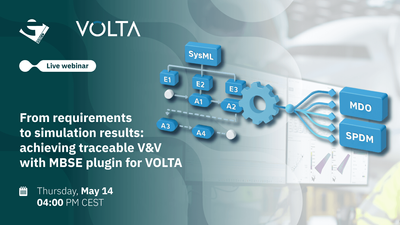
Webinar
From requirements to simulation results: achieving traceable V&V with MBSE plugin for VOLTA
Watch the recording of ESTECO webinar and learn how to link SysML parametric models with physics-based simulation models for requirement verification by analysis.
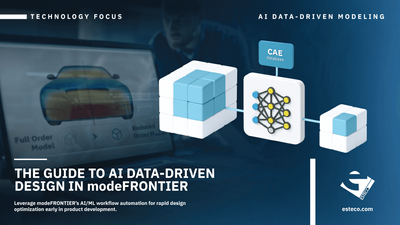
eBook
The guide to AI data-driven design in modeFRONTIER
Leverage modeFRONTIER’s AI/ML workflow automation for rapid design optimization early in product development.
White paper
The digital transformation in energy: integrating requirements, design, and simulation using a digital engineering platform
Discover how digital engineering can help your organization innovate faster, optimize performance, and support the transition toward a more sustainable energy future. Fill the form to download the white paper.
Search results for "modeFRONTIER"
Showing 11 - 20 of 44 results
Success story
BASF Catalysts solutions meet exhaust emissions standards with modeFRONTIER
Using modeFRONTIER to optimize exhaust aftertreatment systems
BASF’s Catalysts division is the world’s leading supplier of environmental and process catalysts. Responding to a request from a customer - a truck manufacturer - BASF researched to provide an alternative technology capable of reducing catalysts costs and improving the performance of the current Euro VI production exhaust aftertreatment system. BASF proprietary exhaust simulation models were integrated in modeFRONTIER software, with the aim of optimizing the operational parameters for accurate emissions prediction. ## Challenge
The global automotive industry faces enormous challenges from increasingly tightening emissions legislations. Regulatory differences between European, Asian and American markets enhance complexity while vehicle manufacturers are constantly seeking to reduce development cycle times. There is a continuous demand for efficient strategies to develop cost effective solutions that meet regional emissions regulations. As a result, simulation techniques for exhaust aftertreatment system has gained popularity. Engineers at BASF focused on developing a model-based simulation for an exhaust system comprising a diesel oxidation catalyst in order to investigate the trade-off between cost and catalytic performance. Besides the minimization of the tailpipe NOx emissions by simulating a transient homologation cycle (WHTC), several functionalities of the oxidation catalyst like NO and hydrocarbon oxidation needed to be optimized in parallel. ## Solution
An effective model based development toolchain was developed building upon BASF proprietary exhaust catalyst models to simulate accurate emissions prediction. Four catalyst design parameters, considered as major cost drivers, were investigated in modeFRONTIER multiobjective optimization platform. As a first step, performing Design of Experiments (DOE) analysis allowed to identify the most important parameters and explore sensitivity of the system performance. Consequently, the optimization task was driven by the MOGA-II, the genetic algorithm included in modeFRONTIER, to minimize catalyst cost and tailpipe emissions. ## Benefits
“Our simulation toolchain combined with modeFRONTIER optimization capabilities led to evaluate 500 catalyst system designs within two weeks. Manufacturing and testing few prototypes would have taken us months and significant resources due to the expensive precious metals incorporated and additional operational costs. Despite the large amount of data, modeFRONTIER allowed to quickly rationalize and visualize results in a smart and efficient way. The Parallel Coordinate Chart enabled us to identify the suitable prototype candidates capable to exactly match particular cost and performance targets based on customer preferences. We look forward to demonstrating the benefits of the toolchain for other customer applications” said Dr. Stefan Kah, responsible for Application Engineering Modeling at BASF Catalysts Germany GmbH.
Success story
modeFRONTIER helps Azimut Benetti optimize yacht propeller performance
Using modeFRONTIER to perform multi-objective cavitating propeller optimization
Azimut Benetti Group is the world’s largest network producing megayachts and leading private group in the luxury yacht industry. Azimut-Benetti’s R&D Centre develops unique technologies, for an effortless and safe navigating experience. The Naval Architecture and Marine Engineering Unit (DITEN Department) of Genoa University work jointly with DETRA Custom Propellers and Azimut Benetti’s R&D Centre, using modeFRONTIER to optimize the design of a custom propeller for a high- speed Azimut Benetti 95 RPH yacht. ## Challenge
The design of a propeller is always a trade-off between competing objectives and constraints: maximizing the propulsion efficiency and ship speed while avoiding cavitation and maintaining a sufficient blade strength. The traditional lifting line / surface methodologies define the propeller shape by including simplified geometric assumptions that make them not suitable for modern fast propellers design. The application of more accurate flow solvers and the automatic investigation, possible through the parametric description of the geometry (unconventional combinations of pitch, camber, or, for instance, local hydrofoil shapes), proves to be a successful design alternative for a high-speed propeller. ## Solution
Following this new approach, the optimization of a reference propeller with modified rake distribution was driven by the MOGA-II, the genetic algorithm included in the automation workflow in modeFRONTIER. The experimental data collected at the cavitation tunnel confirmed the reliability of both the Boundary Elements Method and RANSE numerical approaches.
A dedicated full-scale sea trials, performed with propellers manufactured by Detra, showed that the cruise speed achieved with the optimized propeller is 1 kn higher than the baseline propeller speed, geometry by while the cavitating behavior was also significantly enhanced. “The result is remarkable, especially keeping in mind that the increase of cruise speed, together with the enhancement of comfort onboard, is crucial to the perception of luxury yacht customers”, said Francesco Serra, R&D Office, Azimut Benetti Group. ## Benefits
modeFRONTIER helped build an optimization framework to interact with the parametric description of the geometry to define each new blade shape and employ flow solvers to quantify how each propeller fulfills the constraints and the objectives of the design. “Starting from a set of 48 blade parameters to alter the reference propeller geometry, the use of MOGA-II algorithm allowed to compute and test 50,000 different geometries in about 5 days to achieve a satisfactory Pareto convergence and choose optimal candidates (one for any rake distribution) for RANSE analyses” said Michele Viviani, Associated Professor at DITEN Department, Genoa University.
Success story
Best performance of blast furnace with material charge optimization
Using modeFRONTIER coupled with Rocky DEM to design a better deflector while saving up to 130 hours of computational time
The Arvedi Group turned to the University of Trieste to find a solution to the uneven material distribution inside the hopper of the blast furnace in Trieste, Italy. The Mechanical Engineering Department investigated the problem and used modeFRONTIER to optimize the design of a new deflector ensuring a better distribution of the materials. Exploiting the ESTECO integration and process automation technology they coupled modeFRONTIER with Rocky DEM software to accelerate the simulation process of the material distribution. Using the proprietary algorithms available in modeFRONTIER, they were also able to find the optimal design for a new deflector. ## Challenge
The project concerned the charging process of coke coal and iron ore inside the hopper. The different materials formed piles and pitches, leading to a lower performance of the plant. The uneven material distribution inside the hopper caused variations in the temperature profile, gas flow, and gas composition. To solve this problem modeFRONTIER was coupled with Rocky DEM to get a better understanding of materials behavior and optimize the design of the deflector. The integration with modeFRONTIER also allowed to meet the time constraints, reducing the computational time for each simulation. ## Solution
This project was developed in two phases. The first phase concerned the calibration of Rocky DEM parameters and the simulation of hopper charge. The second phase consisted in optimizing the geometry of a new deflector for the charging process.For the calibration process, they used the parameters of Discrete Element Method as inputs in modeFRONTIER, such as particle- particle static friction and rolling resistance. The repose angle of simulated material was used as output. For the device optimization, a sensitivity analysis with Uniform Latin Hypercube allowed to run 90 designs and identify the most important design variables. Engineers then optimized three different geometries, taking these geometrical variables as inputs. The outputs were based on the material distribution, calculated by virtually splitting the hopper into 12 sectors and performing statistical analysis on the particles found in each. These values were used to define the two objectives and the constraints of the optimization. They used the ESTECO proprietary pilOPT algorithm to run the three optimization studies. Thanks to the autonomous mode they could evaluate more than 1000 designs in just a few weeks, without having to set any parameters and with remarkable benefits in terms of time.
Benefits
Thanks to a user-friendly graphical user interface, modeFRONTIER helped automate the simulation process. Without modeFRONTIER, engineers would have had to manually change the geometry of the deflector for every simulation, with significant waste of time. With modeFRONTIER they were able to save up to 130 hours of computational time. Finally, by automating the process, design engineers could launch the optimization and avoid the painstaking process of manually combining the output from multiple applications.
Success story
Bottero innovates with optimized high performance mold-motion
Bottero innovates with optimized high performance mold-motion
Leading in the glass industry is Bottero’s declared ambition. The recent launch of E-MOC, a family of mold opening and closing mechanisms (MOC), has challenged the hollow glass industry. E-MOC introduces a completely new cooling concept, granting the possibility to achieve the proper temperature profile, according to the type of process required for the application field.
Challenge
“The innovative idea behind E-MOC design is the result of our R&D team’s work: numerous constraints were limiting the possibility of changing the machinery design, so modeFRONTIER, the multi-objective optimization platform, came to our help”, says Marcello Ostorero, Structural and Fluid Dynamics Simulation Department Manager at Bottero. The mechanism had to be equipped with a universal mold holder providing efficient cooling and, when mounted, it had to be readily accessible and installable on both new and existing machines. The optimal system performance called for a smooth and precise mold motion, with fast closing time, and maximum closing and clamping forces. ## Solution
The complexity of the problem was tackled with modeFRONTIER within two optimization cycles. The aim of the first one was to minimize mold motion oscillations. The results were then used to conduct a sensitivity analysis, which revealed the piston center movement as the most important variable for mechanism stability, but the geometrical constraints did not allow the piston to maintain the optimal trajectory. This unexpected obstacle was bypassed by replacing the single large piston with three smaller ones. In the second optimization cycle modeFRONTIER guided the model adjustments to minimize mechanism lability and oscillations, while keeping constant the newfound optimal values of component geometries and of piston center movement. ## Benefits
“Due to the intricate nature of the required mechanism, the systematic optimization approach proposed by modeFRONTIER was the only way to obtain a functioning high-performance design”, says Ostorero, “modeFRONTIER managed to find a fine balance between a high number of rigorous constraints and adjust the model geometry to the most important mechanism specifications so as to increase its efficiency and quality, while successfully driving a number of software, each solving a single aspect of the problem, integrated in a single workflow”.
Success story
Optimizing a perfect race engine. ESTECO Academy Design Competition winner
modeFRONTIER enabled Michael Bambula of the University of Florida to run the workflow, integrate third-party software, automate the design exploration process and perform post-process analysis.
The winner, Michael Bambula of the University of Florida, presented a top-notch design project, in which he achieved significant performance improvements (64.2 hp @16500 rpm) while developing a complete model for a Moto3 bike and realistic simulations that also considered the specifics of the race track. Organized in partnership with Aprilia Racing and Gamma Technologies, the competition was open to teams of undergraduate and graduate engineering students. The challenge was to improve the design of a 4 stroke single cylinder engine through multidisciplinary optimization (using modeFRONTIER) and 1-D simulation of the engine system with GT-SUITE. The competition award included an internship opportunity at the APRILIA Racing team, which counts several World Championship Awards. The goal of the project was to maximize engine power. Due to the constrained engine architecture, an optimization of the Intake/Exhaust system was performed. Gamma Technologies supplied a set of simulation tools (GT-Suite) to develop the 1-D model of the high-performance engine. Various aspects of the base engine architecture were constrained such as Bore, Stroke, Con Rod Length, Engine Speed, Max Valve Diameters, Max Valve Lift, Max Throttle Diameter, Max Compression Ratio, Non-variable Cam Timing, and Naturally Aspirated. Considering these constraints, the optimization of the cylinder filling (Wave Dynamics) was seen as the logical design direction. modeFRONTIER workflow was used to automate the design exploration process and integrate Excel and GT-Suite for computing lifts value intake and exhaust valve lift profiles and simulating the engine power output. During the development of the 1-D Engine Model there were inherently many unknowns, therefore Michael made assumptions supported by rigorous research. The design variables related to the intake/ exhaust system were automatically found by modeFRONTIER to optimize the output results: sum of engine power across engine speeds speeds from lowest to highest respectively (11500 rpm to 17500 rpm). “modeFRONTIER ran 1000 different designs that varied the input parameters.
The Hybrid Algorithm did an amazing job at finding the optimum solutions based on the objective of maximizing the engine power” said Michael Bambula, University of Florida Racing Team. “The analysis went beyond just determining the most powerful engine”, continued Bambula, “in fact the final objective, aimed at determining whether a certain design is sufficient for motorsports, was to compare it to lap times. This is why it was decided that the final group of optimum results from modeFRONTIER would be simulated in OptimumLap software considering, among other assumptions, a Moto3 motorcycle model traversing the Phillip Island Grand Prix Circuit in Australia”.
Success story
A brighter future for TRE solar technology
Optimized heating plate dramatically improved long-term DSSC performance
TRE (Tozzi Renewable Energy), a producer of renewable energy, was looking to improve the long-term stability of its photovoltaic Dye-Sensitized Solar Cells (DSSC) - widely considered the next generation solar cells - under development by TRE start-up company Daunia Solar Cell. Compared to the current generation, DSSCs are cheaper to produce, work well in low-light conditions and are suitable for most engineering applications. They are particularly well suited to architectural applications where aesthetics are important, offering design choices that were previously unavailable (i.e. color and transparency). However, the issue of unconfirmed long-term DSSC stability was standing in the way of satisfying stringent manufacturing certification standards. ## Challenge
In terms of commercialization, stable performance over time is crucial. With long-term stability dependent on the quality of the sealing process and the quality of the sealing process dependant on uniform heat distribution over the heating plate surface, one of the main objectives was to improve thermal uniformity. Using modeFRONTIER optimization software, TRE was able to change the heating plate design and achieved optimal thermal distribution, guaranteeing an effective sealing process. ## Solution
The solution involved a two step process. In the first step, ANSYS Workbench was used to create a CAD (Computer Aided Design) model representing the initial heating plate configuration based on experimental data. This data was the basis for an FE (Finite Elements) model, required for performing transient thermal analysis. This served to find the materials that would perform best in the optimization run and reach the optimization objective. This procedure was necessary to establish the right setup and validate the computation procedure based on the real reference model.
The second step involved deploying the modeFRONTIER optimization platform to modify geometric parameters, increase the thickness of the insulating refractory and the dimensions of the heating coils. modeFRONTIER simulations generated over 250 candidate designs before pinpointing the best design and the optimal time required for the heating process to achieve proper sealing ## Benefits
modeFRONTIER thoroughly explored the design space before converging to the optimal heating plate configuration which now distributes heat evenly across the entire surface, directly impacting sealing process quality and ultimately improving long-term DSSC stability. Furthermore, by automating the entire design optimization process with modeFRONTIER, TRE successfully managed to improve the quality of the heating plate, saving both time and money. As Alessio Antonini, Technology Manager of Daunia Solar Cell says, “Thanks to modeFRONTIER, the operator no longer needs to take a trial and error approach to simulations, but rather can use the “artificial intelligence” of the optimization method to automatically seek and find the best combination of input parameters”.
Success story
Optimization Wins the Race Against Time at Polestar
Improvements in weight, aero-dynamics and brake distribution led to a lap time reduction ranging from 0.19 to 0.50 seconds
Polestar Racing has been using modeFRONTIER in different steps of the development of the “Polestar Performance” concept. The software is used both as a tool for driving the aerodynamics, multibody and structural analysis process, and to improve the real lap time simulation. In 2012 Touring Car Team Association (TTA) championship, Polestar Racing won the first prize for the Drivers, Teams and Manufacturers categories with their innovative car design. ## Challenge
The 2012 season of the Racing Elite League run by TTA introduced new rules leaving little room for engineering design changes. Therefore, the Polestar Racing vehicle model had to be modified without considering the chassis design parameters, which were previously the core of the optimization analysis. Design simulation acquired an even greater importance as the best combination of the Front-to-Rear weight, aerodynamics and brake distribution in less time (track testing was limited to three days) became the new target. ## Solution
The simulation tools used - Adams.Car by MSC Software and the Lap Time Simulation (LTS) in-house code - were easily integrated into the modeFRONTIER optimization workflow, to optimally tune the Front-toRear weight distribution parameters. “Considering the limited amount of time we have had for testing in this championship” – says Per Blomberg, Manager of Chassis Development – “this kind of interrelated parameters study would not have been possible without the capability of modeFRONTIER to extend the simulation analysis ”. Improvements in weight, aerodynamics and brake distribution led to a lap time reduction ranging from 0.19 to 0.50 seconds. ## Benefits
In only a few hours of simulation time modeFRONTIER piloted the evaluation of parameter combinations that might have never been tested, leading to enhanced configurations. The optimization framework initially set up for the TTA championship can be promptly adapted to the typical circuits of the STCC championship. Repeating the study considering different conditions is now “something that we can do even overnight on a weekend race , once we have completed the trial session and gathered some data about the track model”. Similarly, it is rather easy to run a new optimization cycle even with modified conditions, such as the driver, tires, and so forth: once the relevant parameters in the LTS vehicle model (e.g. engine or track model) are set, modeFRONTIER performs a robust sensitivity verification of the output (lap time) in relation to different vehicle parameters.
Success story
Takenaka Corporation automates simulation based architectural design
Takenaka Corporation offers comprehensive services worldwide across the entire spectrum of space creation from site location and planning to design and construction as well as building maintenance. Recently, structural engineers and computational architects at Takenaka Corporation Technical Research Institute have started to apply an optimization-driven design approach in their architectural and engineering projects with the aim of exploring and obtaining innovative design solutions in a shorter time. They chose modeFRONTIER software to optimize the 3D model of a new complex-shaped office building in Osaka, Japan. ## Challenge
Responding to a request of a client - a steel manufacturer - asking for a new office building featuring their fabrication technologies, Takenaka Corporation designed a steel pavilion-like office building which also facilitates and accelerates the communication between employees. Several requirements were considered to perform parametric studies on 3D building models: from maximizing the connections between rooms and expanding office space to designing a stunning atrium. Facing these challenges by manually conducting simulations is quite time-consuming, leading to delays in project schedules. Architects at Takenaka Corporation look at multi-objective optimization as an effective methodology to quickly generate creative and innovative designs while meeting client’s expectations ## Solution
The shape of the building was generated through the 3D Voronoi component available in Rhino3D/Grasshopper. The 3D geometry was integrated in modeFRONTIER workflow to automatically adjust the Voronoi parameters and slab levels, with the aim of optimizing conflicting outputs of the model (area of rooms, floor heights, connection between rooms, angle of surfaces) while also considering required room area and floor height as constraints. After performing an initial Design of Experiments (DOE) to assess the correlation between slab levels and other parameters, the optimization process was guided by the pilOPT algorithm available in modeFRONTIER to maximize the connection between rooms, minimize the sharp angle surfaces of office area and maximize the sharp angle surface of the hall. ## Benefits
“With modeFRONTIER, we run and evaluate 3000 designs in just one day instead of losing weeks doing it manually. Moreover, the easy to use interface and data analysis & visualization tools enabled our designers to process the results faster and select their favorite designs for further studies. Finally, we look forward to demonstrating the potential of combining modeFRONTIER workflow with BRAIN, our in-house structural design software that we use in most of our projects” said Takuma Kawakami, Structural Engineer and Computational Architect at Takenaka Corporation.
Success story
The best compromise between stress and weight at SACMI
Optimization time dropped from 20 to 4 days, with a 44% safety improvement
SACMI is a global OEM (Original - Equipment - Manufacturer), market leader in the production of machines and complete plants for the Ceramics, Packaging (Beverage and Closures&Containers), Food and Plastics industries. ## Challenge
Among other machines, the SACMI packaging division manufactures the Compression Molding Machine (CCM) able to transform plastic resin pellets into semi-finished caps. During the injection phase, a pneumatic piston allows for the melted pellet to be injected inside the mold. The piston is subject to a high acceleration rate and continuous collisions which call for a compromise between stress and weight, in order to limit the risk of failure. ## Solution
The goal of the analysis was to find a light but strong piston geometry in order to improve the Compression Molding Machine performance in terms of tensile and yield strength. The first optimization study was carried out manually for a 12mm piston, while the second study on a 16mm piston took advantage of modeFRONTIER multidisciplinary optimization platform by capturing the piston model, previously created in Solidworks and analyzed in Ansys Workbench, and improving the geometry and performance. Piston geometry modifications led to a 33% safety index increase in the case of manual analysis and 44% in the case of the model optimized with modeFRONTIER. ## Benefits
modeFRONTIER enabled the CAE expert to exploit his original inspiration - which led to an improved piston geometry - by evaluating a higher number of configurations (+240%) in less time and by further enhancing the safety performances. The time for the optimization process dropped from 20 to 4 days, 3 of which were required for manual setup and 1 for automated evaluation. “I wasn’t an experienced modeFRONTIER user - says Andrea Minardi, CAE specialist at SACMI Packaging Division- so I found the Optimization Wizard very useful: it supported the choice of the number of designs, of the algorithm and of the number of iterations according to the time available for the whole analysis.” The automation of the design optimization process allowed to consider a wider range of possibilities and to analyse in depth the influence between the design parameters and the objectives.
Success story
IVECO S-WAY truck: perfecting cab design to maximize driving comfort
IVECO relies on ESTECO technology to innovate its simulation-driven product development process. IVECO engineers combine the use of CAD and CAE solvers within modeFRONTIER workflow to automatically execute parametric simulations across a wide spectrum of disciplines: structural calculation (crash, durability, strength), fluid dynamics, NVH (Noise, Vibration, Harshness) and vehicle dynamics. On top of the automated simulation process, they apply optimization algorithms to achieve better vehicle designs with increased performance at reduced production costs. ## Challenge
The IVECO S-WAY is a complete transport solution which provides excellent life on board conditions to drivers. With a brand-new cab designed to enhance aerodynamic performance and increase fuel efficiency, engineers at IVECO had to completely rethink the suspension system to improve the comfort standard level. In fact, one of the main challenges of the project was to evaluate the cab comfort before the construction of any prototype. Consequently, they made use of multi-body simulation and optimization techniques to verify the overall behavior of the cab by defining the correct set of stiffness and damping parameters for the suspension elastic components.
Solution
A 3D truck model was generated in MSC Adams/Car to simulate the behavior of mechanical components (cab body, suspension, actuator, tractor and trailer frame) on different proving grounds as pave, patched asphalt and speed bump. The simulation model was directly integrated in modeFRONTIER workflow to automatically tune the suspension properties, with the aim of optimizing output parameters related to vibration, cab movements and comfort. An initial Design of Experiments (DOE) analysis allowed to identify the correlation between design variables and system responses, with the aim of simplifying the multi-body simulation model to be further validated in the optimization process. Finally, the MOGA-II algorithm, available in modeFRONTIER, enabled engineers to pick the right designs with minimized cab vibration on different paths.
Benefits
“We took advantage of modeFRONTIER software solution to automatically execute a huge number of simulations and evaluate thousands suspension system designs within few weeks. The Parallel Coordinate Chart enabled us to easily plot several variables and visualize the distribution of the designs in an effective manner. The optimization process led us to achieve up to 10% reduction in cab vibration compared to the baseline. Moreover, the results achieved with modeFRONTIER allowed us to identify specific properties of dampers, springs and bushes that have been considered during the prototype phase of the IVECO S-WAY truck development” said Andrea Morello, Performance Engineer and CAE Senior Analyst, IVECO - CNH Industrial.