
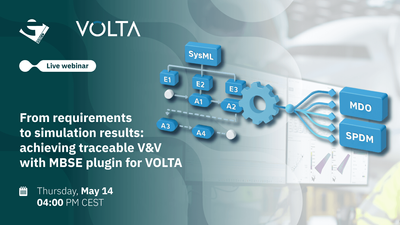
Webinar
From requirements to simulation results: achieving traceable V&V with MBSE plugin for VOLTA
Watch the recording of ESTECO webinar and learn how to link SysML parametric models with physics-based simulation models for requirement verification by analysis.
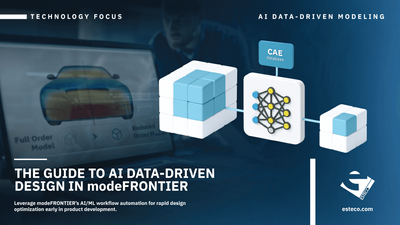
eBook
The guide to AI data-driven design in modeFRONTIER
Leverage modeFRONTIER’s AI/ML workflow automation for rapid design optimization early in product development.
White paper
The digital transformation in energy: integrating requirements, design, and simulation using a digital engineering platform
Discover how digital engineering can help your organization innovate faster, optimize performance, and support the transition toward a more sustainable energy future. Fill the form to download the white paper.
Search results for "modeFRONTIER"
Showing 1 - 10 of 44 results
Success story
Keeping it cool with modeFRONTIER
The optimization platform helped the BMW team create a reliable transient cooling system model
When it comes to reducing fuel consumption, one effective strategy is to improve the performance of an engine’s transient cooling system. The Diesel Engine Development Department at BMW used modeFRONTIER to optimize engine parameters related to the cooling system and to support the validation steps for the newly updated thermal model, in this way determining an accurate framework for comparing and optimizing different cooling packages.
Challenge
In order to identify better configurations for the transient cooling system of the six cylinder/225kW diesel engine, the team of BMW engineers developed the air side and coolant circuit model using Kuli, supported also by 3D-CFD simulations. To validate the model, measurements were taken of two different driving cycles and load step on the test bench. After comparing the coolant heat balance for oil and water circuits in the vehicle and on the test bench, results showed significant differences, even for very similar engine operating points. In particular, the wind speed impacting the crankcase, the oil pan and the cylinder head beside the actual thermal conditions under the vehicle hood are difficult to precisely determine on the test bench, affecting the reliability of related transient cooling simulations. To increase confidence in the reliability of such simulations, the engine model was refined to reduce measurement divergence observed during validation tests. ## Solution
The coolant circuit and the air path models represented in the engine model included two main groups of key parameters requiring enhancement: five heat transfer coefficients and four heat capacities. modeFRONTIER allowed the engineers to set up an effective optimization workflow that was capable of automatically interacting with the Kuli engine model and detecting the optimal configuration for the nine parameters. Günther Pessl, Head of Simulation at BMW says that “the easy-to-build integration between the two software enabled faster identification of the best heat transfer coefficients and thermal inertia in the engine analyzed.” When transferring the test bench model to the real vehicle model, some parameters indicated fluctuations during the validation cycles, especially oil temperatures which showed the biggest deviation during the hill climb. “Thanks to the optimization loop performed on the hill climb cycle, the engine parameters were refined, resulting in a significant improvement in accuracy measured on the Miramas BMW test track” says Günther Pessl. ## Benefits
modeFRONTIER helped the BMW team create a reliable transient cooling system model, compliant with new testing guidelines and accurate enough to be reused for comparing and optimizing different cooling packages. The software contributed to a significant reduction in oil temperature and coolant side model errors and improved related temperature trends. Additionally, the automation capabilities of modeFRONTIER together with its powerful optimization algorithms, enabled automatic fine tuning of the parameters that supported and shortened the model validation steps.
Success story
Hybrid rocket lifts off with modeFRONTIER
modeFRONTIER helped the team meet multiple structural constraint and significantly reduce the rocket weight.
Since the early 2000s, the Hybrid Propulsion Team at the University of Brasilia has been a pioneer in the development and test of hybrid rocket engines and small sounding rockets. By following a system design approach based on the multidisciplinary optimization technique, the Team has developed a conceptual hybrid rocket motor, attaining a valuable technological option for the reentry maneuvering system of SARA, the reusable satellite designed by the Brazilian Institute of Aeronautics and Space. ## Challenge
Solid and liquid rocket propulsion systems are traditionally considered the most convenient technological solution for deboost motor systems. Owing to the improvements in solid fuel regression rates, hybrid propellant rocket engines represent a valid alternative. The team analyzed three different propulsion settings, combining the paraffin as solid fuel with cold gas fuel, thereby responding to the SARA reentry procedure requirements. The final design should meet both the geometric constraints, linked to total mass limitation and the performance indicators for the mission: deboost impulse should produce a deceleration ranging from 235 to 250 m/s and the motor burning. ## Solution
The Team took in account the key parameters impacting the performance of the hybrid engine: grain configuration, combustion efficiency, oxidizer tank pressure and nozzle configuration together with geometrical configuration. The two-step sensitivity analysis performed with modeFRONTIER - dedicated tools led to the selection of the variables showing significant dependencies with design constraints and objectives. These key elements were brought together to build a workflow capable of both preserving the simplicity of hybrid propulsion systems. This automatic framework drove the search for the geometric configuration, yielding to the higher mass reduction for each of the three configurations. “The routine piloted by the modeFRONTIER® workflow helped generate, evaluate and select design alternatives along the optimization process, resulting in lighter engines than the liquid and solid motors previously studied.” said Manuel Nascimento Dias Barcelos, head of the Hybrid Propulsion Team. ## Benefits
modeFRONTIER streamlined the design effort conducted for the hybrid propellant engines based on liquefying fuel (solid paraffin) and two different gas fuels: H2O2 and self-pressurizing N2O. The estimated mass of the reentry system for the cases addressed in the study varied from 22 to 29 kg, lower than either liquid bipropellant or solid engines formerly proposed. “The optimization process discussed in this work can be considered an essential tool for the preliminary phase design of hybrid rocket propulsive systems”, concluded Manuel Nascimento Dias Barcelos.
Success story
Honda enhances pedestrian protection with modeFRONTIER
Using modeFRONTIER to minimize crash deformation of an aluminum hood
Honda Automobile R&D Center strives to fulfil their social responsibilities as an automaker with respect to environmental conservation, safety and quality assurance. Among these challenges, engineers at Honda employed modeFRONTIER software solution to find the optimal vehicle aluminum hood configuration in order to reduce pedestrian head injuries caused by car collisions. ## Challenge
Japanese traffic accident statistics show that more than a thousand of fatalities occur every year mainly due to head injuries. The European New Car Assessment Program (Euro NCAP) is widely used to evaluate pedestrian head protection with impacts against vehicles. In addition, car manufacturers are required to reduce vehicle weight to meet CO2 emissions standard. As a result, they have increased the use of aluminum hood which guarantees 40% of weight reduction compared with steel. However, this normally demands a longer crash deformation for pedestrian protection because the energy absorption characteristics is lower than steel (low inertia and stiffness). Accordingly, aluminum requires increased clearances under the hood together with further restrictions in terms of layout structure. Combining pedestrian protection and weight reduction became a key challenge in the car industry. Engineers at Honda, focused on building an aluminum hood capable of reducing crash deformation and achieving five-star Euro NCAP for head protection. ## Solution
Starting from a conventional aluminum hood with many large holes, the panel has been filled and impressed with truncated cones to increase mass and stiffness. An optimization process was created in modeFRONTIER workflow to perfect the inner embossed aluminum hood for 9 head impact points defined by Euro-NCAP. modeFRONTIER allowed to refine 15 design parameters (mainly related to mass and stiffness) to minimize the impact deformation, and automate the interaction between different simulation solvers. CATIA was used to modify the shape, while ANSA solver generated the mesh for head impact simulation performed by LS-DYNA solver. The results were then processed in LS-PrePost to evaluate Head Injury Criterion (HIC) and deformation.
Benefits
“modeFRONTIER enabled us to save computational time when optimizing design variables for each head impact point. Design of Experiments (DOE) analysis led to identify the impact point (No. 6) which did not meet the HIC requirements. The Multi-Objective Simulated Annealing (MOSA) algorithm was used to optimize the worst impact point. This allowed to find the best designs after few evaluations. The overall optimization process allowed to reduce 6% of the crash deformation compared to the conventional aluminum hood and satisfy HIC target values” said Osamu Ito, Assistant Chief Engineer, Technology Research Division, Honda R&D Co. Ltd.
Success story
modeFRONTIER bolsters Henniges Automotive's seal performance
Henniges Automotive uses modeFRONTIER optimization and robustness evaluation methods to improve seal design
In recent times, car sealing systems design has seen major technological advance in both materials and manufacturing techniques. Getting the design just right involves satisfying a multitude of specifications and dealing with factors that impact performance and, most importantly, requires close collaboration between the manufacturer and the customer. Henniges Automotive, a leader in vehicle sealing and anti-vibration solutions, has technical centers in North America, Europe and China that cater specifically to regional requirements. ## Challenge
Seal design must take into account various customer specifications such as low door closing effort, easy part installation, secure part retention, low glass seal drag and much more, while at the same time, satisfying both short and long-term sealing performance. Moreover, engineers need to optimize seal design to ensure robust performance under vehicle sheet metal variation as well as variations in material and geometry that occur in the rubber manufacturing process. ## Solution
Through the successful integration of MSC MARC and Altair HyperMesh in the modeFRONTIER workflow, Henniges engineers were able to automate the simulation of seal behavior with different geometry configurations. In just two days, more than 1600 design configurations were analyzed by modifying 13 grip fin variables including length, thickness, angle and location (Figure 1). “Thanks to modeFRONTIER we could consider a large amount of possibilities; an impressive result for our customers”, says Ken Ogilvie, CAE Manager. More importantly, modeFRONTIER provides Henniges engineers with the necessary tools to go through the hundreds, even thousands, of designs to find not only better but also more robust solutions. ## Benefits
“It’s difficult to make a part exactly to client specifications due to the variability in the rubber extrusion and molding process. Robustness therefore becomes very important when designing automotive seals. That’s why we choose modeFRONTIER; for its optimization and robustness capabilities,” says Fan Sheng, CAE Technical Specialist at Henniges. Looking to the future, Ogilvie says “modeFRONTIER helps us make significant improvements in the quality of our designs; without modeFRONTIER, it’s just trial and error based on past experience.”
Success story
Environmentally friendly aircraft stretches its wings with modeFRONTIER
Aerodynamic performance enhanced by 2.5% and wing weight reduced by 4%
In an ambitious collaborative venture, Leonardo is heading the Green Regional Aircraft (GRA) design team of the The Clean Sky Joint Technology Initiative, committed to developing environmentally-friendly aircraft. The future of domestic air travel lies in: weight reduction, aerodynamic efficiency, high level operational performance, compliance with emission standards and respect of noise limits. ## Challenge
Targeting multiple objectives such as lowering aircraft drag, wing weight and environmental impact of lower speed conditions (i.e. take-off and landing), enhances overall environmental performance, measured by fuel consumption and noise generation. Seeking the most promising solution for this new generation aircraft, two wing shapes were studied using modeFRONTIER optimization. A “thin” configuration was selected to analyze aerodynamic performance, without any structural restrictions to airfoil thickness; a “thick” configuration was chosen reduce the weight of the wing. ## Solution
modeFRONTIER integrated complex objectives, achieving remarkable enhancement for both wing configurations, while still complying with Top Level Aircraft Requirements (TLAR). The design automation process piloted by the modeFRONTIER workflow generated 20,000 design profiles of the 2D wing shape, while incorporating aerodynamic and structural analysis using Leonardo in-house codes. Once the optimal 2D profile was selected, CFD computations were validated by employing a suitable parametric Catia 3D wing-body. Good aerodynamic results were maintained in the 3D analysis. ## Benefits
“modeFRONTIER has proven to be an effective tool for the design team, identifying feasible solutions and achieving a 2.5% enhancement of aerodynamic performance and a 4% wing weight reduction”, says Enrica Marentino, CFD Specialist at Leonardo. modeFRONTIER successfully streamlined the two-step optimization process for wing shape configuration and its multi-objective genetic algorithm (MOGA-II) was profitably used to solve the optimization problem. Correlations among the aerodynamic parameters were explored thanks to modeFRONTIER statistical tools, providing deep insights which helped set up the optimization strategy effectively. The MCDM tool provided a useful framework towards attaining a ranking for the Pareto front solutions, supporting the design team in determining the best outcome. “The optimized configurations, while still matching TLAR requirements, determined substantial advantages compared to the initial wing profiles”, says Enrica Marentino.
Success story
modeFRONTIER orchestrates system modelling at Whirlpool Corporation
modeFRONTIER helps Whirlpool Corporation create more consistent models by increasing fidelity and performance
Whirlpool Corporation is the world leader in the appliances industry, with 67 manufacturing and technology centers operating globally and strongly committed to maintaining its innovation-oriented strategy. Whirlpool has successfully devised a system of tools that enables the ongoing connection and engagement throughout the network of design teams worldwide. modeFRONTIER plays a key role in streamlining system modeling tasks and helps Whirlpool rationalize the whole process and adapt it efficiently to regional peculiarities, providing diversified product lines. ## Challenge
Sophisticated appliance design is underpinned by complex mechanical and electrical requirements and demands advanced engineering knowledge in dynamics, structures, fluids, thermodynamics and controls. This calls for an in-depth understanding of both market expectations and engineering dynamics at system level. Most of all, the ability to evaluate product performance before identifying specific requirements accelerates the subsequent adaptation to regional peculiarities. Connecting all players doing similar tasks is crucial for identifying not just a single solution, but a set of solutions so as to map out the relevant space before laying down the requirements. Balancing individual and team workloads based on such flexible approach is challenging task which can be tackled only with appropriate mindset and tools. ## Solution
System modeling as concieved by engineers at Whirlpool combines “Attribute” and “Architecture” performance together and relies upon modeFRONTIER as the multidisciplinary project dashboard: it “provides us with an easy way to combine attribute models – defining subsystems configurations - and evaluate product performance without specific requirements”, says Greg Garstecki (Principal Engineer, Fabric Care Advanced Development at Whirlpool). This results in a “correlation and calibration document” described by John Mannisto (Engineering Director, Simulation Based Design at Whirlpool) as “a tool for measuring our confidence in a particular simulation, and for understanding the variations in our processes.” While the interrelated effects of the involved electro-mechanical simulation variables are identified at an early stage, modeFRONTIER multi-objective optimization capabilities allows us to reach a high level of performance once the product requirements are then set”, points out Garstecki. ## Benefits
Modeling product performance at system level is an evolutionary process, from the mere description of specific performance metrics by means of empirical test data to the physics-based predictive model. modeFRONTIER helps Whirlpool create more consistent models by increasing fidelity and performance: this in turn allows for a larger inference space for design and continuous connection at a system level to lay down the basis for knowledge capture. “System modelling is where modeFRONTIER really shines”, Mannisto added. “It’s like a symphony conductor, pulling together the individual subsystem outputs to understand the interplay between them. This lets us explore and discover possibilities we’ve never even considered.”
Success story
modeFRONTIER helps Cummins Improve Engine Performance
Using modeFRONTIER to integrate GT-Valve train and GT-Power models for valve event optimization
Cummins Engine, a leader in the manufacturing of diesel and natural gas-powered engines for a wide range of transportation and equipment purposes, has created a new power module ready to take on the stringent US - EPA regulations. It is significantly more compact and cost-effective than medium-speed engines at the same horsepower. It took 150 engineers to design it, and modeFRONTIER helped the High Horsepower group find the optimal valve timing, hence reducing fuel consumption. ## Challenge
When designing piston engines, timing when opening and closing inlet and exhaust valves is a crucial parameter impacting the fuel consumption / power output ratio. Typically, delaying the Exhaust Valve Closing (EVC) and anticipating the Intake Valve Opening reduces Exhaust Gas Residuals, resulting in lower fuel consumption. Among the complex models composing the 16-cylinder engine, Cummins designers used GT-Suite (Valve Train and Power modules) to simulate valve event performance and dynamics. For optimal engine performance, valve timing and lift profile need to be perfected for given breathing configurations defined by engine speed, and valve and port geometry and performance. ## Solution
Finding the optimal valve timing configuration required a two-step process; to start, a first workflow was created in mode FRONTIER and used to automate the calibration process. Valve train parameters were automatically adjusted with modeFRONTIER to calibrate the GT model and match measured push tube load. The second phase consisted in a second workflow, which was used to investigate the design space; initially with response surfaces and subsequently with the direct optimization algorithms NSGA and Hybrid - to find the best values for 12 output parameters measuring the exhaust and intake cam timing angles, the volumetric efficiency and the Brake Specific Fuel Consumption (BSFC)1. ## Benefits
During both project phases, modeFRONTIER proved highly reliable for reducing design cycle time and improving the performance of the valve train system. From the outset “it helped drastically reduce the time taken for calibrating GT models” said Ambikapathy Naganathan (Structural and Dynamics Analysis Engineer at Cummins). “modeFRONTIER has an excellent capability for integrating with multiple GT models and post processing tools.” Continued Eng. Naganathan: “in fact it helped us link those GT models more efficiently and complement the in-house optimization tool, while at the same time maintaining concurrent use by different analysts in different locations.”
Success story
Lucid Motors boosts electric vehicle performance with modeFRONTIER
Performing multi-objective inverter cooling system optimization with modeFRONTIER
California-based electric car company, Lucid Motors, applies innovative engineering, design and technology to define a new class of premium electric vehicle. Their first Lucid Air all-electric sedan, with up to 400 mile range battery options and 1,000 horsepower twin-motor configuration with all-wheel drive, is to be delivered in 2019. In preparation for production, Lucid Air prototypes are undergoing a rigorous development program. modeFRONTIER has been used - together with other applications - to optimize the design of an inverter with the aim of enhancing efficiency and minimize failure rates. ## Challenge
An inverter is an electronic device that converts the direct current (DC) stored in the battery into alternating current (AC) and send electricity to the three phases of the AC induction motors. Overheating is the most critical issue beside vibration, humidity and dust when designing a drive inverter for hybrid and pure electric vehicles. Its efficiency is instead driven by low chipto-coolant thermal conductivity together with temperature balance and low pumping pressure. The Lucid Motors team focused on designing an inverter cooling system that keeps the temperature under control. ## Solution
Starting from the conceptual design of a cooling channel with different configurations, engineers at Lucid Motors performed different Design of Experiments (DOE) evaluations and sensitivity analysis using a fully-parametric CFD model with modeFRONTIER, which enabled them to find optimal design candidates for temperature reduction, lowering pressure and minimizing channel size. “After deciding on an optimum channel solution, we went further and optimized the manifold design by including a mesh-morphing step in the modeFRONTIER process integration workflow. The objectives there were to keep pressure variations low and reduce velocity variation”, said David Moseley, Director, Powertrain, Lucid Motors. ## Benefits
modeFRONTIER provided an environment to identify inverter optimal designs while enhancing efficiency and minimizing failure rates. The use of modeFRONTIER enabled Lucid engineers to make more power available to the inverter and increase alternative current from 1200 to 1500A. The ESTECO Technology also supported the Lucid Air development in optimizing suspension components and enhancing the thermal performance for the motor cooling.
Success story
Petrobras Designs the P-55 platform using modeFRONTIER
How ESTECO’s first Brazilian customer optimized the largest semi-submersible platform in the country
Last year Petrobras, a state-owned publicly traded Brazilian multinational energy corporation headquartered in Rio de Janeiro, Brazil, launched their P-55 offshore platform, which was initially sized using modeFRONTIER. In order to tackle the complex problem of multiple variables, constraints and objectives, as well as a desire for a rational approach to the design process, Petrobras turned to modeFRONTIER to help them with the optimization study. ## Challenge
Defining the main dimensions of an offshore production platform is a complex problem due to the many variables that can influence the behavior of the platform, including: deck area, deck weight, subsea systems interface, stability issues and wave-induced motions. The dimensioning process is affected by many constraints imposed by more stringent motion requirements, construction and assembly considerations, as well as by the draft limit of shipyards. Ultimately the goal is to reduce to a minimum the vertical wave-induced motions which can cause fatigue damage to the steel catenary risers (the pipes which bring the oil from the seabed to the platform). ## Solution
Dr. Mauro Costa de Oliveira, a naval architect at CENPES, the Petrobras Research Center in Rio, and the first user of modeFRONTIER in Brazil, used the software to integrate the hydrodynamics analysis tool, WAMIT, and CENPES’s own stability software, SSTAB. He then went on to run an optimization study in which modeFRONTIER varied 5 key geometric parameters of the platform with the objective of minimizing, subject to numerous constraints, vertical motion of the platform due to wave loading. During the study, the structure was analyzed for multiple conditions: quayside, transit and in operation with 2 different wave load conditions. Using one of modeFRONTIER’s genetic algorithms to drive the search process, Dr Costa de Oliveira was able to identify the designs which met all the constraints, and from among those to select the configuration with the lowest riser vertical motion. The feasible region (ie the part of design space where all constraints were respected) is very small - to identify this region without the help of a tool like modeFRONTIER would have been almost impossible. The final design is shown in Fig. 2. ## Benefits
“modeFRONTIER - Dr Costa de Oliveira says - proved to be invaluable in helping us to address the complex problem of selecting the main dimensions of a deep water floating production system, where there is potentially a huge number of alternatives to be evaluated. The software allowed us to rationalize our approach to the problem and conduct an automatic search, driven by a genetic algorithm, which quickly identified the best design which met all constraints. The post-processing tools also proved to be extremely useful for the conceptual phases of the design of a deep water floating production system”. In January 2014 the P-55 began operation in Brazil’s Roncador field at a site where the depth of the seabed is 1,800 meters. At 52,000 tons and 10,000 square meters in size and displacing 105,000 tons, the P-55 is the largest semi-submersible platform built in Brazil and one of the largest of its kind in the world; it is capable of processing 180,000 barrels of oil per day , compressing 6 million cubic meters of natural gas per day, and injecting 290,000 barrels of water per day.
Success story
Bombardier uses modeFRONTIER to optimize high-speed trains
Bombardier reduces aerodynamic drag by 20% and saves about the 10% of energy consumption with modeFRONTIER
“Rail transportation is a concrete eco-friendly solution for sustainable mobility. Therefore, if we decrease the aerodynamic resistance of our trains, we can increase energy efficiency and further reduce CO2 emissions”, says Alexander Orellano, Head of Aerodynamics at Bombardier, world leader company in aerospace and rail transportation. ## Challenge
Reducing energy consumption implies optimizing the aerodynamic shape of a vehicle, thus inevitably facing two main opposing factors: the best models for drag do not have a good crosswind stability, and viceversa. In addition, high passenger capacity conflicts with optimal aerodynamic shape and elegancy and functionality not always go hand in hand. These are some of the reasons that made Bombardier choose modeFRONTIER, the multi-objective, multi-disciplinary optimization platform, for their award-winning ZEFIRO 380 train design. ## Solution
“The application of the multi-objective optimization method to Bombardier high-speed trains leads to a highly competitive product, entailing both to energy efficiency and cost reduction, due to a lower traction power dimensioning”, declared Mr. Orellano. The goal was to find a Pareto-optimal, or trade-off, design which would simultaneously give low drag and good cross-wind stability characteristics. The solution was obtained using modeFRONTIER, not only to integrate the various CAE tools in use at Bombardier, but also to drive the geometry modification and simulation process providing the necessary graphical tools for the statistical interpretation of results. modeFRONTIER, de-veloped by ESTECO, uses genetic algorithms to determine Pareto optimal solutions, combining 3D models and simulations of aerodynamic drag and crosswind stability. Bombardier experts considered as many as sixty different design parameters in the modeling phase, taking into account the train’s outer shell, cab, crash structure and ergonomic constraints. ## Benefits
The company was therefore able to reduce the aerodynamic resistance by 20%, obtaining a decrease of energy consumption of about 10%. By using modeFRONTIER, Bombardier engineers were able to choose from a selection of designs in order to suit particular styling preferences, but secure in the knowledge that each complies with the principles of optimized energy performance and maximum stability and safety.