
Webinar
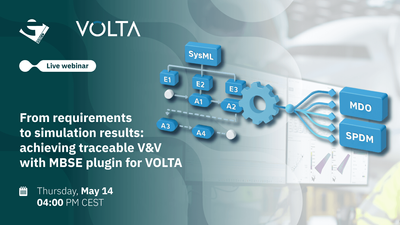
From requirements to simulation results: achieving traceable V&V with MBSE plugin for VOLTA
Watch the recording of ESTECO webinar and learn how to link SysML parametric models with physics-based simulation models for requirement verification by analysis.
eBook
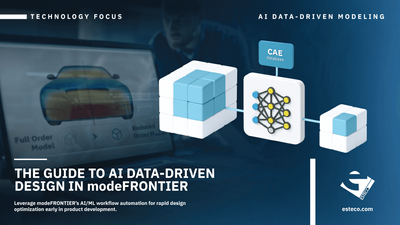
The guide to AI data-driven design in modeFRONTIER
Leverage modeFRONTIER’s AI/ML workflow automation for rapid design optimization early in product development.
White paper
The digital transformation in energy: integrating requirements, design, and simulation using a digital engineering platform
Discover how digital engineering can help your organization innovate faster, optimize performance, and support the transition toward a more sustainable energy future. Fill the form to download the white paper.
Search results for "python"
Showing 1 - 3 of 3 results
Webinar
Unlocking design innovation: modeFRONTIER 2025 new features explained
Let's take a deep dive into modeFRONTIER, focusing on its latest innovations for process automation and design optimization. Watch the webinar now and explore the latest innovations in process automation and design optimization with modeFRONTIER.
This session spotlights the modeFRONTIER Planner environment, which empowers you to create, reuse and apply various design space exploration strategies within a single simulation workflow and project file. Discover the newly introduced AI data-driven modeling capabilities, enabling real-time simulation of complex what-if scenarios. The webinar also explores the modeFRONTIER python ecosystem, which offers APIs for creating custom simulation workflows or performing ML-based design exploration or optimization analysis. Additional highlights include improved integration with electronic design automation (EDA) and 3D Modeling software, the introduction of the proprietary MUSA optimization algorithm and the all-new sensitivity analysis tool.
Success story
Optimizing commercial aircraft designs to use future aviation fuels
Learn how ESTECO modeFRONTIER helped Delft University of Technology to perform multi-objective aircraft design optimization to compare future aviation fuels. Pieter-Jan Proesmans, PhD Candidate in the Flight Performance & Propulsion group at Delft University of Technology, used modeFRONTIER to perform multi-objective aircraft design optimization to compare future aviation fuels. ## Challenge
This research has been undertaken in the framework of the GLOWOPT project sponsored by the EU’s Clean Sky 2 program, and under the supervision of Dr.Ir. Roelof Vos, associate professor at Delft University of Technology. The objective is the development and validation of Climate Functions for Aircraft Design (CFAD) with respect to minimizing global warming and their application to the Multidisciplinary Design Optimization (MDO) of next-generation aircraft for relevant market segments.
To reach this goal, novel fuels, such as liquid hydrogen (LH2) and sustainable aviation fuel (SAF) can provide more sustainable solutions. However, the climate objective conflicts with the typical design objective of minimal operating costs. While these two fuels can offer a significant reduction in climate impact, they are also more expensive and have consequences for the aircraft design (in the case of cryogenic LH2 tanks). ## Solution
The modeFRONTIER Multidisciplinary Design Optimization (MDO) framework was selected to investigate the climate impact reduction and operating costs for hydrogen and SAF fuel in regional, medium-range and long-range aircraft categories. The cost-optimal, kerosene-powered aircraft served as the reference case for all multidisciplinary aircraft design optimizations. The MDO process was set-up in a modeFRONTIER workflow. Its Python interface made it possible to orchestrate in-house tools for aerodynamics, propulsion, mission analysis, mass estimation and climate impact. Next, the optimization strategy was executed.
The pilOPT algorithm evaluated thousands of configurations by changing airframe, turbofan engine and mission design variables to obtain the cost versus climate trade-off for all fuel types in the three aircraft categories. ## Benefits
“The easy-to-use parallel coordinates and scatter matrix charts were very helpful in gaining conceptual insights. One of the key finding was that the SAF-powered aircraft are preferred over the cost-optimal hydrogen aircraft for the regional and medium-range categories. With modeFRONTIER, we could perform the multi-objective optimization and post-processing in a much faster and user-friendly way compared to when we had to rely on programming libraries. In the future, we will investigate how to combine the aircraft optimization with a network allocation routine to update not only aircraft design variables, but also top-level aircraft requirements” said Pieter-Jan Proesmans, PhD Candidate in the Flight Performance & Propulsion group at Delft University of Technology.
Success story
Takenaka Corporation: from Integration to Collaboration in the simulation process
Discover how designers, engineers and managers benefit from ESTECO Technology to simplify their DESIGN&BUILD process. Using VOLTA simulation process & data management, and design optimization capabilities, they collaboratively assessed the performance of structural elements of a new company building to maximize office space capacity. ## Why Design&Build and Simulation Process and Data Management
Collaboration between design and construction has traditionally been playing an important role in the Architecture, Engineering, and Construction (AEC) industry. Takenaka Corporation, one of the top construction companies in Japan, ensures certified process and construction quality at the highest levels with its integral DESIGN&BUILD system. This methodology integrates architecture, building technology, and construction in a unified flow of work from concept through completion, replacing the traditional approach where the design and construction phases of a building project are carried out in a sequential manner.
The DESIGN&BUILD system leads to many advantages: effective communication, unified quality, effective timing and cost overruns, and reduced completion time. In fact, architects and engineers collaborate with each other, share data, and are updated on various requirements to deliver innovative building solutions and meet clients’ expectations. When Takenaka Corporation embraced the DESIGN&BUILD system, it looked for a reliable Simulation Process and Data Management (SPDM) platform. That is why they partnered with ESTECO to simplify the whole simulation design process, manage a huge amount of data across teams, and shorten product development time. Designers, engineers and managers involved in the architectural projects access ESTECO VOLTA from a web browser and intuitively interact with the simulation process. From running 3D building simulations to applying design optimization techniques, analyze results and share data on the internal cloud for collaborative decision making. ## Expanding 3D building modeling and design optimization techniques across the enterprise
Conducting manually parametric studies on 3D building models can become a time-consuming process leading to delays in project schedules. Overcoming these challenges for designers and engineers at Takenaka Corporation translate into an extensive use of ESTECO process automation, integration, and design optimization technology to significantly accelerate the architectural simulation design process. By combining modeling solvers as Rhino3D/Grasshopper, Abaqus, Midas iGen, or other in-house design software in modeFRONTIER powerful workflow, they can execute complex simulation chains and evaluate thousands of complex geometries in a short time. On top of that, applying ESTECO state-of-the-art design exploration and optimization algorithms to assess the correlation between several requirements (room size, thermal comfort, structural design to name a few) and maximize the building performance. At Takenaka, they had to make a step forward to expand the usage of 3D building modeling and design optimization techniques across teams with different expertise. Indeed, designers and engineers usually perform simple data analysis and are not necessarily confident in simulation and workflow set-up execution. Moreover, the DESIGN&BUILD methodology requires effective collaboration between the different actors involved in the simulation process to make changes and update their models for further analysis.
This gap has been filled by scaling up modeFRONTIER desktop solution capabilities across the enterprise with the ESTECO VOLTA collaborative web platform. It enables simulation experts to create and make the simulation workflow ready to be executed via web. Then, designers and engineers can use these simulation models, apply design optimization techniques, and analyze results in the VOLTA platform. Since the simulation data are accessible in their internal cloud, it is easier for them to quickly interact with the simulation experts asking for updated CAD/CAE models when design changes are required. In the end, managers can log in to the VOLTA web platform, access product performance metrics, and monitor the whole simulation product development advancements. This scenario has been successfully applied in the early design phase of a new office building project. VOLTA made simulation usable by different teams to optimize structural elements in order to guarantee maximum office space capacity.
Use case: rationalize the slab shape of an office building with VOLTA web collaborative platform
Expanding the usage of simulation and optimization became a true fact when Takenaka’s designers and engineers had to collaborate in order to assess the performance of structural elements for a new office building. The subcontracted project required to drastically reduce the number of columns to make the most of the office space. However, the expected distance between the columns is about 17 meters, which is quite a lot according to the Japanese regulations. This has an unavoidable impact on the flat surface of a slab, a common structural element used to construct floors and ceilings. The slab needs a proper curve in order to guarantee the stiffness. Although, a side effect of the increased curvature may unbalance the floor forces and cause local additional bending moments.
The solution is not just filling the curved slab shape, rather including massive amounts of ribs in some areas. To achieve this, the company’s designers and engineers combined the use of 3D building modeling techniques with ESTECO VOLTA collaborative web platform to explore reasonable volume amounts and coverage of the slab.
First, they used Rhino3D/Grasshopper to create and model the shape of the office building and then converted it (in Grasshopper) to be meshed in Midas iGen to perform structural analysis. In the end, the several outputs from finite element analysis such as maximum displacement and the stress were extracted by using a python script. The interaction between the different simulation solvers was automated in the modeFRONTIER workflow coupled within the ESTECO VOLTA platform environment. This enabled simulation experts to upload the modeFRONTIER workflow and execute it through a web interface.
Then, the structural engineers benefited from the VOLTA Advisor, a web environment for advanced post-processing and data visualization, to assess the simulation results from the finite element analysis model and validate the deformed shape of the all structure. For the same project, they also performed additional analysis through the VOLTA Planner dashboard, a modular interface to apply several optimization strategies in an intuitive way. This allowed them to easily create new simulation plans, change parameters bound, objectives and constraints with the aim of finding the best designs with minimized both the building weight and the maximum displacement of slab. “Thanks to the VOLTA HPC & Cloud capabilities, we were able to evaluate more than 700 designs in just four days. The VOLTA Player interface allowed to execute these computational heavy multi objective optimization analysis on the cloud without having to think how resources are used remotely”. Toru Inaba, Computational Design Group at Takenaka Corporation, also said that one of the key benefits of using VOLTA is to make simulation data accessible to a broader team of designers and engineers. “In particular,” concluded Toru Inaba, “our simulation experts could share the best practices on how to use the VOLTA Advisor, the web environment for advanced data analysis and visualization, with the structural engineers. The VOLTA web platform and its apps enabled us to truly democratize our DESIGN&BUILD simulation process. Designers and engineers can now access to the simulation results in one click and collaboratively take decisions without only relying on siloed reports of data”.