Webinar
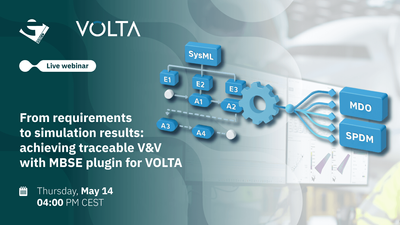
From requirements to simulation results: achieving traceable V&V with MBSE plugin for VOLTA
Watch the recording of ESTECO webinar and learn how to link SysML parametric models with physics-based simulation models for requirement verification by analysis.
eBook
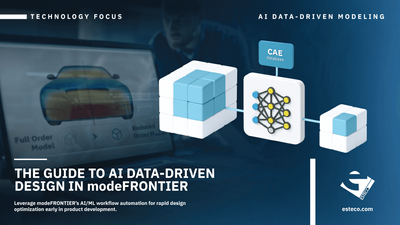
The guide to AI data-driven design in modeFRONTIER
Leverage modeFRONTIER’s AI/ML workflow automation for rapid design optimization early in product development.
White paper
The digital transformation in energy: integrating requirements, design, and simulation using a digital engineering platform
Discover how digital engineering can help your organization innovate faster, optimize performance, and support the transition toward a more sustainable energy future. Fill the form to download the white paper.
Search results for "VOLTA"
Showing 1 - 6 of 6 results
Success story
Takenaka Corporation: from Integration to Collaboration in the simulation process
Discover how designers, engineers and managers benefit from ESTECO Technology to simplify their DESIGN&BUILD process. Using VOLTA simulation process & data management, and design optimization capabilities, they collaboratively assessed the performance of structural elements of a new company building to maximize office space capacity. ## Why Design&Build and Simulation Process and Data Management
Collaboration between design and construction has traditionally been playing an important role in the Architecture, Engineering, and Construction (AEC) industry. Takenaka Corporation, one of the top construction companies in Japan, ensures certified process and construction quality at the highest levels with its integral DESIGN&BUILD system. This methodology integrates architecture, building technology, and construction in a unified flow of work from concept through completion, replacing the traditional approach where the design and construction phases of a building project are carried out in a sequential manner.
The DESIGN&BUILD system leads to many advantages: effective communication, unified quality, effective timing and cost overruns, and reduced completion time. In fact, architects and engineers collaborate with each other, share data, and are updated on various requirements to deliver innovative building solutions and meet clients’ expectations. When Takenaka Corporation embraced the DESIGN&BUILD system, it looked for a reliable Simulation Process and Data Management (SPDM) platform. That is why they partnered with ESTECO to simplify the whole simulation design process, manage a huge amount of data across teams, and shorten product development time. Designers, engineers and managers involved in the architectural projects access ESTECO VOLTA from a web browser and intuitively interact with the simulation process. From running 3D building simulations to applying design optimization techniques, analyze results and share data on the internal cloud for collaborative decision making. ## Expanding 3D building modeling and design optimization techniques across the enterprise
Conducting manually parametric studies on 3D building models can become a time-consuming process leading to delays in project schedules. Overcoming these challenges for designers and engineers at Takenaka Corporation translate into an extensive use of ESTECO process automation, integration, and design optimization technology to significantly accelerate the architectural simulation design process. By combining modeling solvers as Rhino3D/Grasshopper, Abaqus, Midas iGen, or other in-house design software in modeFRONTIER powerful workflow, they can execute complex simulation chains and evaluate thousands of complex geometries in a short time. On top of that, applying ESTECO state-of-the-art design exploration and optimization algorithms to assess the correlation between several requirements (room size, thermal comfort, structural design to name a few) and maximize the building performance. At Takenaka, they had to make a step forward to expand the usage of 3D building modeling and design optimization techniques across teams with different expertise. Indeed, designers and engineers usually perform simple data analysis and are not necessarily confident in simulation and workflow set-up execution. Moreover, the DESIGN&BUILD methodology requires effective collaboration between the different actors involved in the simulation process to make changes and update their models for further analysis.
This gap has been filled by scaling up modeFRONTIER desktop solution capabilities across the enterprise with the ESTECO VOLTA collaborative web platform. It enables simulation experts to create and make the simulation workflow ready to be executed via web. Then, designers and engineers can use these simulation models, apply design optimization techniques, and analyze results in the VOLTA platform. Since the simulation data are accessible in their internal cloud, it is easier for them to quickly interact with the simulation experts asking for updated CAD/CAE models when design changes are required. In the end, managers can log in to the VOLTA web platform, access product performance metrics, and monitor the whole simulation product development advancements. This scenario has been successfully applied in the early design phase of a new office building project. VOLTA made simulation usable by different teams to optimize structural elements in order to guarantee maximum office space capacity.
Use case: rationalize the slab shape of an office building with VOLTA web collaborative platform
Expanding the usage of simulation and optimization became a true fact when Takenaka’s designers and engineers had to collaborate in order to assess the performance of structural elements for a new office building. The subcontracted project required to drastically reduce the number of columns to make the most of the office space. However, the expected distance between the columns is about 17 meters, which is quite a lot according to the Japanese regulations. This has an unavoidable impact on the flat surface of a slab, a common structural element used to construct floors and ceilings. The slab needs a proper curve in order to guarantee the stiffness. Although, a side effect of the increased curvature may unbalance the floor forces and cause local additional bending moments.
The solution is not just filling the curved slab shape, rather including massive amounts of ribs in some areas. To achieve this, the company’s designers and engineers combined the use of 3D building modeling techniques with ESTECO VOLTA collaborative web platform to explore reasonable volume amounts and coverage of the slab.
First, they used Rhino3D/Grasshopper to create and model the shape of the office building and then converted it (in Grasshopper) to be meshed in Midas iGen to perform structural analysis. In the end, the several outputs from finite element analysis such as maximum displacement and the stress were extracted by using a python script. The interaction between the different simulation solvers was automated in the modeFRONTIER workflow coupled within the ESTECO VOLTA platform environment. This enabled simulation experts to upload the modeFRONTIER workflow and execute it through a web interface.
Then, the structural engineers benefited from the VOLTA Advisor, a web environment for advanced post-processing and data visualization, to assess the simulation results from the finite element analysis model and validate the deformed shape of the all structure. For the same project, they also performed additional analysis through the VOLTA Planner dashboard, a modular interface to apply several optimization strategies in an intuitive way. This allowed them to easily create new simulation plans, change parameters bound, objectives and constraints with the aim of finding the best designs with minimized both the building weight and the maximum displacement of slab. “Thanks to the VOLTA HPC & Cloud capabilities, we were able to evaluate more than 700 designs in just four days. The VOLTA Player interface allowed to execute these computational heavy multi objective optimization analysis on the cloud without having to think how resources are used remotely”. Toru Inaba, Computational Design Group at Takenaka Corporation, also said that one of the key benefits of using VOLTA is to make simulation data accessible to a broader team of designers and engineers. “In particular,” concluded Toru Inaba, “our simulation experts could share the best practices on how to use the VOLTA Advisor, the web environment for advanced data analysis and visualization, with the structural engineers. The VOLTA web platform and its apps enabled us to truly democratize our DESIGN&BUILD simulation process. Designers and engineers can now access to the simulation results in one click and collaboratively take decisions without only relying on siloed reports of data”.
Success story
Daiwa House reforms structural analysis with collaborative design optimization
Read how Daiwa House streamlined structural calculations & cut costs with ESTECO Technology, enabling more designers to perform structural design optimization. Daiwa House Industry Co., is a pioneer in the “industrialization” of construction in Japan, and since it was established in 1955, it has been developing and supplying high-quality housing that stresses the needs of inhabitants. Today it has grown into one of Japan’s leading home builders. It has a wide range of business developments, centered around housing and extending to the construction of shops and office buildings, and it also includes the company’s own special brand of resort operations and retail do-it-yourself home centers. Daiwa House has embraced a digital strategy known as the Mobius Loop Concept, aiming to integrate technology across the building lifecycle. A key pillar of this approach is the internal mandate to adopt building information modeling (BIM) within its building division, initiated in 2017.
The company began developing a BIM platform to serve as a central hub for all project data. At the heart of this system lies the common data environment (CDE) — a collaborative space where all project members can manage all data related to the construction process and contribute to a unified 3D model. By minimizing the reliance on paper drawings and siloed workflows, Daiwa House has laid the foundation for efficient, data-driven decision-making across departments. Japan’s vulnerability to seismic activity poses a unique challenge in structural engineering. Structural design in the country must meet three fundamental criteria:
Functional requirements: meeting the client’s expectations for performance and usability.
Safety: ensuring buildings can withstand frequent and potentially devastating earthquakes.
Economic efficiency: balancing cost-effectiveness with high structural integrity.
Traditionally, Daiwa House’s structural design process involved manual iterations: engineers created a model, ran calculations, made adjustments based on experience, and repeated the process until a final plan emerged. While this approach has served its purpose, it faced four major limitations:
A limited number of design alternatives considered.
Risk of missing better solutions due to fixed thinking patterns.
Subjective decision-making based on individual judgment.
Long lead times for design completion.
Given these limitations, the need for a more efficient structural design process became clear. Daiwa House turned to modeFRONTIER and VOLTA software solutions to introduce an optimization system for their structural engineering teams, allowing them to perform many simulations more quickly.
In particular, modeFRONTIER was chosen for its ability to integrate and automate structural analysis software with the aim of performing rapid, high-volume simulations and applying design optimization methods. Engineers use it to define variables such as beam and column types, run calculations, and evaluate performance across hundreds of design variants — from cost and material usage to seismic resilience.
Once a simulation workflow is created in modeFRONTIER, it is uploaded to VOLTA platform, which allows engineers across Daiwa House’s 50+ regional branches to:
Execute the simulation workflow and apply design optimization studies remotely.
Visualize and analyze simulation results through interactive web-based dashboards.
Collaborate more easily by sharing design results and insights.
Case study highlights:
With the new optimization system, structural engineers analyzed two steel-framed buildings (a 2-story, 1000m² and a 3-story, 3700m² structure). Optimization objectives included minimizing the amount of steel structure (cost factor) and the deformation of the building (performance factor). Results showed:
7.4% cost reduction in Project 1
2.5% cost reduction in Project 2
Both while meeting or exceeding structural performance targets. Daiwa House engineers are located at various branches throughout Japan. To ensure consistent and efficient use of the optimization system across the entire company, it was essential that all engineers, regardless of their location, have access to it. That’s why they adopted the VOLTA digital engineering platform to democratize optimization across all engineers in the company, making it easy to share, monitor, and replicate best practices.
How they use it:
Upload and execute optimization workflows created in modeFRONTIER.
Visualize results across multiple projects.
Share insights with project teams and decision-makers. By integrating optimization into their structural design process, Daiwa House achieved a paradigm shift in how buildings are designed:
More design alternatives explored in less time.
Collaborative data-driven decision-making.
Clear performance insights for every design considered.
With VOLTA, Daiwa House can simulate up to 200 design alternatives — compared to just five in the traditional method — and visualize their performance clearly.
It has significantly improved collaboration, decision-making, and reduced the design time by up to 67%, which amounts to a total reduction of 2100 hours to 700 hours annually across all projects. This translates to safer, more competitive products and time savings.
Looking forward, Daiwa House plans to accelerate digital transformation by integrating optimization results with a centralized database, enabling smarter iterations and knowledge reuse. The company also sees potential to expand optimization to other structural types such as reinforced concrete (RC) structures, and architectural and equipment design.
Success story
Multidisciplinary collaboration made easy at Airworks Engineering
Multidisciplinary collaboration made easy at Airworks Engineering
Airworks, a multidisciplinary company for mechanical engineering, was facing the challenge of improving efficiency in the conversion of wind energy into electrical power by optimizing the whole assembly of a wind power unit rotor. ## Challenge
Experts in wind power unit, specialists in CAD (Computer Aided Design) and CFD (Computational Fluid-Dynamics) professionals from different organizations were involved in a complex design scenario and needed to collaborate by effectively sharing a different kinds of information and resources. Engineers from the University of Trieste prepared the parametric CAD model and set up CFD simulations, while Airworks took care of aerodynamic performance calculations of the wind rotor blade, and subsequently performed optimization analysis with modeFRONTIER, the multidisciplinary optimization platform. The need for a common platform to share results emerged rapidly, and was successfully tackled with SOMO software solution (now evolved in VOLTA SPDM enterprise platform). This enabled the seamless execution of inter-organizational simulation workflows. ## Solution
With SOMO each partner of the simulation workflow was able to contribute to the project providing its own high level of collaboration. The CAD expert generated the geometry of the blades providing a parametric model and the CAD solution used to update it, while the CFD expert set up the aerodynamic simulation model, which used the geometry to evaluate the rotor aerodynamic performance. Both simulation workflows were made available to partners in a shared repository. Then the wind power unit expert was able to integrate his performance evaluation software into an automated multi-disciplinary workflow. Ultimately he used the workflow to evaluate the power efficiency of the system and to optimize it in a complete range of environmental conditions. ## Benefits
Through the entire process, simulation data and engineering knowledge were effectively managed and shared through SOMO, allowing a faster process and a considerable resource-saving”, says Stefano Picinich, Airworks Engineering Managing Director. With the set up of the optimization workflow, Airworks professionals were able to explore and evaluate new parametric geometry, leading to innovative designs, analyzed by the decision-maker via the post-processing tools. The considerable result was of a wind turbine design with an outstanding power coefficient and an annual energy production increase of respectively 1.26% and 0.47%.
Success story
Hyundai streamlines Genesis luxury sedan's conceptual design
Learn how ESTECO world-class engineering software helped Hyundai Motor Group R&D optimize the vehicle architecture trade-offs. In the wider context of Hyundai Motor Group R&D efforts aimed at integrating engineering design, Computer Aided Engineering (CAE) and testing for vehicle development, ESTECO world-class engineering support proved itself a trustworthy partner in optimizing the vehicle architecture trade-offs. In particular, ESTECO modeFRONTIER software solution was utilized in the conceptual design phase for the next generation of Genesis luxury sedan. ## Challenge
Hyundai’s architecture-driven structure conveys vehicle concept planning which takes numerous factors into account from the initial stage of development, including vehicle performance, parts sharing, standardization and even up to procurement, production and suppliers. Currently, their research engineers need to find a proven simulation-driven design technology for upcoming Electric Vehicle (EV) architecture development. To test this methodology, they took as baseline a Genesis G80 luxury midsize sedan looking at rapidly investigating and identifying the global optimum design region , focusing on mechanical package, system selection, and attribute modeling. The analysis involved components such as suspensions, fuel economy, battery, and architecture costs.
Solution
By employing modeFRONTIER, they could perform Trade Space Analysis (TSA) in order to identify a set of system parameters, attributes, and characteristics to satisfy the required vehicle performance during the conceptual product development phase. In practice, starting from an automated multidisciplinary modeFRONTIER workflow, they ran 3000 Design of Experiments (DOE) to rapidly evaluate all the possible vehicle configurations. For this purpose it was mandatory to build fast evaluation simulation models such as Matlab (Octave) for suspensions, Excel for batteries, RSM for the performance and so on, to get the results in a few hours. Then, they applied advanced post-processing techniques such as Clustering and Multi-Criteria Decision Making (MCDM) to group similar designs and rank all reasonable alternatives on the basis of given preferences. ## Benefits
“We realized that modeFRONTIER software is the ideal solution for vehicle trade-off-analysis and optimization. After generating 3000 different vehicle configurations, we could cluster and then rank all reasonable design alternatives on the basis of user-defined preferences. This significantly accelerated our internal decision making process among all stakeholders involved in the project. We look forward to applying the same methodology for our next EV architecture development projects by also considering ESTECO VOLTA SPDM platform to foster collaboration across departments” - said James (KR) Yoon - Senior Research Engineer, Virtual MBSE & HPC AI Research, Hyundai Motor Company.
Success story
Balancing multiple disciplines to design adaptable and sustainable buildings
Bouygues Construction develops innovation to support companies with new construction methods and materials, while considering future usages. The main requirements for a new construction include objective measures, flexibility, industrialization, collaboration and sustainability. Bouygues Construction develops innovation to support companies with new construction methods and materials, while considering future usages. The main requirements for a new construction include objective measures, flexibility, industrialization, collaboration and sustainability. Moreover, customers also ask for innovative and evolving buildings. Bouygues keeps developing innovative processes together with a collaborative Multidisciplinary Design Optimization (MDO) platform, which allows the various actors involved in the project to make quicker decisions and have a crystal clear overview of the possible solutions.
Cover image: courtesy of Bouygues Construction | Morpheus Hotel | credit photo Virgile Simon Bertrand (2018)
Challenge
A building is a prototype that is manufactured once. It’s not a functional project like a car or an airplane, where a design process can be profitable thanks to the sales volumes involved. On top of this, a building is created on site with local resources and labour, as well as environmental challenges that need to be taken into account. Engineers have to mix different disciplines such as cost engineering, methods, structure (reinforce concrete, steel, timber etc.), and building life cycle.
Bouygues Construction had to take into consideration a variety of disciplines and variables to optimize building performances and propose the most adapted design to its client. ## Solution
Bouygues has automated the design process of a building floor with modeFRONTIER, considering 26 input parameters such as geometry, solutions, usage specifications, structural dimensions, unit prices, and unit times of construction. The outputs were the costs, construction pace, carbon footprint.
Within the VOLTA collaborative platform, engineers succeeded in implementing different construction designs and provided the most profitable and the most sustainable solutions to the building team. This was possible thanks to the seamless integration of the simulation tools currently deployed at Bouygues. This was performed in as little as two days with one engineer. “The good software is the one the designer knows and masters - explained Sylvain Géry, Senior Structural Engineer at Bouygues Construction - ESTECO Technology can easily integrate with any simulation solver. This helps when a project involves different countries and enterprises who are used to working with different tools”.
Benefits
Thanks to the ESTECO Technologies for process automation, design optimization and simulation data management, Bouygues fastened the simulation process and reduced the overall design project time. Engineers built multidisciplinary processes and effectively coordinated all the phases involved. They could also assess the final design performance while considering costs and carbon footprint. Moreover, the collaboration between experts from different areas and the traceability of the simulation model evolution simplified the management of the project. In the building industry there are many construction options available. “Thanks to MDO, - Géry said - we could objectively quantify the benefits of the various construction types and identify the most appropriate combination of material usage, material technology and construction workers costs.”
Success story
Handling the Complexity of Mechatronic System Design
ABB Group, a global leader in power and automation technologies, covers almost every segment of the power generation and industrial process control market with its products and systems. With $1.4 billion in annual investments, the 8,500 engineers and scientists at ABB Research & Development are committed to meeting the automation industry’s ever-increasing demand for reducing energy consumption and improving reliability and performance. The design projects illustrated here highlight how ABB Group leverages optimization-based development to handle the complexity that electronic and software components entail. Looking at system interdependencies from the earliest concept phase is crucial for an effective strategy that aims at maximizing product performance, meeting reliability demands and easing the environmental impact of their products. ## Optimization-Based Development of Ultra High Performance Twin Robot Xbar Press Tending Robot System
The industry challenge
Industrial robots are sophisticated systems incorporating hardware and – increasingly – software components. Subsystem design (gearboxes, motors, sensors and brakes) and the interactions between elements such as machine interfaces, safety integrations, field buses, PCBAs, power supplies and drive modules must be carefully planned to assure the best possible performance. Over the years, cost pressures have made robots a commodity in terms of physical specifications. Among the many design challenges, the need for lighter components has resulted in reduced stiffness, making the control problem more complex. Furthermore, many third-party interfaces require integration and products that must comply to software, electrical and mechanical quality standards.
ABB experience
In the case of the Twin Robot Xbar Press Tending Robot System, one of ABB’s flagship robots, engineers considered 18 design variables (representing the gear torque, motor torque and motor speed) and managed objectives and constraints in modeFRONTIER, achieving a 12% energy saving, solely by varying the software components. “We optimized this robot ‘manually’ for 30 years and it is one of the most used. With modeFRONTIER we were able to identify a new design – requiring no implementation costs – bringing 12% of energy savings without compromising performance by changing only the software configuration. Obviously, this is something that can’t be done by hand – you need an optimization software to do it.” says Dr. Wappling, Global R&D Manager at ABB. ### Benefits
“The ability to manage mechatronics is becoming increasingly important as simulation encompasses more and more systems and not just components: the impact of the mechanics, electronics and software all need to be accounted for.” continues Wappling. ESTECO technology keeps pace with evolving R&D needs and provides designers with a flexible environment that handles each delicate step of complex system analysis and enhancement. As seen in the example of the robot, inserting virtual control models in the simulation framework enables designers to apply the optimization approach, calibrate the software and identify zero-cost solutions. ## Multiobjective Optimization of a Medium Voltage Recloser
The challenge
Medium voltage reclosers now represent an important grid protection device that connects different grid sources, increase the network/grid reliability and make the implementation of self-healing and auto reconfiguration schemes for overhead lines possible. With a high level of renewable energy penetration, medium voltage networks are becoming bidirectional. Therefore, the associated switching devices must ensure the protection of newer types of power systems as well as new types of loads. The optimal design of medium voltage reclosers is therefore important in order to enable excellent switching capabilities. The switching capabilities of medium voltage recloser can be influenced by various parameters such as actuation energy responsible for opening and closing the device. Therefore, to maximize the lifetime of the recloser, it is essential to establish an optimized control especially related to the actuation energy. The goal of the multi-objective optimization is to identify an optimal actuation energy control strategy for the closing and opening operations.
The solution
ABB R&D Teams built a two-step optimization framework that incorporates the energy efficiency constraints by working initially on the electromagnetic actuator and directly optimizing the Finite Elements Model (FEM). The numerical simulation step was then completed with physical calibration via a Hardware-in-the-Loop (HIL) optimization process, ensuring that the whole system reaches the desired performance. During the first iterations, modeFRONTIER helped improve the FEM model by identifying the best configuration possible for the electromagnetic system, while satisfying the constraint imposed by the design boundary conditions. The parameterized FEM model created with COMSOL Multiphysics was connected to Matlab LiveLink so as to pilot all design changes automatically and control both models in sequence, leveraging the direct integration node for Matlab in modeFRONTIER. In the second step, the R&D Teams opted for the in-depth analysis of the system where modeFRONTIER was coupled both with the simulation model and with the hardware to further enhance the switching properties. The HIL framework enabled an investigation environment for the whole recloser system.
Thanks to this approach, optimization can be applied to the control scheme implemented with CompactRIO/LabVIEW: after running one full closing-opening operation, data is transferred to Matlab for post processing and reinserted in the loop for the next runs. Since reducing overtravel and backtravel is extremely important for the product lifetime, with modeFRONTIER piloting the HIL system (1,500 runs with a DOE featuring selected parameters from the first optimization step), R&D Scientists pinpointed a new control scheme that enables significant extension of the product lifetime. “The identified control scheme enables up to 50% reduction of the overtravel and backtravel, enabling a remarkable improvement in terms of lifetime”, says Octavian Craciun Senior Scientist at ABB.