
Webinar
From requirements to simulation results: achieving traceable V&V with MBSE plugin for VOLTA
Watch the recording of ESTECO webinar and learn how to link SysML parametric models with physics-based simulation models for requirement verification by analysis.
eBook
The guide to AI data-driven design in modeFRONTIER
Leverage modeFRONTIER’s AI/ML workflow automation for rapid design optimization early in product development.
White paper
The digital transformation in energy: integrating requirements, design, and simulation using a digital engineering platform
Discover how digital engineering can help your organization innovate faster, optimize performance, and support the transition toward a more sustainable energy future. Fill the form to download the white paper.
Search results
Showing 1 - 10 of 49 results
Success story
Luna Rossa Prada Pirelli: predict design performance with numerical optimization
Discover how Luna Rossa Prada Pirelli team can predict design performance for sailing yachts thanks to ESTECO modeFRONTIER simulation process automation. Luna Rossa Prada Pirelli is all set to challenge for the Louis Vuitton 37th America’s Cup. Once again on an AC75 foiling monohull and representing the yacht club Circolo della Vela Sicilia for the third time. With the help of ESTECO simulation process automation and design optimization technology, the team has tested solutions and materials for their sailing yachts, built and developed in-house at the Cagliari base on Sardinia’s southern coast, Italy. The AC75 Class has also been chosen to compete in the 37th America’s cup. It’s a high-performance monohull intended to spearhead the development of sailing through innovative technology, ensure the class is relevant to the sport of sailing and provide competitive racing in light and stronger wind conditions. The class rule defines the limits of the design space. Some parts, like the foil arm and foil cant system, are the same for every team. The AC37 Protocol also focuses on cost reduction, including limitations on the number of components:
Teams are only permitted to build one new AC75
Limitations on the quantity of foils and componentry that can be built for the AC75’s
Introduction of the multipurpose One Design AC40 class which teams will be able to partially convert and use for testing, component development and Match Race training
Possibility to use test boat (LEQ12) with max LOA 12m
Furthermore the towing tank or wind tunnel tests are prohibited. As a result, numerical simulation is a crucial and integral part of the design process at the Luna Rossa Prada Pirelli team. They analyze and optimize ideas before even seeing them applied to the yacht. The 38-member unit forms the largest design team and is divided into five units: naval architecture, structural engineering, mechanical engineering, computer engineering, and aero-and hydrodynamic engineering. Among them, there is a group of designers who use modeFRONTIER to improve the design performance of AC75 yacht components:
Matteo Ledri, Head of CFD
Simone Bartesaghi, CFD Specialist
Martin Jacoby, CFD Specialist
Andrea Vergombello, Head of VPP
Andrea Zugna, Performance & Mechatronics
In addition to designing hulls, sails, and custom components, the team analyzes data from simulators and computers connected to the boat during sea training. Through synchronized collaboration with the Sailing team and the Shore team, they work daily on studying and designing solutions to enhance the boat’s performance. Foiling boats can be explained by comparing them to aircraft in case anyone has never seen one. These similarities can be useful to understand why simulation technology used in designing and testing foiling boats can draw upon decades of development in the aerospace industry. If you compare the AC75 boat to a glider, it is possible to identify the fuselage with the hull, the wing with the main wing foil, the winglet with the wing tip, and the rudder with elevator. The main difference in the case of the AC75 is that only one foil maintains the boat out of the water, so the roll balance is achieved by considering the upward force of the foil, the weight of the boat, and the roll component of the force of the sail, which is continuously adjusted to keep the boat upright.
Continuing the fly analogy, regarding controls, the pitch of the boat is controlled by the rake of the rudder blade, which changes the angle of attack of the rudder elevator. Ground clearance is maintained by controlling the flap angle of the foils. The most precious commodity in an America’s Cup campaign is time, despite having a three/four year timeframe to design the yacht. This is why, when it comes to selecting tools for simulation, the design team prefers relying on proven and reliable commercial solutions. modeFRONTIER is one of those. The software offers flexibility, usability and straightforward methods for design exploration and optimization, making it possible to accomplish various automated tasks in a short amount of time. The optimization-driven design process begins with defining an objective function and constraints, followed by parameterizing the design, running an optimization algorithm, and validating the optimized solutions. ### 4.1 Hull shape optimization
For the hull shape, a preliminary investigation related to raw geometric parameters linked to the AC75 rules was done to try to cover the entire design space, even with out of the box shapes generated by using input parameters from a Design of Experiments (DOE) table.
Good candidates coming from a preliminary geometry optimization (rulewise) were tested via CFD hydro simulations and then the obtained data were integrated in modeFRONTIER to properly analyze the trends and compare the different solutions. By using the same approach, combining DOE exploration and direct optimization, the design space was refined in the optimum area extracted from preliminary design loops and updated at every step of the design itself. ### 4.2 Optimization of the foil section
modeFRONTIER has been used extensively to perfect the design of the foil section by setting up a multi-objective optimization with genetic algorithms. The direct optimization allowed us to explore millions of possible shapes and select a family of best candidates to test and deep compare on the virtual AC75 complete model. The main goal was to minimize drag for a given lift with constraints like structural properties (stress and stiffness), cavitation, systems. Also, the process involved a parametrization based on B-Splines curves and parametric models to account for control system volume and some 3D effects. ### 4.3 Design space exploration of the wing
The design space of the wing was explored exhaustively using modeFRONTIER in two main areas: bulb and twist distribution.
This optimization task was very complex due to lots of constraints and objectives to be fulfilled. Regarding the bulb optimization, the requirement of a given volume to carry the required weight, the space to fit the flap system and a shape that has minimum as possible drag in all conditions. These are the constraints and objectives for the bulb optimization. The geometry generation was done with Rhino/Grasshopper and automated in modeFRONTIER to execute a DOE. Then, the geometry was sent to an HPC cluster to run a CFD analysis. In this context, modeFRONTIER enabled our team to efficiently perform this task and reduce the time to produce the optimized geometry. The purpose of Twist optimization was to find the optimum distribution of Angle of Attack of the hydrofoil section along the span of the foil.
This distribution of twist angle impacts several aspects of the foil performance and behavior. You could think about the structural part, where the center of lift spanwise will impact on the stress at the root of the wing, therefore asking for higher modulus which might lead to thicker sections. Seeking performance is the main objective where the aim is to fit the 2D section at a range of AoA where the efficiency is maximized, and from a 3D hydro point of view there is performance loss due to the eddies created by the lift produced. This with an optimal twist distribution can be minimized, always monitoring how the cavitation area gets modified with the twist changes. In that complex scenario modeFRONTIER fitting capabilities enabled us to find a virtual optimum with great confidence. The twist optimization problem had big non-linearities related to the laminar-turbulent transition and with the correct settings we were able to optimize with Response Surface models (RSM) techniques and validate the optimum with excellent results. ### 4.4 RSM modeling for wave model fitting: hydro and aero
Lots of challenges require CFD computations that are very costly in terms of computational power, however with the correct study of the problem, a good fitting of the CFD response can be done and then being used to reduce the need of simulations to be run. The choice of the RSM settings is of major importance, not only should be checked with validation points but also with engineer’s criteria. Later the fitting can be used to “anchor” low fidelity models that can expand the scenarios studied. Anchoring means that the expected difference between the high fidelity and the low fidelity model is studied and fitted and when that is known, it can be used to correct the low fidelity model in other parts of the design space, where a specific high fidelity simulation has not been run. Here the cases of study are the wave-resistance model of the AC75, where the URANS have been conducted at “center” sailing conditions. And, with the creation of an analytical wave model it was possible to expand the results to a very big amount of conditions that a wave scenario can have, think about wave height, wave period, angle, flight height.
modeFRONTIER was used to bring up the quality of the low-fidelity model and enable us to study a broader space. modeFRONTIER has become an indispensable tool in developing the new AC75 class boat, providing the design team with the necessary optimization techniques to excel in various fields such as hull and foil design. Simone Bartesaghi, CFD Specialist, Luna Rossa Prada Pirelli says, “modeFRONTIER has helped us to improve and speed up our design process, allowing us to explore all the design space and finding unusual, out of the box shapes that we may not have considered otherwise. Based on our results from modeFRONTIER, we could quickly and effectively obtain 2D section design and optimization for foils and rudders, and even adapt them for different zones along the span of a foil or rudder. Finally, the software enabled us to create models for complex scenarios like waves interaction and aerodynamics forces for direct optimization".
Video
Interview with the engineers of the Luna Rossa Prada Pirelli boat for the 37th America’s Cup
As the Luna Rossa Prada Pirelli prototype was getting ready to sail the waters of Cagliari, Italy, we took a moment to interview Matteo Ledri, Head of CFD, and Andrea Vergombello, VPP and CFD Optimization of the Luna Rossa Prada Pirelli Team.
Success story
Faster than the wind: the optimization experience in the America's Cup Challenge
The 34th edition of the America’s Cup was a breakthrough event in the world of sailing, with traditional mono hulls giving way to the AC72 class foiling catamarans equipped with foils and wing sails. Since then, sailing and engineering teams have been dealing with a new set of challenges ranging from boat handling, tactics and, it goes without saying, the design of these new vessels and their subsystems. ## New America’s Cup regulations: a design challenge
From a design point of view, naval architects and engineers have been forced to rethink their way of working and open up to other design processes and methods, like in motor racing, which has already gone through a similar shift, where regulations tend to trigger a series of small incremental changes rather than radical one-off developments. Moreover, the change from yacht to flying catamaran has revolutionized sailing philosophy, leading to constant changes in speed and boat response to conditions. This means that catamaran performance needs to be maximized by taking into consideration a whole new set of predictions and external factors. When the Luna Rossa Challenge Team started developing the concept for the catamarans in view of their campaign of the 35th America’s Cup, it opted to implement design process integration and automation routines. The limitations imposed by America’s Cup regulations served to highlight the need for simulations and multi-domain analysis - tools that proved crucial to developing and improving the new AC62 class boats. ## The sailing modes and the need for optimization
The new race regulations have brought about a multifaceted design process which requires taking into account different “sailing modes” and their respective physics in parallel. Even though the impact of the hull on overall performance at high wind speeds is practically negligible, its impact becomes significant at low-to-medium sailing speeds. Whereas in displacement sailing mode, the hull is fully immersed and more than 80% of the lift is due to the buoyancy of the hull, in skimming sailing mode, wind intensity makes the boat to start flying, resulting in a reduced effect of the buoyancy to 20% of the lift force. In foiling mode, at high wind speeds, the hull is completely out of the water and the catamaran sails on foils, reaching 30 knots upwind and 50 knots downwind. Analysts therefore need to consider both hydrodynamic and aerodynamic drag when switching from one mode to another, meaning that the higher the number of different configurations in terms of hull, foils and wings considered as design alternatives, the higher the probability of enhancing the performance of each mode.
Moreover, given that regulations prevent the actual sailing of 62-foot catamarans until around five months before the competition, most of the important early design decisions are necessarily based on data taken from simulations. The highly sophisticated design skills needed and the different disciplines involved in the design make performance prediction harder, leading to the conclusion that the use, coupling and automation of simulation tools in the design process are indispensable. Add to that the sheer number of variables, constraints and objectives involved and it becomes obvious that a trial and error approach is unfeasible. These considerations led the Luna Rossa Challenge Team to adopt modeFRONTIER as its automation and numerical optimization tool of choice, ensuring an integrated design approach from the earliest stages of the catamaran design process. ## The Design Program
Hull shape optimization
As mentioned earlier, the hull is still a crucial element in the design of the boat.
In the first stage of the design process the team decided to focus on the hydrodynamic analysis, considering the displacement and skimming modes. It is in pre-start phase when the hull shape affects performance the most as the boat accelerates from an almost static condition to reach peak speed and in some of the maneuvering conditions where the wind is not strong enough to make the boat fly. To optimize the hull shape taking into account the two sailing conditions, the team developed a hull shape generator to simulate the response for each variation and calculate the drag considering exclusively the shape. Michele Stroligo, CFD Analyst at Luna Rossa Challenge, set up the logic flow with modeFRONTIER to drive the design investigation and optimization of the hull shape. He first prepared VBA macros in Excel to generate the set of control points and splines. These were then transferred to Maxsurf to create the surfaces and return a geometry file as output. CFD simulations were then computed with STAR CCM+, analyzing a single hull 3D geometry with a time-dependent simulation where the boat was free to sink, moving from the hydrostatic to the dynamic equilibrium. “The automatic process was developed using modeFRONTIER, taking advantage of the Excel direct integration node, and two scripting nodes piloting the Maxsurf routine and the execution of CFD simulations on a remote cluster. This set up enabled us to use up to 400 cores for each design, significantly reducing the computational time from 10 hours to about 40 minutes” says Stroligo.
The results from the first design step showed a reduction of drag of the order of 2% in displacement mode and of 18% in skimming mode. A single-objective process was used in the preliminary phase, where the cost function was weighted on each of the two computed conditions making this solution a compromise between the two scenarios.
In the second step, the use of a multi-objective approach gave the advantage of making the solution independent from the user defined weight, imposed previously. The geometries generated during this second optimization study ensured better results for the combined displacement and skimming conditions.
Moving forward, the team wanted to make sure that even during dynamic acceleration and take-off, the new candidates would bring about the same improvements when compared to the reference hull shape. With this in mind, the team performed a series of acceleration tests using a mathematical model that simulated wing and sail loads and the related force that pulled the boat in order to determine the time needed to switch from skimming to foiling mode. An appended hull configuration was used (hull, daggerboard, rudder and elevator) for these simulations. The angles and extensions of the appendages were the same for both cases. The comparison between a baseline hull and an optimized hull is shown in the chart below. As highlighted in the image above, the optimized hull (right) confirmed its superiority also during accelerations and take-offs, enabling the catamaran to begin the foiling phase about 5 seconds earlier, giving an advantage in terms of speed, distance traveled and agility. ### Foil optimization
The other major task of the design program at Luna Rossa Challenge was to maximize performance during in foiling mode. The use of daggerboards - or foils - enables boats to lift both hulls out of the water and “fly” in medium and high wind intensity. From a physical perspective, foils must ensure a sufficient upward lift force - approximately equal to the weight of the boat - as well as a high horizontal force to counteract the side force generated by the wing sail and jib. At the same time, the drag and roll moment had to be minimized. To be complete, the analysis also needed to take into account constraints coming from rule specifications, structural behavior, cavitation limitations and stability criteria.
“At Luna Rossa Challenge, we managed to setup a workflow that helped us explore a very wide range of foil shapes in an attempt to identify the optimum shape for given targets (drag, heeling moment, VMG…) and subject to a number of constraints (rule compliance, structural, cavitation, stability….). In this way, the exploration became fully automatic, resulting in significant time savings” says Giorgio Provinciali, Velocity Prediction Program (VPP) Leader, in charge of the foil design. The optimization workflow for the foil was built by integrating a Rhino 3D/Grasshopper model to generate the parametric 3D geometry; a CFD code (Panel code / Ranse) then evaluated the hydrodynamic performance. The geometry generation was driven by a script defining – among others - the following parameters:
A spine curve defining the front view of the foil
The leading edge shape
Chord values along the span
Airfoil thickness values along the span
Airfoil camber values along the span
Airfoil twist values along the span
Airfoil sections basic shapes along the span
The file was read and run by a Grasshopper script within Rhino 3D and the updated .igs geometry file was then transferred to the CFD code selected for the simulation - either the in-house panel code (DasBoot) or Ranse (StarCCM+). When the panel code was used, leeway and rake capable of achieving a target lift and side force were sought for different speed values. Whereas with the Ranse code, the simulated values for leeway and rake were interpolated to find the target lift and side force at given values of speed. The optimization objectives were drag and roll moment minimization at different speeds determined by the upwind and downwind sailing configuration for a given wind condition. These conditions were estimated by weighting each wind condition with the expected wind distribution at the competition venue. All inputs, geometrical variables, constraints and objectives were defined in the modeFRONTIER workflow. To successfully handle the highly constrained physical problem and efficiently explore the design space, the team opted for a combination of the ESTECO proprietary HYBRID and the NSGA II genetic algorithms. By taking advantage of the internal and automatic RSM computation of HYBRID, execution time was reduced even further.
Despite the pervasive constraints, the algorithm was able to find feasible and efficient solutions and identify the Pareto front, balancing the optimal solutions for the two objective functions. “The post-processing tools available in modeFRONTIER gave us a good grasp of the most important parameters impacting the objectives and their correlation. Even more so, these advanced tools clearly highlighted the design trends, putting us in the right direction for more detailed investigation. ### Benefits and conclusions
The America’s Cup regatta showcases the best sailing and engineering teams in the world who push design and vessel performance to the limits in their aim to win the coveted competition. Relying on design and simulation tools has become unavoidable; however, choosing the technology that serves as a true enabler of a designer’s ingenuity is still an invaluable source of advantage against other teams.
As highlighted in the case studies, modeFRONTIER gave Luna Rossa specialists four key advantages: the automation of the design processes, the seamless integration of the software chain, the effective exploration capabilities of its proprietary algorithms and – boosting the efficiency of the whole simulation process - the flexible handling of distributed computing resources. By integrating and automating the multiple tools, engineering team was able to let the complex, multi-disciplinary simulation workflows run autonomously and simultaneously consider several physical aspects while having more time to focus on design analysis, post-processing of results and in-depth decision making. The intelligent design space exploration and optimization capabilities of the algorithms combined with the efficiency of using a distributed computation set-up helped reduce the development time and quickly delivered prototypes to be tested by the sailing team. By running parallel simulations on a network of computers using the modeFRONTIER Grid Tool, designers found better solutions with a reduced number of iterations made by the robust algorithms.
Further steps of the design program at Luna Rossa aim to include the other disciplines (structures and aerodynamics) as well as other modeling approaches (VPP simulation, race modeling program, wing sail optimization, and boat handling) in the process. Provinciali concludes that “working on the Velocity Prediction Program (VPP) and race modeling within the foil design optimization workflow would allow us to optimize boat performance by also considering the race track and the wind conditions expected at the AC venue.” Stroligo points out that “sensible reduction of parallel simulation execution in this perspective gives us the option to add robustness in the design optimization process of the hull shape taking into account the variability of sea conditions as well as focus our attention on maneuver and handling requirements”.
Webinar
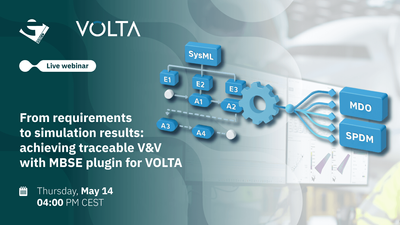
From requirements to simulation results: achieving traceable V&V with MBSE plugin for VOLTA
Watch the recording of ESTECO webinar and learn how to link SysML parametric models with physics-based simulation models for requirement verification by analysis. Watch the recording of ESTECO webinar with Marco Turchetto, VOLTA Product Manager, and Gabriele Degrassi, Senior Solutions Engineer, Professional Services.
Our speakers explain how the MBSE plugin for VOLTA digital engineering platform enables traceable verification and validation (V&V) within existing toolchains: from requirements to simulation results.
During this 30-minute session, you'll learn how to automate synchronization between Cameo Systems Modeler and simulation workflows while maintaining model versioning and traceability of SysML and simulation models.
eBook
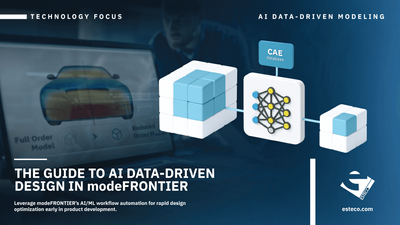
The guide to AI data-driven design in modeFRONTIER
Leverage modeFRONTIER’s AI/ML workflow automation
for rapid design optimization early in product development. In this eBook we explore how modeFRONTIER, the process automation and design optimization software from ESTECO, empowers you to become an AI/simulation hybrid professional.
This new generation of engineers combines physics-based simulations with AI-driven, data-centric modeling to significantly reduce computational costs, accelerate development cycles, and enhance product performance in a fraction of the time.
Download the eBook to gain an in-depth understanding of how to integrate AI and machine learning capabilities into modeFRONTIER. Learn how to build computationally efficient surrogate models that accelerate design space exploration while making it more sustainable and scalable.
Webinar
Developing and deploying reduced order models
Watch and learn how to combine physics and AI for faster, smarter simulation workflows. In this exclusive roundtable, Digital Engineering 24/7 and ESTECO explore how AI-derived reduced order models (ROMs), also known as surrogate models, are transforming engineering workflows.
By leveraging trained models to approximate complex physical behavior, engineers can bypass time-consuming, compute-intensive physics solvers and dramatically accelerate simulation cycles.
In this roundtable, Kenneth Wong and Danilo Di Stefano - modeFRONTIER Product Manager discuss:
how physics-based simulations and ROMs complement and strengthen each other,
why relying on only one approach can limit your results,
what you need to develop and deploy your first ROM successfully.
Watch the discussion and discover how to combine physics and AI for faster, smarter simulation workflows.
Webinar
Accelerate design predictions with modeFRONTIER’s automated AI/ML workflow
Watch and learn how our AI/ML process data approach for engineering design optimization is orchestrated by modeFRONTIER’s workflow. Watch now the webinar Accelerate design predictions with modeFRONTIER’s automated AI/ML workflow with Danilo Di Stefano, modeFRONTIER Product Manager, and Luca Battaglia, Support Engineer, as they illustrate how our AI/ML process data approach for engineering design optimization is orchestrated by modeFRONTIER’s workflow.
Learn how this methodology facilitates the effective handling of both table-like and CAE simulation data enabling the development of computational efficient machine learning (ML) based Response Surface Models (RSM) and Reduced Order Models (ROM) to expedite the exploration of complex design spaces, and make fast design predictions early in the product development process.
Webinar
Democratizing simulation with VOLTA web apps
Watch and learn Runbox - the VOLTA web app which bridges the gap between simulation experts and non-experts. Watch now the webinar with Marco Turchetto, VOLTA Product Manager, Gabriele Degrassi, Senior Application Engineer and Chiara La Guardia, Application Engineer. We demonstrate how to close the gap between simulation experts and non-experts by capturing and automating processes into web apps, enabling seamless execution of design exploration and optimization studies within the VOLTA digital engineering platform.
The complexity of simulation workflows often limits access to a selected group of domain experts. How can we extend the use of simulation workflows and empower a wider audience of engineers to run simulations while maintaining accuracy and consistency? By leveraging VOLTA APIs, method developers can encapsulate CAE expert knowledge into user-friendly, web apps. This allows any engineer to perform design evaluations without expert-level simulation experience.
Webinar
Uniting Simulation and Requirements: Verifying Cameo Requirements using Physics-Based Artifacts in VOLTA
Learn how VOLTA digital engineering platform empowers MBSE programs to evolve from concept to compliance, with repeatable, traceable, and simulation-driven V&V at the core. Watch now the webinar and learn how VOLTA digital engineering platform empowers MBSE programs to evolve from concept to compliance, with repeatable, traceable, and simulation-driven V&V at the core.
AIAA hosted us for a webinar focused on tackling the practical challenges of implementing traceable verification and validation (V&V) in MBSE initiatives, using a structured multidisciplinary design optimization (MDO) approach.
Roel Van De Velde, VP of Aerospace and Defense and Daniel Schmidt, Senior Application Engineer at ESTECO North America, explore how simulations from diverse tools can be referenced in Cameo models using VOLTA, the digital engineering platform for MDO and SPDM.
Discover how VOLTA helps manage simulation data with full traceability, version control, and context, ensuring data-driven decisions are made with confidence.
Webinar
Unlocking design innovation: modeFRONTIER 2025 new features explained
Let's take a deep dive into modeFRONTIER, focusing on its latest innovations for process automation and design optimization. Watch the webinar now and explore the latest innovations in process automation and design optimization with modeFRONTIER.
This session spotlights the modeFRONTIER Planner environment, which empowers you to create, reuse and apply various design space exploration strategies within a single simulation workflow and project file. Discover the newly introduced AI data-driven modeling capabilities, enabling real-time simulation of complex what-if scenarios. The webinar also explores the modeFRONTIER python ecosystem, which offers APIs for creating custom simulation workflows or performing ML-based design exploration or optimization analysis. Additional highlights include improved integration with electronic design automation (EDA) and 3D Modeling software, the introduction of the proprietary MUSA optimization algorithm and the all-new sensitivity analysis tool.