
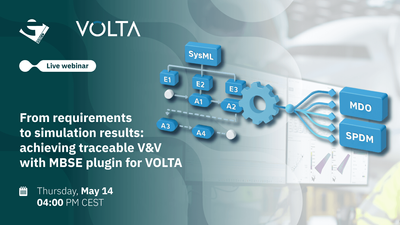
Webinar
From requirements to simulation results: achieving traceable V&V with MBSE plugin for VOLTA
Watch the recording of ESTECO webinar and learn how to link SysML parametric models with physics-based simulation models for requirement verification by analysis.
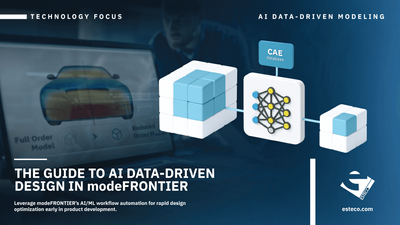
eBook
The guide to AI data-driven design in modeFRONTIER
Leverage modeFRONTIER’s AI/ML workflow automation for rapid design optimization early in product development.
White paper
The digital transformation in energy: integrating requirements, design, and simulation using a digital engineering platform
Discover how digital engineering can help your organization innovate faster, optimize performance, and support the transition toward a more sustainable energy future. Fill the form to download the white paper.
Search results for "modeFRONTIER"
Showing 21 - 30 of 44 results
Success story
Optimizing commercial aircraft designs to use future aviation fuels
Learn how ESTECO modeFRONTIER helped Delft University of Technology to perform multi-objective aircraft design optimization to compare future aviation fuels. Pieter-Jan Proesmans, PhD Candidate in the Flight Performance & Propulsion group at Delft University of Technology, used modeFRONTIER to perform multi-objective aircraft design optimization to compare future aviation fuels. ## Challenge
This research has been undertaken in the framework of the GLOWOPT project sponsored by the EU’s Clean Sky 2 program, and under the supervision of Dr.Ir. Roelof Vos, associate professor at Delft University of Technology. The objective is the development and validation of Climate Functions for Aircraft Design (CFAD) with respect to minimizing global warming and their application to the Multidisciplinary Design Optimization (MDO) of next-generation aircraft for relevant market segments.
To reach this goal, novel fuels, such as liquid hydrogen (LH2) and sustainable aviation fuel (SAF) can provide more sustainable solutions. However, the climate objective conflicts with the typical design objective of minimal operating costs. While these two fuels can offer a significant reduction in climate impact, they are also more expensive and have consequences for the aircraft design (in the case of cryogenic LH2 tanks). ## Solution
The modeFRONTIER Multidisciplinary Design Optimization (MDO) framework was selected to investigate the climate impact reduction and operating costs for hydrogen and SAF fuel in regional, medium-range and long-range aircraft categories. The cost-optimal, kerosene-powered aircraft served as the reference case for all multidisciplinary aircraft design optimizations. The MDO process was set-up in a modeFRONTIER workflow. Its Python interface made it possible to orchestrate in-house tools for aerodynamics, propulsion, mission analysis, mass estimation and climate impact. Next, the optimization strategy was executed.
The pilOPT algorithm evaluated thousands of configurations by changing airframe, turbofan engine and mission design variables to obtain the cost versus climate trade-off for all fuel types in the three aircraft categories. ## Benefits
“The easy-to-use parallel coordinates and scatter matrix charts were very helpful in gaining conceptual insights. One of the key finding was that the SAF-powered aircraft are preferred over the cost-optimal hydrogen aircraft for the regional and medium-range categories. With modeFRONTIER, we could perform the multi-objective optimization and post-processing in a much faster and user-friendly way compared to when we had to rely on programming libraries. In the future, we will investigate how to combine the aircraft optimization with a network allocation routine to update not only aircraft design variables, but also top-level aircraft requirements” said Pieter-Jan Proesmans, PhD Candidate in the Flight Performance & Propulsion group at Delft University of Technology.
Success story
Pipistrel: flying straight from simulation to production
The ESTECO optimization technology as a way to skip any prototype phase for a hybrid-electric aircraft propeller
Pipistrel, an aviation & aerospace company based in Slovenia, relied on ESTECO Technologies to design the propeller for a highly efficient, hybrid-electric aircraft. The work was part of the EU-funded project MAHEPA (Modular Approach to Hybrid Electric Propulsion Architecture), that had the aim of advancing two variants of a low emission, serial hybrid-electric propulsion architecture to TRL (Technology Readiness Level) 6. The modeFRONTIER process automation and optimization software allowed automation in the simulation process and identification of innovative and optimized designs in a limited time. ## Challenge
Engineers at Pipistrel had the challenge to design a propeller, driven by hybrid-electric propulsion system taking into account the different conditions the aircraft meets during the four flight phases: takeoff, climb, cruise and descent. Considering speed, power and thrust requirements changing during the flight, the objective was to maximize takeoff thrust and recuperation power during descent and minimize power during climb and cruise phase. The optimization involved three stages: the preliminary propeller optimization, the airfoil optimization, and the final propeller optimization. ## Solution
For this multi-phase optimization project, Rok Lapuh and David Eržen, aero-dynamics engineers at Pipistrel, used modeFRONTIER coupled with CHARM (Comprehensive Hierarchical Aeromechanics Rotorcraft Model) and XFOIL, an interactive program for the design and analysis of subsonic isolated airfoils. Benefiting from the ESTECO process automation technology, Pipistrel could automate the simulation workflows, simultaneously evaluate thousands of designs and identify innovative optimized results.
This process was conducted in a fully autonomous way leaving Pipistrel’s engineers the task to select the most appropriate design. With the first propeller optimization, Pipistrel optimized the chord and twist distribution to get the maximum thrust and minimum power for a given set of airfoils. The results were then used as requirements for the airfoil optimization. The design team used modeFRONTIER to design the airfoil under specific geometry constraints (thickness, cur- vature or leading-edge radius), while increasing the lift and reducing the drag. They started a Design of Experiments phase and then used the HYBRID genetic algorithm to successfully run the airfoil optimization and get the Pareto front with the optimal designs. At last, they used the optimum airfoil for the final propeller optimization. With the ESTECO optimization algorithms, engineers at Pipistrel could evaluate almost five thousand designs in a limited time and increase the thrust by 30% during takeoff. ## Benefits
Before using modeFRONTIER, Pipistrel went through a manual process to simulate multiple designs and choose the preferred one. With the introduction of ESTECO Technology, Pipistrel engineers not only were able to automate this process, but could evaluate options not considered otherwise. “modeFRONTIER optimization technology gave me the opportunity to think outside of the box - said Rok Lapuh, Aerodynamics Engineer at Pipistrel - We could find a design that is completely different from what we’re used to, but that may work even better”. They also dramatically reduced the go-to-market time as they moved from simulation directly to the production. “We trust the results we get with modeFRONTIER so much that we don’t expect we’ll require a prototype - said David Eržen, Aerodynamics Engineer at Pipistrel - We go straight into production”.
Success story
Optimizing metal 3D printing process at Clemson University
Jingyuan Yan, Ph.D in Department of Mechanical Engineering, used modeFRONTIER to develop his Ph.D research project focused on the design and optimization of the Direct Metal Deposition (DMD) process.
DMD is a 3D printing process for metal, similar to welding, using powders instead of wire. It uses a continuous wave or pulsed laser to induce a melt pool on a substrate, and metallic powders are delivered into the pool via injection nozzles. The process is able to deposit different metal powders onto different locations of the powder substrate in order to manufacture multi-material parts according to user requirements at the microscale level. Despite the benefits of DMD, this process is not widely used in industry: the building powder waste, the need for reduction of energy usage and inaccurate material composition in the fabricated parts are still critical issues. The DMD system provided by Optomec was used to implement the research. During his research on DMD, Jingyuan worked on an injection nozzle designing first of all its geometry to maximize the process efficiency and investigate the relationship between the desired part’s composition and the process parameters. Jingyuan also wanted to improve the DMD process parameters considering their effect on efficiency when manufacturing multi-material parts. “In order to make the best use of powders and to minimize the laser energy consumption, we aimed at optimizing the process parameters. The bi-objective optimization problem was set up in modeFRONTIER workflow using the direct node to MATLAB. Eight design variables related to the process parameters (injection angles, velocities and nozzle diameters for the two materials as well as the laser power and the scanning speed) were set and automatically adjusted with modeFRONTIER to minimize the outputs results: powder waste and energy cost.".
“The multi-objective genetic algorithm (MOGA-II)” continues Jingyuan, “turned out effective in driving the search process and identify the designs which met the constraints on the deposition of multiple materials. As we see in the scattered chart, the feasible designs show a trade-off relationship between the two objective functions. The Pareto front results, marked with green color, enable the users to rapidly select the configuration with lower powder waste.” “The calculation process took about three hours. Using modeFRONTIER, we saved about three days of calculation time compared to the traditional optimization method. In the future, the optimization method can be applied to analyze other combinations of materials used in DMD, with any powder feed rate ratio. The results will be validated with experimental tests and it will be possible to generate a database of optimal process parameters for any given condition to be reused for future DMD projects. In the long run, modeFRONTIER can help tailor the process parameters during the DMD manufacturing of functionally graded parts, in order to get an accurate material composition as desired.”
Success story
Hyperloop Makers UPV, Universitat Politecnica de Valencia. SpaceX Top Design Concept winners
modeFRONTIER helped the team select the optimum design in terms of travel experience, maximizing energy efficiency while accelerating design iterations and development time.
The Hyperloop Makers UPV team from the Universitat Politécnica de Valencia was awarded the Top Design Concept and the Propulsion/Compression Subsystem Technical Excellence Awards at the 2016 SpaceX international challenge. The goal of the competition, launched by SpaceX CEO Elon Musk, is to perfect its revolutionary land transport system, driven by compressed air and able to connect Los Angeles and San Francisco in 30 minutes. Whereas the majority of the competing teams opted for passive magnetic levitation or designing the passenger pod suspended on air bearings, Hyperloop UPV developed a system that enables levitation through the magnetic attraction of the pod to the top of the tube. This rail-free solution saves up to 30% on Hyperloop tube construction costs. ## Challenge
The engineering challenge consisted in providing the base design for a 30-passenger cabin travelling as fast as possible through a vacuumed tube.
Solution
The technological solutions, in terms of comfort for the travelers subject to such high acceleration and cruise speed, were investigated by the team, assisted by advanced multiobjective optimization techniques. The computations related to the acceleration and cruise phase were set up in Excel and integrated into the modeFRONTIER workflow. The design variables mainly related to the compressor and the turbine (pressure ratio and discharge velocity) were automatically adjusted by the software to optimize the output results: acceleration time, specific energy required, pod mass and travel speed. ## Benefits
“The effects of modifying even a single variable were, at best, difficult to explain as the physical models regarding the behavior of the system were highly interconnected and interdependent. With a traditional approach, this fact would have lead to a slow and difficult system optimum. modeFRONTIER on the other hand, enabled the team to obtain a family of optimum solutions for a range of inputs in a mere fraction of the time” said Germán Torres, Technical Director at Hyperloop Makers UPV Team. In terms of specific energy per passenger/km, the results show the pod consumes ten time less energy and travels ten times faster than traditional road transport. “We are developing a small levitation demonstrator for the next phase of the SpaceX International Challenge”, continued Torres, “in fact we plan use modeFRONTIER again to optimize the new Hyperloop design proposal”.
Success story
M-Fly. The University of Michigan Team at SAE Aero Design Competition
Long, freezing winters in Michigan leave the M-Fly team with only a month and a half to design and test their plane for the SAE Competition. Thanks to modeFRONTIER, the team can save precious time and improve their design.
The SAE Aero Design Competition was created to connect engineering students with real-life engineering experiences and prepare them for their professional paths. As of this year, the M-Fly team participates both in the regular and the advanced class of the Competition. The 2016/2017 regular class objective is to maximize the amount of “passengers” on the plane without leaving empty seats - a realistic challenge faced by commercial airliners. The advanced class includes the design of the internal combustion power, static and dynamic payloads that must be dropped on a target during the flight, as well as the use of sensors and other electronic systems. M-Fly has partnered with ESTECO Academy and will benefit from free training and access to modeFRONTIER optimization platform to improve their aircraft design and validate analysis results faster. At M-Fly, our goal is to teach aerospace engineering, specifically aircraft design through competing at the SAE Aero Design competition. We balance winning and teaching, so we try to involve as many interested University of Michigan students in our project, while still designing the best aircraft for the competition. However, our design cycle is brutal as we have two major factors against us: our school year and the weather. If we want to finish the testing phase before we head to competition, we need to get to the final design by Thanksgiving and finish the construction in January: a very tight schedule. In Michigan, from December through March the temperature highs are hovering at freezing temperatures and opportunities for prime weather conditions to flight test are minimal. If we get lucky, we can perform a flight test or two before we head off to competition which is in the much nicer Southern United States (the competition rotates between Florida, Georgia, and Texas). The more time we have with a full aircraft built, the bigger are the chances of us getting more test flights in. That is where modeFRONTIER comes into play - it allows us to explore a much larger design space in significantly less time than we could do by ourselves. Just the Design of Experiments (DOE) runs give us more data that we have ever gotten in our past design cycles in terms of different configurations.
We are currently using modeFRONTIER to do two things: iterate through many different configurations to optimize and do multi-disciplinary analysis since it interfaces so well with other analysis and CAD software we have here at Michigan such as ANSYS, StarCCM+, and SolidWorks. Instead of a standard design, analyze, build, test, go back to first step and repeat - design cycle, we can multiply the iterations for each step: design x 10000 -> analyze x 10000 -> downselect design -> build -> test and repeat the last 3 steps, with the first 3 steps taking only a couple of hours if needed. modeFRONTIER also has a superb post processing capability that allows us to analyze our results in many different ways to make sure we are choosing the right design, as well as provide insights into our design problem.
Success story
HI-SEAS. NASA-funded Mars simulation habitat on Mauna Loa volcano, Hawaii
modeFRONTIER helps the astronaut-like researchers develop system models for sustainable living on Mars, in particular in terms of waste reduction and sustainable lifestyle.
Hawaii Space Exploration Analog and Simulation (HISEAS) is a NASA-funded research project aimed to help determine the individual and team requirements for long term space exploration missions, including travel to Mars. HI-SEAS V is an 8-month Mars analog isolation mission that begun on January 19th, 2017. Two 8-month missions are scheduled starting in January 2017 and 2018. During the HI-SEAS Mission V, six researchers are studying human behavior on Mars by entering in a geodesic dome in the isolated environment of Mauna Loa volcano on the Hawaii Big Island, including 20-minutes delayed communication and partial self-sufficiency. The purpose of Campaign 3 is to directly address the IRP Team Risk: “Risk of Performance Decrements Due to Inadequate Cooperation, Coordination, Communication, and Psychosocial Adaptation within a Team”.
Ansley Barnard is the Engineering Officer for Mission V. She is in charge of monitoring their life support systems and fixing things that break down. “On a space mission, the astronaut crew is very limited on what they can bring with them. Launch mass (fully fueled) is highly valuable, so every item you send on a rocket needs to be weight and size efficient, including food, water, research materials, and personal effects. When you are traveling far away, like a manned mission to Mars, you need more supplies and you have to burn more fuel to get everything there - this makes resource optimization even more challenging”. “Parametric modeling and optimization software tools like modeFRONTIER provide us with faster and more robust ways to optimize. It is possible to find trends that your human eyes might have missed, which can yield better solutions in less time. modeFRONTIER is an easy to learn tool with a lot of built-in capability and modular flexibility. It is possible to tailor the software to specific needs, and the modeFRONTIER support people have always been helpful when I feel stuck”.
Moreover, our resources are limited and we have to use them wisely. If we run out of something before we are resupplied, we have to find a way to make do. Sustainable living is important to me on a personal level and is a big motivator for me to use an optimization approach in my engineering work. While in the habitat, I am hoping to learn more skills about efficient living, like using less water and power by making active choices in how I cook, shower or do laundry. These are real skills I can bring home with me. Just like in space, each of us can balance what we use with what resources are available if we have a curious and observant eye.
Tools like modeFRONTIER can help us model systems, but changes are carried out through our actions. By building parametric models of our life support system, I hope to balance our resource needs and find ways for the crew to have energy and water available for all our research and personal uses. My goal is to make a tangible difference in how my crewmates live day-to-day in our mission and provide future HI-SEAS crews with updated engineering information on the habitat life support systems.
Success story
Optimized Valvetrain System Boosts Two-wheeler Performance at Piaggio
Piaggio & C. s.p.a. uses modeFRONTIER optimization capabilities to improve a 125cc 4-valve engine design
The Piaggio Group is the largest European manufacturer of two-wheel motor vehicles and one of the world leaders in its sector. Headquartered in Italy and with Technology & Innovation centers located in India, China and Vietnam, Piaggio is known for its unique range of two-wheel and light transport powertrain vehicles. The company’s R&D activities focus mainly on reducing the environmental impact of its products and improving vehicle efficiency, performance and passenger safety. For many years now, Innovation & Research engineers have been using modeFRONTIER to achieve these design objectives. ## Challenge
Reducing the environmental impact of two-wheeler engines, in other words, increasing overall engine efficiency, means, amongst other things, opting for engine downspeeding or downsizing strategies, with the need of reducing engine friction; however, in order to maintain or improve vehicle performance, this requires an increase in specific engine power. The use of numerical models and calculation methodologies provide important support in pursuing these goals. In this case, the design of valve lift events and the valve train components are crucial when taking into account multiple engine issues like valve train systems stability, durability, resisting torque and engine breathing. ## Solution
Starting with the baseline valve lift profiles of a 125cc 3-valve engine, engineers at Piaggio set up an automatic workflow within the modeFRONTIER environment that piloted the GT-SUITE calculation in order to evaluate the engine performance and the valve train system behavior in relation to specific valve lift profiles. “With this automated optimization approach we were able to avoid manual, time-consuming tasks involved in modifying the valve lift event in closed loop and to gain control of the entire system behavior”, says Francesco Maiani, Engine Calculation Engineer from Piaggio & C. s.p.a. ## Benefits
“modeFRONTIER allowed us to adopt a modular approach to the problem that led us to the final valve lift event design. This methodology made it possible to define the valve lift event and support the analyst during the design of a cam profile. The optimization process sought to improve the system in terms of kinematic and dynamic characteristics and thermodynamic performance requirements”. This allowed engineers to simultaneously modify both the valve springs setup and the cam profile shapes, conveying the required response for the engine friction reduction. Additionally, the whole timing system benefitted from this procedure, also improving stability and durability.
Success story
Hyundai streamlines Genesis luxury sedan's conceptual design
Learn how ESTECO world-class engineering software helped Hyundai Motor Group R&D optimize the vehicle architecture trade-offs. In the wider context of Hyundai Motor Group R&D efforts aimed at integrating engineering design, Computer Aided Engineering (CAE) and testing for vehicle development, ESTECO world-class engineering support proved itself a trustworthy partner in optimizing the vehicle architecture trade-offs. In particular, ESTECO modeFRONTIER software solution was utilized in the conceptual design phase for the next generation of Genesis luxury sedan. ## Challenge
Hyundai’s architecture-driven structure conveys vehicle concept planning which takes numerous factors into account from the initial stage of development, including vehicle performance, parts sharing, standardization and even up to procurement, production and suppliers. Currently, their research engineers need to find a proven simulation-driven design technology for upcoming Electric Vehicle (EV) architecture development. To test this methodology, they took as baseline a Genesis G80 luxury midsize sedan looking at rapidly investigating and identifying the global optimum design region , focusing on mechanical package, system selection, and attribute modeling. The analysis involved components such as suspensions, fuel economy, battery, and architecture costs.
Solution
By employing modeFRONTIER, they could perform Trade Space Analysis (TSA) in order to identify a set of system parameters, attributes, and characteristics to satisfy the required vehicle performance during the conceptual product development phase. In practice, starting from an automated multidisciplinary modeFRONTIER workflow, they ran 3000 Design of Experiments (DOE) to rapidly evaluate all the possible vehicle configurations. For this purpose it was mandatory to build fast evaluation simulation models such as Matlab (Octave) for suspensions, Excel for batteries, RSM for the performance and so on, to get the results in a few hours. Then, they applied advanced post-processing techniques such as Clustering and Multi-Criteria Decision Making (MCDM) to group similar designs and rank all reasonable alternatives on the basis of given preferences. ## Benefits
“We realized that modeFRONTIER software is the ideal solution for vehicle trade-off-analysis and optimization. After generating 3000 different vehicle configurations, we could cluster and then rank all reasonable design alternatives on the basis of user-defined preferences. This significantly accelerated our internal decision making process among all stakeholders involved in the project. We look forward to applying the same methodology for our next EV architecture development projects by also considering ESTECO VOLTA SPDM platform to foster collaboration across departments” - said James (KR) Yoon - Senior Research Engineer, Virtual MBSE & HPC AI Research, Hyundai Motor Company.
Success story
High-Rise Office Building
achieves zero energy use with
optimization-driven design technology
Evangelia Despoina Giouri, MSc graduated from the Faculty of Architecture and the Built Environment of Delft University of Technology, used modeFRONTIER to assess the energy performance and thermal comfort towards zero energy high-rise buildings. ## Challenge
Currently, 40% of the European Union’s final energy consumption and 36% of greenhouse gas emissions are attributed to buildings. New strategies to design nearly Zero Energy Buildings (nZEBs) are essential to meet climate targets set by the European Energy Performance of Building directive. This research applies process automation and optimization technologies to develop a new integrated simulation methodology to design nZEBs in a Mediterranean climate. This concept has been applied to a high-rise office building featuring photovoltaic panels integrated into the facade walls, located in the hot-dry climate of Athens, Greece. ## Solution
The goal is to define which construction parameters have the highest impact on annual energy demand and thermal comfort in the building. The simulation process was created in modeFRONTIER workflow coupling Rhino/Grasshopper modeling environment and EnergyPlus software to simulate energy consumption and daylight illuminance levels. Two optimization runs have been executed to investigate the influence of building parameters that can have a contradictory impact on cooling, lighting, heating energy loads, and four different facade orientations. ## Benefits
The genetic algorithm NSGA-II allowed performing 1000 evaluations in order to find the trade-off solutions for several design issues affecting energy performance and thermal comfort levels. “We were able to achieve 33% reduction on annual building’s energy consumption (from 109.12 kWh/m2 to 73.13 kWh/m2) compared to standard data provided by the current Greek legislation. Moreover, modeFRONTIER engineering and data intelligence capabilities enable us to visualize optimization trends and perform sensitivity analysis to assess the impact of the various facade parameters on the energy use and adaptive thermal comfort performance of the building” said Evangelia Despoina Giouri, MSc graduated from the Faculty of Architecture and the Built Environment of Delft University of Technology.
Success story
Luna Rossa Prada Pirelli: predict design performance with numerical optimization
Discover how Luna Rossa Prada Pirelli team can predict design performance for sailing yachts thanks to ESTECO modeFRONTIER simulation process automation. Luna Rossa Prada Pirelli is all set to challenge for the Louis Vuitton 37th America’s Cup. Once again on an AC75 foiling monohull and representing the yacht club Circolo della Vela Sicilia for the third time. With the help of ESTECO simulation process automation and design optimization technology, the team has tested solutions and materials for their sailing yachts, built and developed in-house at the Cagliari base on Sardinia’s southern coast, Italy. The AC75 Class has also been chosen to compete in the 37th America’s cup. It’s a high-performance monohull intended to spearhead the development of sailing through innovative technology, ensure the class is relevant to the sport of sailing and provide competitive racing in light and stronger wind conditions. The class rule defines the limits of the design space. Some parts, like the foil arm and foil cant system, are the same for every team. The AC37 Protocol also focuses on cost reduction, including limitations on the number of components:
Teams are only permitted to build one new AC75
Limitations on the quantity of foils and componentry that can be built for the AC75’s
Introduction of the multipurpose One Design AC40 class which teams will be able to partially convert and use for testing, component development and Match Race training
Possibility to use test boat (LEQ12) with max LOA 12m
Furthermore the towing tank or wind tunnel tests are prohibited. As a result, numerical simulation is a crucial and integral part of the design process at the Luna Rossa Prada Pirelli team. They analyze and optimize ideas before even seeing them applied to the yacht. The 38-member unit forms the largest design team and is divided into five units: naval architecture, structural engineering, mechanical engineering, computer engineering, and aero-and hydrodynamic engineering. Among them, there is a group of designers who use modeFRONTIER to improve the design performance of AC75 yacht components:
Matteo Ledri, Head of CFD
Simone Bartesaghi, CFD Specialist
Martin Jacoby, CFD Specialist
Andrea Vergombello, Head of VPP
Andrea Zugna, Performance & Mechatronics
In addition to designing hulls, sails, and custom components, the team analyzes data from simulators and computers connected to the boat during sea training. Through synchronized collaboration with the Sailing team and the Shore team, they work daily on studying and designing solutions to enhance the boat’s performance. Foiling boats can be explained by comparing them to aircraft in case anyone has never seen one. These similarities can be useful to understand why simulation technology used in designing and testing foiling boats can draw upon decades of development in the aerospace industry. If you compare the AC75 boat to a glider, it is possible to identify the fuselage with the hull, the wing with the main wing foil, the winglet with the wing tip, and the rudder with elevator. The main difference in the case of the AC75 is that only one foil maintains the boat out of the water, so the roll balance is achieved by considering the upward force of the foil, the weight of the boat, and the roll component of the force of the sail, which is continuously adjusted to keep the boat upright.
Continuing the fly analogy, regarding controls, the pitch of the boat is controlled by the rake of the rudder blade, which changes the angle of attack of the rudder elevator. Ground clearance is maintained by controlling the flap angle of the foils. The most precious commodity in an America’s Cup campaign is time, despite having a three/four year timeframe to design the yacht. This is why, when it comes to selecting tools for simulation, the design team prefers relying on proven and reliable commercial solutions. modeFRONTIER is one of those. The software offers flexibility, usability and straightforward methods for design exploration and optimization, making it possible to accomplish various automated tasks in a short amount of time. The optimization-driven design process begins with defining an objective function and constraints, followed by parameterizing the design, running an optimization algorithm, and validating the optimized solutions. ### 4.1 Hull shape optimization
For the hull shape, a preliminary investigation related to raw geometric parameters linked to the AC75 rules was done to try to cover the entire design space, even with out of the box shapes generated by using input parameters from a Design of Experiments (DOE) table.
Good candidates coming from a preliminary geometry optimization (rulewise) were tested via CFD hydro simulations and then the obtained data were integrated in modeFRONTIER to properly analyze the trends and compare the different solutions. By using the same approach, combining DOE exploration and direct optimization, the design space was refined in the optimum area extracted from preliminary design loops and updated at every step of the design itself. ### 4.2 Optimization of the foil section
modeFRONTIER has been used extensively to perfect the design of the foil section by setting up a multi-objective optimization with genetic algorithms. The direct optimization allowed us to explore millions of possible shapes and select a family of best candidates to test and deep compare on the virtual AC75 complete model. The main goal was to minimize drag for a given lift with constraints like structural properties (stress and stiffness), cavitation, systems. Also, the process involved a parametrization based on B-Splines curves and parametric models to account for control system volume and some 3D effects. ### 4.3 Design space exploration of the wing
The design space of the wing was explored exhaustively using modeFRONTIER in two main areas: bulb and twist distribution.
This optimization task was very complex due to lots of constraints and objectives to be fulfilled. Regarding the bulb optimization, the requirement of a given volume to carry the required weight, the space to fit the flap system and a shape that has minimum as possible drag in all conditions. These are the constraints and objectives for the bulb optimization. The geometry generation was done with Rhino/Grasshopper and automated in modeFRONTIER to execute a DOE. Then, the geometry was sent to an HPC cluster to run a CFD analysis. In this context, modeFRONTIER enabled our team to efficiently perform this task and reduce the time to produce the optimized geometry. The purpose of Twist optimization was to find the optimum distribution of Angle of Attack of the hydrofoil section along the span of the foil.
This distribution of twist angle impacts several aspects of the foil performance and behavior. You could think about the structural part, where the center of lift spanwise will impact on the stress at the root of the wing, therefore asking for higher modulus which might lead to thicker sections. Seeking performance is the main objective where the aim is to fit the 2D section at a range of AoA where the efficiency is maximized, and from a 3D hydro point of view there is performance loss due to the eddies created by the lift produced. This with an optimal twist distribution can be minimized, always monitoring how the cavitation area gets modified with the twist changes. In that complex scenario modeFRONTIER fitting capabilities enabled us to find a virtual optimum with great confidence. The twist optimization problem had big non-linearities related to the laminar-turbulent transition and with the correct settings we were able to optimize with Response Surface models (RSM) techniques and validate the optimum with excellent results. ### 4.4 RSM modeling for wave model fitting: hydro and aero
Lots of challenges require CFD computations that are very costly in terms of computational power, however with the correct study of the problem, a good fitting of the CFD response can be done and then being used to reduce the need of simulations to be run. The choice of the RSM settings is of major importance, not only should be checked with validation points but also with engineer’s criteria. Later the fitting can be used to “anchor” low fidelity models that can expand the scenarios studied. Anchoring means that the expected difference between the high fidelity and the low fidelity model is studied and fitted and when that is known, it can be used to correct the low fidelity model in other parts of the design space, where a specific high fidelity simulation has not been run. Here the cases of study are the wave-resistance model of the AC75, where the URANS have been conducted at “center” sailing conditions. And, with the creation of an analytical wave model it was possible to expand the results to a very big amount of conditions that a wave scenario can have, think about wave height, wave period, angle, flight height.
modeFRONTIER was used to bring up the quality of the low-fidelity model and enable us to study a broader space. modeFRONTIER has become an indispensable tool in developing the new AC75 class boat, providing the design team with the necessary optimization techniques to excel in various fields such as hull and foil design. Simone Bartesaghi, CFD Specialist, Luna Rossa Prada Pirelli says, “modeFRONTIER has helped us to improve and speed up our design process, allowing us to explore all the design space and finding unusual, out of the box shapes that we may not have considered otherwise. Based on our results from modeFRONTIER, we could quickly and effectively obtain 2D section design and optimization for foils and rudders, and even adapt them for different zones along the span of a foil or rudder. Finally, the software enabled us to create models for complex scenarios like waves interaction and aerodynamics forces for direct optimization".