
Webinar
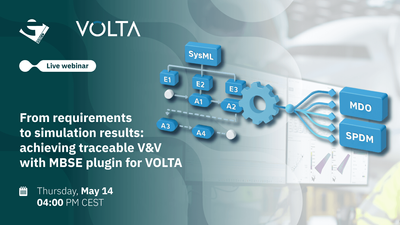
From requirements to simulation results: achieving traceable V&V with MBSE plugin for VOLTA
Watch the recording of ESTECO webinar and learn how to link SysML parametric models with physics-based simulation models for requirement verification by analysis.
eBook
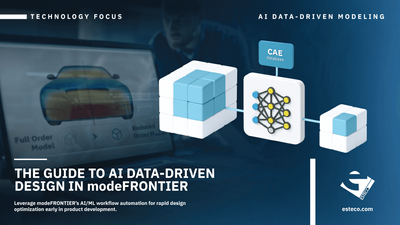
The guide to AI data-driven design in modeFRONTIER
Leverage modeFRONTIER’s AI/ML workflow automation for rapid design optimization early in product development.
White paper
The digital transformation in energy: integrating requirements, design, and simulation using a digital engineering platform
Discover how digital engineering can help your organization innovate faster, optimize performance, and support the transition toward a more sustainable energy future. Fill the form to download the white paper.
Search results
Showing 31 - 40 of 54 results
Webinar
Integrating GT-Suite, ANSA, TaiTherm and modeFRONTIER to optimize a muffler heat shield
This webinar hosted by ESTECO, Gamma Technologies, BETA CAE Systems and ThermoAnalytics, presents the successful integration of their technologies in the modeFRONTIER workflow to reduce bumper temperature through coupled simulations for a compact car.
Expert engineers from GT-Suite, BETA CAE Systems, ThermoAnalytics and ESTECO will demonstrate the advantages of the integration of their software to reduce bumper temperature in order to prevent car paint peeling.
Watch it to find out more about an integrated approach to modify the muffler heat shield properties to reduce bumper temperature by implementing various solvers.
Webinar
Exploiting Design of Experiments (DOE) techniques for multibody and structural vehicle analysis with modeFRONTIER, Adams and MSC Nastran
In this webinar ESTECO and MSC Software present the successful integration of their technologies to explore and improve design solutions for multibody and structural vehicle analysis.
Dynamic behavior of a car in terms of handling, steering and ride is influenced by many vehicle body parameters, which also affects the structural behavior of the system.
ADAMS and MSC NASTRAN software can be coupled together with modeFRONTIER multi-disciplinary optimization environment in order to efficiently explore the combination of the design parameters and improve the system design.
Webinar
Reliability based robust design optimization of a free-fall-life-boat
This webinar, hosted by ESTECO and BETA CAE Systems, focuses on a reliability-based optimization method that statistically increases the safety of free fall lifeboats, which are typically used to evacuate passengers in oil platforms and large transport vessels.
Dimitris Drougkas from BETA CAE Systems and Alberto Clarich from ESTECO demonstrate the advantages of the integration of their software in the modeFRONTIER multi-objective design environment for a reliability based optimization of a free fall lifeboat.
ANSA software is used to morph the free fall lifeboats mesh by editing its shape and its initial position, and modeFRONTIER is used to automate the simulations performing an optimization under the uncertainties of the operational parameters.
Webinar
A CAD-Mesh mixed approach to enhance shape optimization capabilities
In this joint webinar, ESTECO and RBF Morph present an innovative CAD-Mesh mixed approach to enhance shape optimization capabilities.
Riccardo Cenni from SACMI describes how engineers at SACMI Ceramic Engineering Department leveraged modeFRONTIER, RBF Morph and ANSYS Workbench to develop an hybrid methodology combining CAD and mesh based approach overtaking the limits of the shape optimization based on the single disciplines. The approach helped find better solutions for the SACMI industrial component analyzed and turns out to be promising for future optimization projects.
Agenda:
Overview on ESTECO and its technology
Overview on RBF Morph and its technology
Introduction to SACMI and the engineering challenge
Shape optimization: the CAD-based, the Mesh-based and the mixed approach
Optimization results and takeaways
Webinar
Introducing VOLTA part 2 | Democratization
This webinar introduces you to key concepts and provides an overview of VOLTA - the ESTECO platform for SPDM and design optimization - and insights on exploiting enterprise engineering data and managing the entire simulation process.
VOLTA acts as the engineering hub, where teams benefit from customizable data structures and fine-grained permissions to ensure efficiency for each role involved. Simulation experts can avoid the burden of managing “work in progress” data with the advanced version control system that traces, organizes and makes all kinds of simulation-related data accessible: from models to library files, methodologies, key results and reports.
Watch the video and learn more about the VOLTA concepts: Project, Model, Plan, Evaluator and Session, Folder Based Structure, Dataset and Executed Sessions, Tags, Sharing and Notification System.
Click here for the webinar Part 1
Webinar
Optimizing the automotive manufacturing system design with modeFRONTIER
In this joint webinar, ESTECO and COMAU present the new outcome of the ProRegio project\*: a new approach for a System Design Platform able to respond to regional requirements while dramatically reducing manufacturing systems design cycle and quoting time.
Andrea Ascheri from COMAU Spa presents the case study based on a Car Engine Assembly Production Line, where modeFRONTIER helped optimize the costs and layout responding to the different regional requirements.
The webinar focuses on a novel approach to the preliminary design of complex production systems, capable of:
Capture, store and re-use the existing technical knowledge
Reduce the design time under region and customer dependent conditions with first-time-right design
Integrate the design with visualization and analytics tools
Improved design quality – evaluation of more design alternatives
\*The presented results were conducted within the project “ProRegio” entitled “customer-driven design of product-services and production networks to adapt to regional market requirements”. This project has received funding from the European Union’s Horizon 2020 research and innovation program under grant agreement n° 636966.
Webinar
Introducing the VOLTA SPDM platform part 1 | Collaboration
This 2017 webinar introduces you to key concepts and provides an overview of VOLTA - the ESTECO platform for Simulation Process and Data Management and Design Optimization - with insights on exploiting enterprise engineering data and managing the entire simulation process.
VOLTA acts as the engineering hub, where teams benefit from customizable data structures and fine-grained permissions to ensure efficiency for each role involved. Simulation experts can avoid the burden of managing “work in progress” data with the advanced version control system that traces, organizes and makes all kinds of simulation-related data accessible: from models to library files, methodologies, key results and reports.
Watch the video and learn more about the VOLTA concepts: Project, Model, Plan, Evaluator and Session, Folder Based Structure, Dataset and Executed Sessions, Tags, Sharing and Notification System.
Click here for the webinar Part 2
Webinar
Integrating XFlow, WB-Sails and modeFRONTIER for olympic sail optimization
In this joint webinar, expert engineers from WB-Sails, Next Limit Dynamics and ESTECO demonstrate the advantages of the integration of their software, illustrating the details of the models, and presenting the results of the optimization.
The focus of the webinar is to illustrate the optimization process used to enhance the shape of the sails used for Olympic disciplines and produced by the Finnish WB-Sails.
The “flying shape” of the sail is modeled by a parametric CAD (Catia v5), and a non-stationary simulation is performed using XFlow, the CFD software by Next Limit Dynamics, recently acquired by Dassault Systèmes. The automatic simulation process was set up in modeFRONTIER. With only few simulation the optimization algorithm was able to identify the optimal shape, while minimizing resistance and heeling moment on the boat.
Agenda:
Olympic Sail Parametrization (Catia v5)
modeFRONTIER integration with XFlow CFD software
Optimization results and post-processing analysis
Webinar
Integrating modeFRONTIER with Enventive and ANSYS Workbench
ESTECO and Enventive Engineering Inc. present the integration of modeFRONTIER, Enventive®, and Ansys Workbench to optimize the shape of an electrical connector.
In this webinar Alexander Duggan ( Senior Application Engineer, ESTECO) and Kristin Dawson (Product Manager, Enventive Engineering, Inc.) demonstrate using Enventive® to analyze variation of the forces and friction between a pin and connector, coupled with using Ansys Workbench to determine the stress in the connector as it is deflected by the pin. By integrating Enventive® and Ansys Workbench, modeFRONTIER can optimize design parameters to ensure that the pin insertion force and contact reaction force fulfill design requirements while ensuring that the stress in the connector component does not exceed the yield strength of the material.
Agenda:
ANSYS Workbench for finite element analysis (FEA)
Enventive's force and dimentional variation analysis
modeFRONTIER integration with Enventive and ANSYS Workbench
Webinar
Robust Design Optimization with modeFRONTIER 2016
In this webinar Alberto Clarich (Technical Manager, ESTECO) presents the modeFRONTIER 2016 approach of dealing with uncertainties is based on Multi-Objective Robust Design Optimization (MORDO). This consists of investigating the noise factors in the neighborhood of a sample design with a given probability distribution.
While tackling optimization within manufacturing process, engineers face uncertainty with regards to design variables and problem parameters from various sources. These uncertainties impact the optimization process both in terms of reliability and in terms of robustness. Using modeFRONTIER, this case applied a multi-objective optimization algorithm to optimize mean values while minimizing their variations.
Highlights:
Theory and real world applications about Robust Design and Polynomial Chaos
Efficient methodologies for large number of uncertainties
Robust Design Optimization and Reliability-based Optimization